


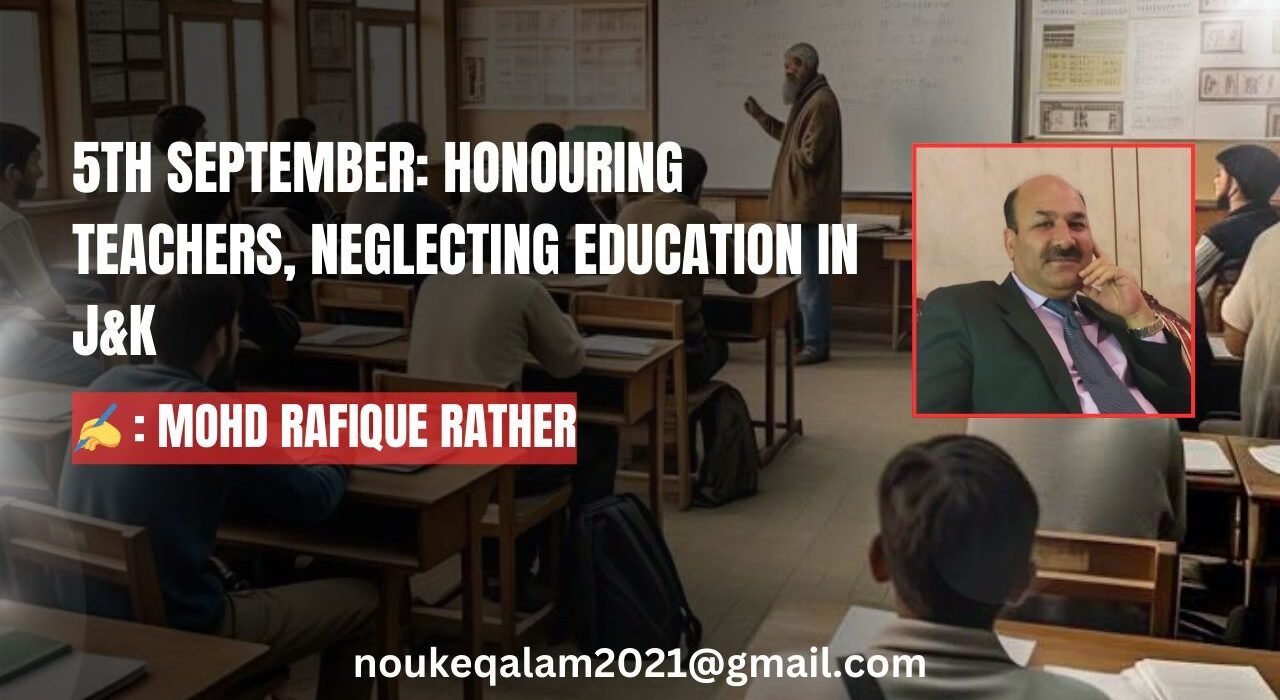
✒️:. Mohd Rafique Rather
Every year, on 5th September, India commemorates Teachers’ Day to honor the invaluable role of educators in shaping the destiny of nations. This occasion should ideally be one of pride and celebration, yet in the context of Jammu and Kashmir, it becomes a day of painful introspection. The region’s education system, despite substantial investments and lofty promises, has sunk into alarming decline. Education, regrettably, has never been elevated as the foundational pillar of progress; instead, it has been treated with bureaucratic apathy and political indifference.
On this day, teachers across India are conferred with national and state awards for exemplary service. In J&K, however, the credibility of these recognitions has often been clouded by allegations of favoritism and nepotism. As a result, even those who genuinely deserve acknowledgment are pushed into a doubtful category, diminishing the spirit of these honors. The irony is profound: while questionable awards are distributed, teachers in the Valley have toiled in extraordinarily adverse conditions, especially through three decades marked by insurgency, bandhs, and prolonged shutdowns. Their courage in keeping classrooms alive amidst turmoil is a saga of resilience that deserves unblemished recognition, not perfunctory gestures.
The profession also suffers from systemic stagnation. A teacher in J&K must often wait at least fifteen years to ascend to the master grade, with little scope for further advancement. The persistence of the in-charge system of officers—where individuals are placed in higher positions without regularization—has created administrative paralysis. Moreover, the culture of promotions based strictly on seniority, rather than academic merit or performance, has institutionalized mediocrity. These practices erode motivation, suppress excellence, and corrode the very dignity of teaching.
Teacher education itself has remained woefully neglected. Training sessions are perfunctory rituals rather than serious exercises in modern pedagogy, creativity, or innovation. This results in a cycle of mediocrity, where uninspired teachers fail to ignite curiosity in their students, perpetuating underachievement. The irrational deployment of staff compounds the crisis: while urban schools are congested with surplus teachers, rural and remote institutions struggle with skeletal staff. Often, a single teacher is compelled to shoulder multiple subjects, sometimes beyond their expertise. This imbalance, dictated more by political favoritism than academic logic, has crippled equity in educational delivery.
Equally damaging has been whimsical and unscientific planning. Schools have mushroomed on the basis of political patronage rather than demographic necessity, leading to a bizarre scenario of schools without buildings, buildings without teachers, and teachers without students. This reckless expansion has hollowed the system, producing institutions in name but not in substance. The absence of specialized teachers in mathematics, science, and languages further deepens the crisis. Students aspiring for higher learning or competitive examinations remain handicapped, while private institutions exploit the vacuum—at exorbitant costs—thus entrenching educational inequality.
The physical infrastructure of government schools reflects chronic neglect. Dilapidated buildings, overcrowded classrooms, dysfunctional laboratories, and the absence of libraries and digital facilities have created an environment unworthy of serious learning. While private schools are rapidly modernizing with smart classrooms and digital ecosystems, government institutions remain trapped in archaic conditions. This duality perpetuates a pernicious divide, where only the affluent access quality education, thereby widening socio-economic inequities.
Perhaps the gravest malaise is the collapse of accountability. Educational administrators and teachers alike often escape scrutiny for inefficiency or non-performance. Inspections have become token exercises, more symbolic than substantive. This erosion of oversight has allowed mediocrity to flourish unchecked. The diversion of teachers to non-teaching assignments aggravates the situation further. Instead of shaping young minds, they are routinely deputed to clerical work, surveys, BLO duties, and election assignments—thereby stripping classrooms of vital teaching hours and corroding the sanctity of education.
The abrupt imposition of the National Education Policy (NEP) 2020 has added another layer of confusion. While the policy envisions transformation, its hurried implementation in J&K without adequate groundwork—teacher orientation, curriculum adaptation, or infrastructural readiness—has overwhelmed both students and educators. What should have been a carefully phased reform has instead become a premature experiment, risking further disarray in an already fragile system.
If education is to reclaim its rightful stature in J&K, sweeping reforms are non-negotiable. Teacher education must be revitalized with rigorous training, exposure to global pedagogies, and merit-based growth. Rationalisation of staff should be undertaken on scientific principles to ensure fairness between rural and urban areas. Planning must be evidence-based and insulated from political interference, while infrastructure must be modernized with a strong focus on digital literacy and specialized teaching. Accountability must be restored through credible evaluations, and teachers must be freed from clerical encumbrances to devote themselves exclusively to academics. Above all, NEP 2020 should be introduced gradually, contextualized to local realities, and supported by robust institutional preparation.
On this Teachers’ Day, as the nation pays glowing tributes to educators, Jammu and Kashmir must confront the uncomfortable truth of why its education system has been allowed to slide into disrepair. The tragedy is not merely of dysfunctional institutions, but of generations betrayed—young minds whose potential has been throttled by systemic neglect. Education must no longer remain a rhetorical flourish; it must be reclaimed as a sacred investment in the collective future. The destiny of Jammu and Kashmir hinges not on ceremonial awards or lofty speeches, but on whether education is finally treated as the lifeblood of progress or continues to languish under bureaucratic indifference and political expediency.
The author is a former trade union leader, educationist, writer, and TV debater. He can be reached at: mrafiqr65@gmail.com
Support Independent and Impartial Journalism
Nouk-e-Qalam News is a free and independent journalistic platform. To maintain our ethical standards and avoid obscene advertisements, we have disabled Google Ads. We now rely on your generous financial support to continue our unbiased reporting. Our Writers and readers are kindly urged to contribute—daily, weekly, or monthly. Thank you for standing with truth.



Binance账户创建
September 5, 2025I don’t think the title of your article matches the content lol. Just kidding, mainly because I had some doubts after reading the article.