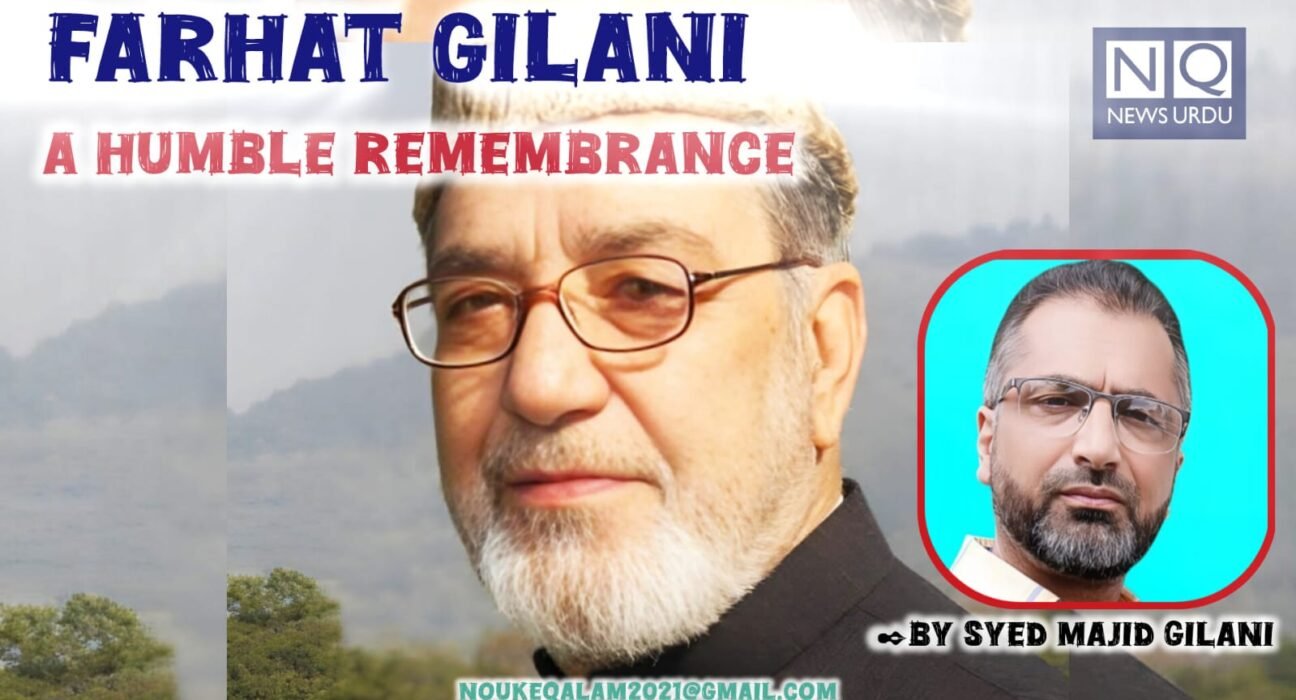
✒️:. Syed Majid Gilani
During a recent visit to the revered shrine of Hazrat Syed Mirakh Shah Kashani (RA) at Shalimar, my eyes rested on a Persian poem inscribed on one of the walls. Composed by Farhat Gilani in memory of one of Mirakh Sahib’s Khalifas, the verses carried a gentle gravity.
Standing there, reading those lines, I felt an unexpected stirring within—an intimate connection with our shared spiritual, literary, and cultural inheritance. The poem did not merely commemorate a saintly figure; it echoed the soul of its poet.
I did not know Farhat Gilani very closely in the conventional sense. Our interactions were few, measured, and dignified. Yet whatever little I knew of him—through brief meetings, conversations, and the words spoken about him—revealed a personality shaped by grace, learning, and quiet refinement.
He never sought attention, yet possessed a natural charisma that left a lasting impression on all who encountered him.
Popularly known as Farhat Gilani, he was born Syed Mohammad Aslam Gilani, the son of the eminent Persian poet and scholar Maulana Syed Mubarak Shah Gilani, celebrated by his takhallus, Fitrat Kashmiri.
Born at Khanqahi Moulla, Farhat Gilani grew up in an atmosphere steeped in scholarship, poetry, and spiritual discipline. From his father, he inherited not only literary brilliance but also a deep love for Persian and Urdu—languages that, through his writing, expressed beauty, devotion, and moral thought.
True to the meaning of his name—Farhat, signifying freshness and solace—he emerged as a versatile and dignified voice of his time. A poet, playwright, translator, broadcaster, news anchor, and television personality, Farhat Gilani wore many roles with grace.
Through his writings and translations, he made meaningful contributions to Kashmir’s literary and spiritual landscape, always guided by clarity of thought and cultural sensitivity.
His writings bore the unmistakable stamp of purity and tenderness. Particularly noteworthy was his Naatiya Kalam, frequently aired on radio and television, which found a special place in the hearts of listeners.
These verses were not mere recitations; they were sincere expressions of reverence, humility, and spiritual longing—soothing in tone, honest in intent, and deeply rooted in faith.
Beyond his literary stature, Farhat Gilani was a man of warmth, humility, and composure. He treated people with equal affection, irrespective of age or status.
He valued relationships deeply and often reminded younger generations of the importance of respecting elders, honouring family ties, and upholding moral values. To him, relationships were sacred bonds—threads that anchored individuals to their ethical and spiritual roots.
One memory remains particularly vivid. On a quiet winter morning in 2018, he invited me to his home at Fitrat Abad, Sheikhpora. During that visit, he gifted me something deeply personal and precious—a handwritten biography of Maulana Syed Mohammad Yasin Shah Gilani, his uncle and my great-grandfather, penned by his own father, Fitrat Kashmiri.
That thoughtful gesture spoke volumes. It reflected his reverence for ancestry, his commitment to preserving heritage, and his quiet generosity of spirit.
For Farhat Gilani, poetry was never merely an artistic pursuit; it was an expression of truth, devotion, and inner discipline.
More than a poet or an author, he was a man of relationships, refinement, and respect. His life represented a graceful harmony between intellect, humility, and tradition.
Men like Farhat Gilani do not truly depart. They continue to live—softly yet enduringly—through their words, their values, and the memories they leave behind in the hearts of those who pause, reflect, and remember.
Syed Majid Gilani is a government officer by profession and a reflective storyteller by passion. He writes on family values, moral wisdom, and real-life emotions.
Support Independent and Impartial Journalism
Nouk-e-Qalam News is a free and independent journalistic platform. To maintain our ethical standards and avoid obscene advertisements, we have disabled Google Ads. We now rely on your generous financial support to continue our unbiased reporting. Our Writers and readers are kindly urged to contribute—daily, weekly, or monthly. Thank you for standing with truth.