✒️: Mohd Ishaq Shah
This article examines recent shifts in global geopolitics and the growing uncertainty in world affairs. It reflects on U.S. strategic decisions, the risk of large scale conflict, and the weakening role of international institutions. The focus remains on future consequences for humanity, ecology, and the global economy.
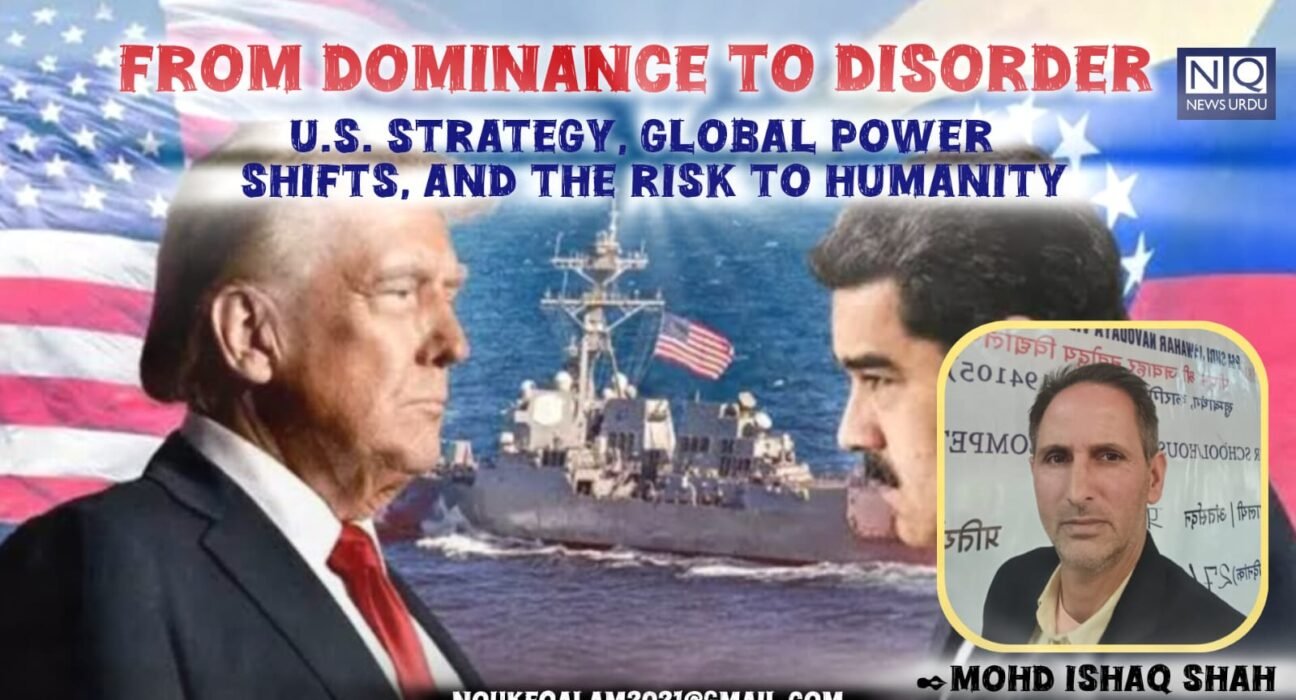
Recent actions by the United States highlight serious strategic failures. The decision attributed to former President Donald Trump to target Venezuela and seek the arrest of its president on allegations of drug trafficking lacked credibility under international law. No state has the legal right to attack another without clear evidence of armed aggression. Such actions violate established norms of sovereignty and peace.
Similar patterns appeared in earlier conflicts. The invasion of Iraq followed claims of weapons of mass destruction that later proved false. The war dismantled state institutions, caused mass civilian suffering, and destabilized the region. Strategic goals failed. Control over resources became the dominant outcome.
Afghanistan presents another example. After the attacks of 11 September 2001, the United States launched a prolonged war to dismantle terrorism and reshape governance. After twenty years of military engagement, the U.S. withdrew in 2021. The Taliban returned to power. Large quantities of weapons remained behind. The effort ended without achieving its stated objectives.
These failures have accelerated global realignment. Power blocs are forming again. One group aligns with the United States, supported by Israel, the United Kingdom, France, Italy, and South Korea. Another cluster gravitates toward China, supported by Russia, Iran, and several regional powers. Tensions between these blocs increase the risk of direct confrontation.
Statements from global leaders intensify these fears. Warnings of retaliation, references to first strike doctrines, and mentions of advanced nuclear weapons signal dangerous escalation. Any future global war would surpass the devastation of earlier world wars. Civilian casualties would rise sharply. Environmental damage would be irreversible. Economic systems would collapse.
The United Nations holds a central mandate to prevent such outcomes. Article 2(4) of the UN Charter prohibits the use of force against the territorial integrity or political independence of any state. Article 51 allows self defense only in response to an armed attack and requires immediate reporting to the Security Council. Enforcement mechanisms exist under Chapter VII, including sanctions, diplomatic isolation, and collective military action.
In practice, these mechanisms depend on the political will of the Security Council. Veto power often blocks accountability. Powerful states avoid consequences. Conflicts persist. International law loses credibility.
The question facing humanity is urgent. How can such a catastrophe be prevented. Are global institutions fulfilling their purpose. Power politics dominate decision making. Smaller nations lack equal protection.
The solution demands restraint, mutual respect, and adherence to international law. The principle of live and let live must guide global conduct. The United Nations must act impartially and decisively. If reform fails, the world risks institutional paralysis at a time of greatest need.
Without corrective action, future conflict may leave no winners. Only destruction. As history and literature warn, a victory without survivors serves no one.
Support Independent and Impartial Journalism
Nouk-e-Qalam News is a free and independent journalistic platform. To maintain our ethical standards and avoid obscene advertisements, we have disabled Google Ads. We now rely on your generous financial support to continue our unbiased reporting. Our Writers and readers are kindly urged to contribute—daily, weekly, or monthly. Thank you for standing with truth.