


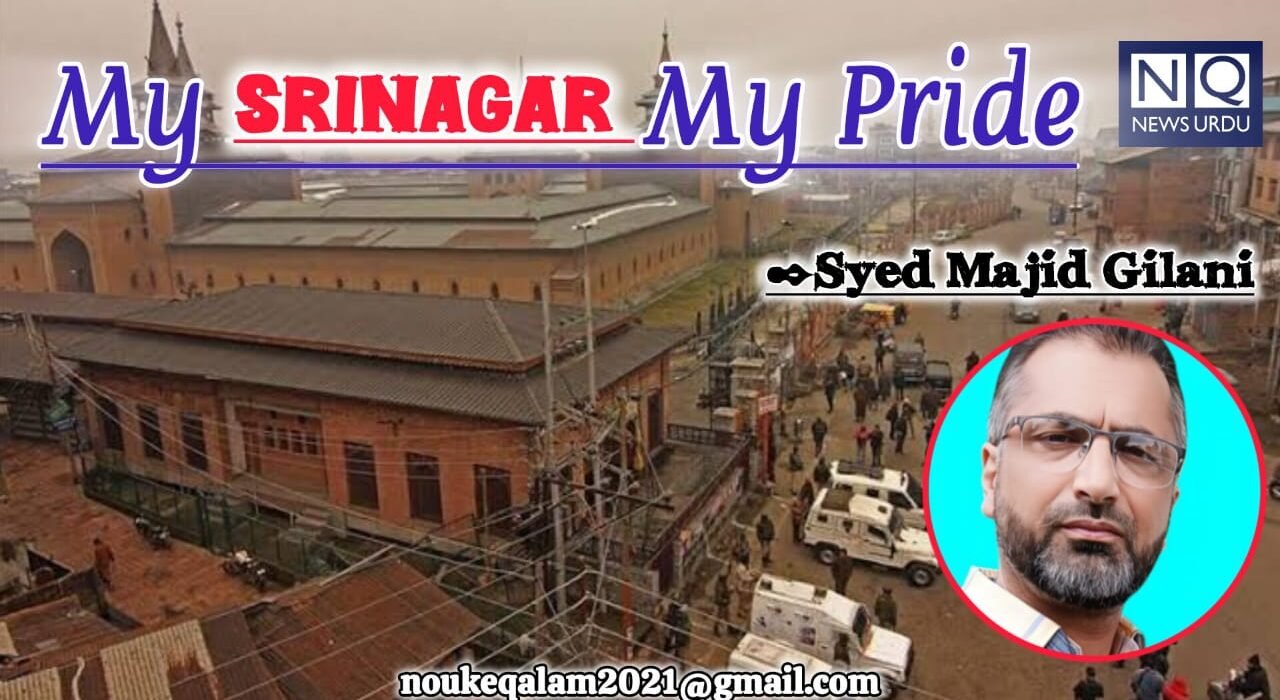
✒️:. Syed Majid Gilani
This is my heartfelt memoir of the Srinagar I was born into and the Srinagar I carry within me.
Yesterday, as the results of the 10th and 12th grade examinations were declared, social media was instantly flooded with news of success. Every platform echoed with happiness, joy, and excitement as students and parents celebrated together. Today, a large number of students pass these examinations with remarkably high scores.
Many secure more than 90 percent marks, and quite a good number even achieve a perfect 100 percent, resulting in multiple students sharing the first, second, and third positions.
Watching all this, my mind drifted back to my own past.
I was reminded of the year 1992, when I passed my 10th-grade examination—then known as the matric examination. In those days, there was no social media, no television tickers, and no instant updates. Results were declared through a printed gazette.
Sometimes, even before the gazette arrived, the results were announced over radio sets and transistors, eagerly listened to by families and neighbours alike.
I still remember the anxious night before the result. Sleep refused to come as I lay in bed, counting the wooden planks on the ceiling of my room. Early the next morning, I rose and, by around 10 a.m., accompanied my father in search of the result gazette. It was commonly available in almost every locality. In a nearby mohalla, I saw a man holding the gazette, surrounded by students and parents, all patiently waiting for their turn.
Those who passed would willingly give him twenty or thirty rupees, while those who secured a distinction or first division happily gave more.
The moment a student was declared successful, neighbours, relatives, and friends would arrive instantly at the student’s home to congratulate the family. There were no formal invitations or planned gatherings. One ritual, however, was essential—the burning of isband and the showering of almonds and candies on the successful student and family members.
The focus was always on joy—pure, collective joy. Laughter filled the air, hearts remained open, and there was no place for material display. Serving kehwa with sheermal was a graceful and cherished tradition.
Celebrations often continued not just for a day but for an entire week, like a small festival. Whether a student passed in first division or third division hardly mattered. Passing itself was celebrated, and effort was respected as much as achievement.
Today, much of that has changed—along with many other beautiful elements of Srinagar’s rich cultural heritage. The declaration of results, passing examinations, and even achieving distinctions are now often celebrated behind closed doors, confined within four walls. At best, a small and selected circle of relatives or neighbours may be present, but the warmth of collective celebration has faded.
The simplicity of kehwa and sheermal has given way to pomp, extravagance, and unnecessary show. Snacks, tea, and even kanti kebab may still be served, yet hearts often remain closed. The genuine warmth, openness, and excitement that once defined such occasions—when guests were welcomed with sincerity rather than formality—seem increasingly absent.
Like many other aspects of life in my Srinagar, which once felt like a shared home, relationships too have changed. In those days, people truly belonged to one another. Festivals and celebrations were never personal affairs; they belonged to the entire neighbourhood.
Joy and sorrow, happiness and grief, were shared collectively and never owned by one family alone. Visiting neighbours and relatives was not a duty—it was simply a way of life.
Srinagar, especially the old city, lived and breathed around its wooden bridges—Zero Bridge, Budshah Kadal, Amira Kadal, Habba Kadal, Fateh Kadal, Zaina Kadal, Nawa Kadal, Aali Kadal, and Safa Kadal. Life moved slowly and gently, with simplicity, dignity, and very little pretence. If there was happiness, everyone joined in. If there was sorrow, everyone stood together.
This is the Srinagar I was born into. This is the Srinagar I remember—a city where distances were measured in footsteps, not vehicles; where bridges connected hearts, not just localities; where culture was not performed but lived sincerely, with dignity and togetherness.
My Srinagar, my pride.
Syed Majid Gilani is a government officer by profession and a reflective storyteller by passion. He writes on family values, moral wisdom, and real-life emotions.
Support Independent and Impartial Journalism
Nouk-e-Qalam News is a free and independent journalistic platform. To maintain our ethical standards and avoid obscene advertisements, we have disabled Google Ads. We now rely on your generous financial support to continue our unbiased reporting. Our Writers and readers are kindly urged to contribute—daily, weekly, or monthly. Thank you for standing with truth.


