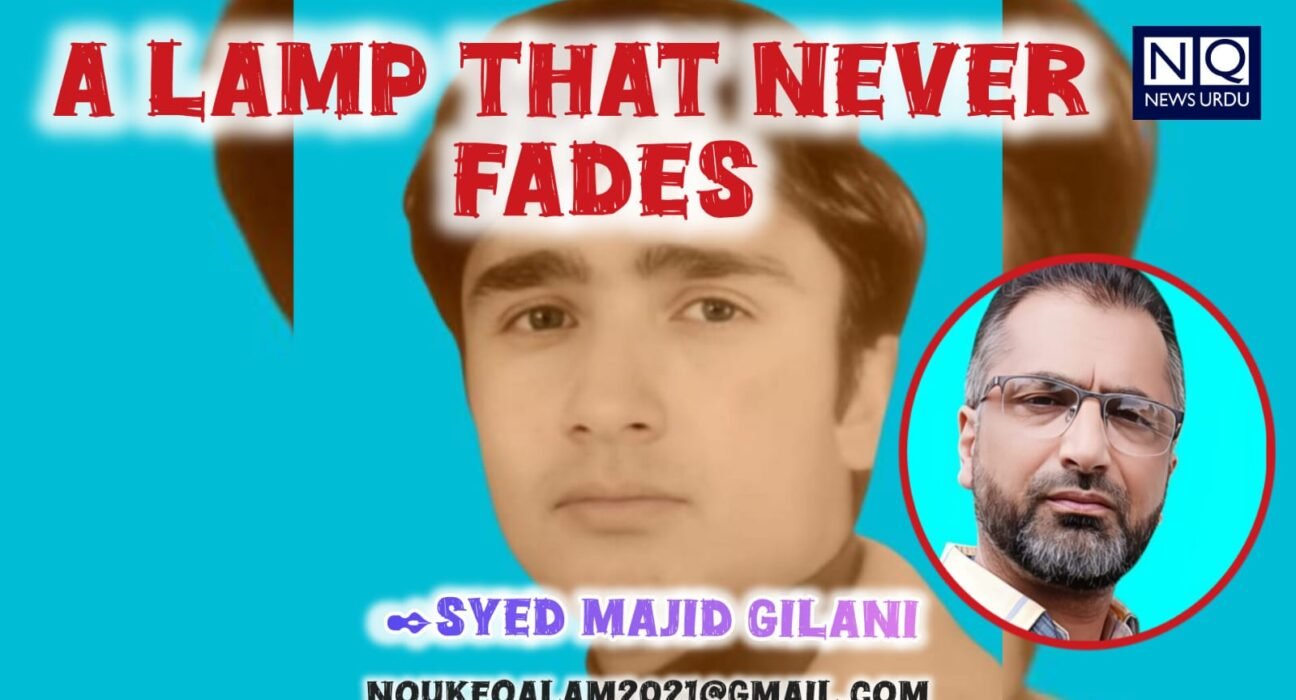
✒️:. Syed Majid Gilani
The memory of my late father, Syed Iftikhar Gilani (1950–2001), still lives in my heart like a lamp that never grows dim. With time, instead of fading, its light only grows brighter and warmer. He was not only my father; he was my closest friend—quiet yet wise, gentle yet strong, a protective presence who stood beside me at every turn of life. His presence carried a natural sense of safety, and even his silence felt full of guidance.
This is the story of a man whose memory has never faded from my heart—my beloved father. Born in 1950 at Khanqah-e-Mualla, Srinagar, he grew up in an environment shaped by faith, discipline, and simplicity. Our family history is deeply rooted in the old city of Srinagar—a place moulded by centuries of learning, devotion, and quiet service.
In 1872 A.D., Hazrat Syed Ghulam-ud-Din Gilani ( RA), the father of Maulana Syed Muhammad Yaseen Shah Gilani (RA), migrated from our ancestral home in Khanyar to Khanqah-e-Mualla. That movement was not merely geographical; it symbolised continuity—of values, worship, humility, and moral discipline. The lives of our elders were simple yet deeply meaningful.
Their strength lay not in claims or words, but in character and conduct—an inheritance silently passed from one generation to the next.
My father carried this inheritance with quiet dignity. He completed his graduation in Electronics from S.P. College, Srinagar, in 1972, and later joined the Sales Tax Department through the Services Selection Board. As a government servant, he remained simple yet firm—no display, no complaints, only honest work, self-discipline, and an unwavering sense of duty.
In his personal life, he was cheerful, warm-hearted, and deeply respectful. His speech was gentle, his dress always neat, and his manners unassuming. Hospitality flowed naturally from him. He respected elders instinctively and showed genuine affection toward the young. His bond with the Holy Qur’an was intimate and constant; prayer brought him peace, and remembrance shaped his days. His life, from beginning to end, was one of simplicity, wisdom, humility, and silent strength.
Even today, when I look back at my childhood under his care, those memories remain fresh. I consider myself fortunate to have grown up in the warmth of his affection. They bring joy because of the love he gave us, and sorrow because he left too soon—at just fifty years of age. Yet his teachings continue to shape my life and the lives of my siblings.
The night of 11 June 2001 is a line in my life that will never fade.
That day, my father returned from office visibly exhausted and complained of breathlessness. He mentioned that due to excessive sweating, he had drunk seven glasses of water at work. Despite his discomfort, he offered Maghrib prayers and remained engaged in the remembrance and praises of Almighty Allah.
That same day, I too returned home from Banihal, where I had been transferred just two days earlier. I had been unwell there—my heartbeats irregular, appetite gone, nights sleepless. A deep restlessness and homesickness compelled me to return, and I reached home around 8:30 p.m.
As I entered, I saw my father offering prayers. I embraced him tightly, tears filling my eyes.
Just days earlier, he had been healthy and active. That embrace—warm, reassuring, and protective—brought me a comfort I cannot describe.
After Isha prayers, we sat together for dinner. Soon after, his breathlessness worsened. In panic, I called my maternal uncles from the Chishti family. They arrived immediately and rushed him to SKIMS Hospital, Soura. Doctors conducted an ECG, which surprisingly appeared normal. He was given a diazepam injection and discharged, with the assurance that there was nothing serious. None of us could have imagined that these were the final hours of his life.
On the way back home, he spoke normally but kept mentioning difficulty in breathing. At home, he tried to sleep but could not. In a half-sleeping, half-waking state, he began reciting the final Surahs of the Holy Qur’an.
Just before dawn, around 4 a.m., his voice rose clearly as he recited:
“Qul a‘udhu bi Rabbil-Falaq.”
A strange uneasiness filled the room, though we thought it was the effect of the medicine.
He then softly told me,
“Majid, light the candles and call the tailor.”
We did not understand. He continued reciting Kalimaat and said that dawn was near and we should be prepared. Still, the depth of his words escaped us. We gave him some sweet tea, after which he went for a bath. When he returned and changed into fresh clothes, his complexion turned pale and his voice grew faint.
We helped him sit on a mattress in the living room—the very place where he used to offer prayers and recite the Qur’an. Even in those final moments, his lips remained engaged in Zikr.
Holding the hands of his daughters—Yasmeen in his right and Sabiyah in his left—he softly repeated:
“Allah… Allah… Allah…”
We sat around him, silently crying, rubbing his feet, praying for his recovery. Neighbours from the Shah family rushed in, urging us to take him back to the hospital. Yasmeen and I supported him toward the waiting car.
At that moment, something beyond our understanding occurred. His gaze fixed toward the horizon, as if witnessing something unseen. We called his name, tried to wake him—but it was too late.
With trembling hands, I gently closed his eyes.
In the early hours of 12 June 2001, my father left this world while still in service—leaving behind a family shattered, yet forever proud of the life he lived and the love he gave.
Behind his simplicity lay a deep spiritual heritage.
The life of his grandfather, Maulana Syed Muhammad Yaseen Shah Gilani (RA), stands as a shining example of piety, discipline, and service.
The spiritual fragrance of Dastgeer Sahib Aastan and Khanqah-e-Mualla was clearly reflected in my father’s humility, devotion, and moral strength.
He remained connected to that sacred soil throughout his life—and even after death, he rests beside his grandfather at Maqbara-e-Sadāt-e-Gilani, Khanqah-e-Mualla, as if the long journey of lineage, faith, and simplicity found its peaceful completion there.
In the years that followed, it was my mother, Shahida Chishti, who held our broken family together. At just forty-two, she displayed unimaginable strength and courage. She raised us with dignity, discipline, and faith, ensuring we remained rooted in our culture and values.
My paternal grandparents—Syed Abdul Rashid Gilani and Syeda Sakina Gilani—embraced us as their own. Their love, wisdom, and moral guidance became our strength. May Allah grant them the highest place in Jannah for the care they bestowed upon us.
Whenever I visit our ancestral graveyard and stand beside my father’s grave, my heart speaks silently to him—sharing joys, sorrows, and words life left unsaid.
Now, when my sons Arshad and Murshad recite Qur’anic verses at his grave, and when my daughter Sarah recites the Holy Qur’an at home, an indescribable peace settles in my heart.
Though my children never saw their own grandfather, through these recitations and prayers they remain deeply bonded to him.
It feels like a silent promise—that the love of a father and grandfather never fades, never dies. It lives on in blood, in faith, and in the quiet inheritance of values passed from one generation to the next.
I pray to Almighty Allah to grant my father’s soul eternal peace, to bless our ancestors with the highest place in Jannat-ul-Firdous, and to protect my children with health, faith, and righteous deeds. May this chain of love, prayer, and remembrance never break. Ameen.
Syed Majid Gilani is an Indian government officer, storyteller, and opinion writer who writes real-life narratives on family, faith, emotions, and moral reflections. He can be reached at syedmajid6676@gmail.com.
Support Independent and Impartial Journalism
Nouk-e-Qalam News is a free and independent journalistic platform. To maintain our ethical standards and avoid obscene advertisements, we have disabled Google Ads. We now rely on your generous financial support to continue our unbiased reporting. Our Writers and readers are kindly urged to contribute—daily, weekly, or monthly. Thank you for standing with truth.