✒️:. Ehsan Ul Haq Malik
In the shifting political landscape of Jammu and Kashmir, the J&K Justice and Development Front (JKJDF) has frequently found itself in headlines,often amid controversy or deliberate confusion. Yet headlines are fleeting. What endures, and what history ultimately records, are ideology, discipline, and moral clarity. Accusations fade with time,principles do not.
JDF was never conceived as a vehicle for slogans, personalities, or momentary political hype. Its foundation rests on the shoulders of men and women who consistently chose service over comfort, responsibility over reward, and society over self. Many among them dedicated their entire lives to social reform, education, relief work, and the moral nurturing of communities. That legacy-quiet, persistent, and deeply rooted,cannot be erased by political cycles or media narratives.
For decades, across towns and villages, people witnessed schools being built, orphans supported, families assisted in silence, and communities uplifted without cameras or publicity campaigns. This culture of service did not emerge from access to power; it grew from ikhlaaq (moral character), discipline, and sacrifice. It represented a social ethic rather than a political strategy.
It is also important to state plainly that mainstream political engagement is not new to this constituency. When political participation began to take structured form in Jammu and Kashmir, they were already present-at the front line-armed with clarity of purpose and disciplined thinking and then what happened in 1987 every one is well aware of that. The current moment, therefore, is not an abrupt departure, but part of a longer historical continuum.
During a lengthy conversation in May 2025, a widely respected thinker of Banned JEI J&K,often described by peers as an “Aristotle” of political wisdom,offered a candid reflection:
Had internal damage not occurred, Jamaat-e-Islami J&K could well have emerged as the first or second largest political force in the region.
The observation was not an expression of regret, but of unrealized potential.
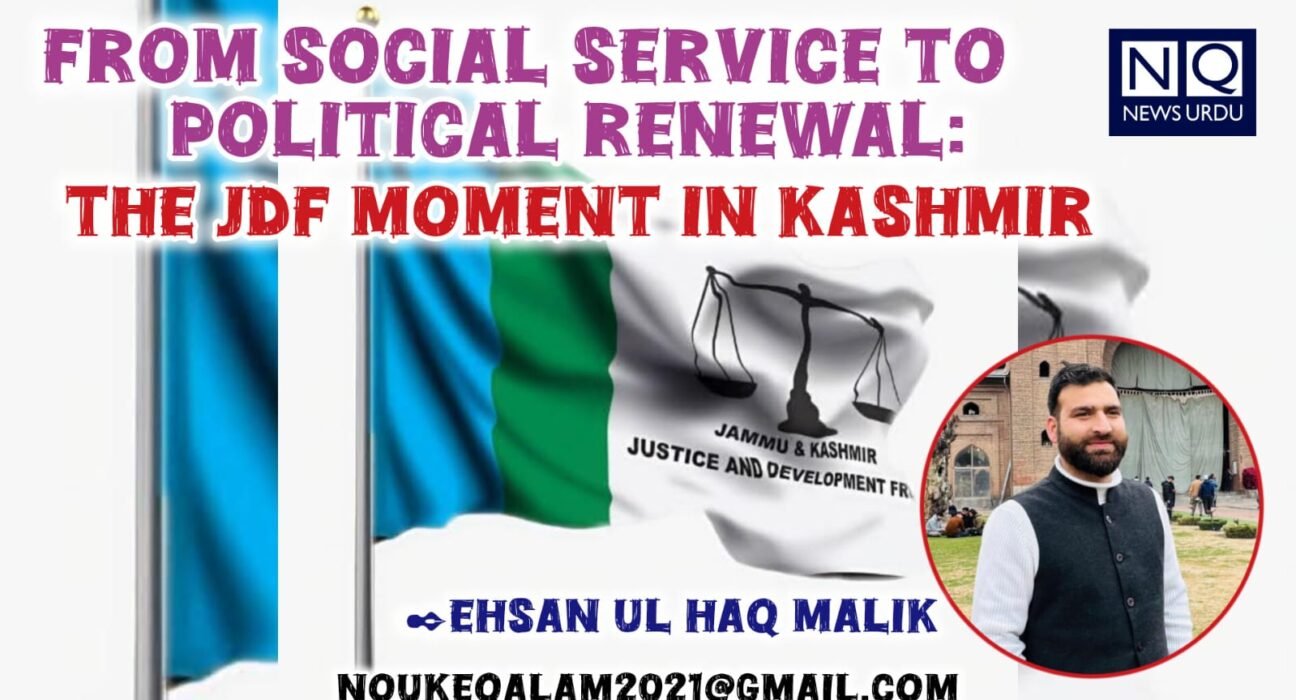
Today, the challenge is not to dwell on the past, but to renew and reimagine. Not nostalgia,but rebranding with purpose. In this context, JDF presents itself as an X-factor: a platform designed to rebuild, groom, and channel a long-standing legacy of social service into a disciplined, people-centric political future.
What distinguishes JDF from conventional political formations is its clear conceptual framework, articulated through four people-centric pillars:
Zameen (Land), Zaruriyat (Basic Needs), Ikhlaaq (Moral Character), and Itehaad (Unity).
These are not rhetorical devices or campaign buzzwords. They represent tangible concerns-land rights, access to essential services, ethical leadership, and social cohesion-issues that decades of opportunistic politics have often sidelined.
Equally significant is JDF’s organizational ethos. Unlike traditional parties that rely on dynastic succession, favoritism, or crowd mobilization, JDF emphasizes merit-based advancement. Positions are earned, not inherited. Representation emerges from across the Valley, guided by integrity, competence, and commitment rather than surnames or shortcuts.
JDF does not chase numbers for the sake of visibility. It focuses on building cadres rather than mobs, subscribing to the belief that quality precedes quantity. Sustainable political change, after all, is born of conviction and coherence,not noise.
Crucially, JDF is not a temporary adjustment to prevailing circumstances. It positions itself as a long-term movement,one that seeks justice rooted in morality, development guided by dignity, and politics anchored in ethics.
For those seeking power alone, there are many avenues.
For those seeking purpose, discipline, and meaningful change, JDF offers a different proposition.
It is not merely an alternative.
It is a continuation of service.
And, for its supporters, it represents the future.
Disclaimer :The views expressed are solely those of the writer and should not be linked to the institution.
Support Independent and Impartial Journalism
Nouk-e-Qalam News is a free and independent journalistic platform. To maintain our ethical standards and avoid obscene advertisements, we have disabled Google Ads. We now rely on your generous financial support to continue our unbiased reporting. Our Writers and readers are kindly urged to contribute—daily, weekly, or monthly. Thank you for standing with truth.