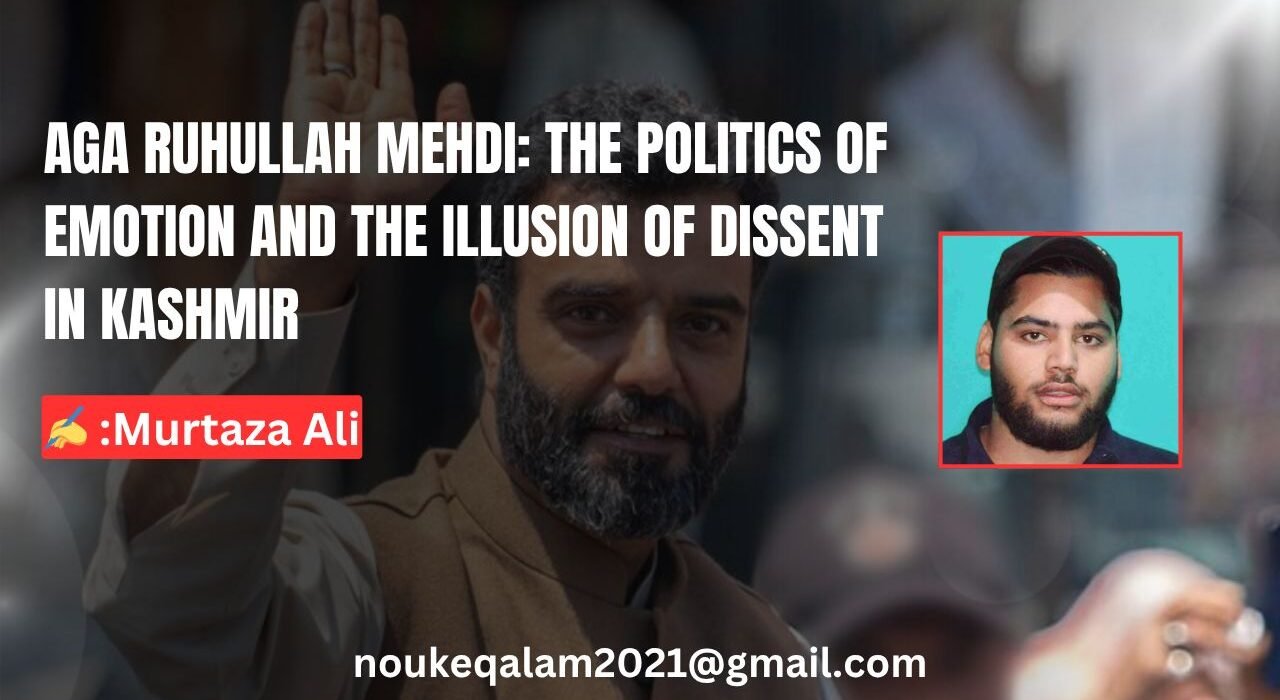
✒️:. Murtaza Ali
From a political and intelligence perspective, the unfolding power play within the Jammu and Kashmir National Conference (JKNC) reflects a calculated attempt to balance dissent and dominance. At the centre of this evolving drama stands Aga Ruhullah Mehdi — Member of Parliament from Srinagar, multiple-time MLA, and once the most prominent campaign face of the National Conference. His recent remarks on reservation policy and the party’s manifesto have drawn attention not only for their content but also for what they reveal about the NC’s internal contradictions. His statements questioning the party’s stand on reservation and engagement with the Centre have been projected as independent thinking, but to a careful observer, they represent a deeper, coordinated duality within the NC leadership.
During the first Assembly elections after the abrogation of Article 370 and the downgrade of the state into a Union Territory, Ruhullah emerged as the poster boy and key campaigner of the NC. His fiery rhetoric against the BJP, RSS, and the misuse of PSA and UAPA gave voice to public anger. Promising the release of Kashmiri youth detained across India, he campaigned on emotion and identity, helping the NC secure 42 seats, a result the party hailed as a historic mandate. Yet, the election was unlike any in the history of Jammu and Kashmir. It was not fought over development but over aspiration and identity. Voters treated it as a symbolic referendum against Delhi’s 2019 decisions. However, what followed was revealing: while emotion won the ballots, governance failed to deliver.
Inside the government, the NC leadership appeared divided. Omar Abdullah, as Chief Minister, projected calm pragmatism, while Ruhullah played the emotional voice of conscience. Together, they balanced two poles — administrative control and street-level sentiment. But this carefully managed duality soon turned into public friction, particularly when Ruhullah began questioning his own party’s commitments and even the manifesto that brought them to power. This discontent reached its peak during the Budgam seat dispute, when Ruhullah pushed for Muntazir Mohiuddin, an Apni Party figure, to get the NC ticket. Farooq Abdullah overruled the suggestion and handed the mandate to Aga Syed Mehmood, exposing the deep familial control that defines the NC. Omar initially supported Ruhullah’s choice but later withdrew, leaving Ruhullah cornered and humiliated.
If Ruhullah truly believed the party had lost its ideological path, he could have resigned or taken a public stand. Instead, he continues to operate within the same structure, criticizing from inside while benefiting from the same political umbrella. This selective dissent now appears to be part of a larger strategy — to project internal democracy while retaining centralized control. The contradiction becomes even clearer when viewed against the backdrop of governance. Compared to the Lieutenant Governor’s administration, which maintained bureaucratic order and continuity, the elected NC government seems directionless. Under the LG, the state machinery displayed efficiency, development projects advanced, and corruption networks were disrupted. In contrast, the elected government is trapped between populism and paralysis, often using emotion as a substitute for performance.
For many political analysts, the LG administration — though unelected — functioned with a greater sense of purpose and administrative discipline than the current dispensation, which appears consumed by image management rather than real reform. Ruhullah’s attempts to portray himself as the moral conscience of the NC also falter under historical scrutiny. He has been associated with the party for over two decades, serving as MLA and minister during crucial years — including 2008, 2010, and 2013 — when mass protests shook the Valley. The Tufail Mattoo case, where a 17-year-old student was killed by police action in 2010, remains a painful reminder of that period. The NC-led government of the time failed to deliver justice, and Ruhullah, as part of that system, cannot claim innocence today.
This is where Ruhullah’s politics appears most conflicted. He speaks of accountability yet avoids introspection. He condemns injustice yet represents a party historically responsible for political excesses. His criticism of Omar Abdullah and Farooq Abdullah now looks less like rebellion and more like theatre for public consumption — a controlled opposition within the same power circle. For intelligence and political observers, this pattern reflects a deliberate strategy. Omar Abdullah manages the corridors of power, ensuring the party’s administrative survival, while Ruhullah channels public anger to keep the emotional base intact. The NC thus controls both governance and grievance — a dual act designed to retain influence under changing political realities.
In the broader context, this reveals a deeper truth about Kashmir’s post-370 politics: the real battle is not between the Centre and regional parties but between truth and tactical deception. The NC continues to exploit emotion as a political tool, while the LG administration, despite its constitutional limits, demonstrates a stronger grip over governance. Aga Ruhullah Mehdi’s dissent, therefore, is not rebellion but role-playing — a carefully calculated posture that sustains the illusion of ideological struggle.
Until leaders like him choose conviction over convenience, Jammu and Kashmir’s politics will remain trapped in the cycle of emotional manipulation and selective accountability. In today’s Kashmir, emotion has become the substitute for efficiency, and dissent the disguise for design — a reality every voter must now see clearly.
(Disclaimer :.idea’s Expressed by the Writer are his own,The NQ News Dosnt Necessarily Agree with him)
Support Independent and Impartial Journalism
Nouk-e-Qalam News is a free and independent journalistic platform. To maintain our ethical standards and avoid obscene advertisements, we have disabled Google Ads. We now rely on your generous financial support to continue our unbiased reporting. Our Writers and readers are kindly urged to contribute—daily, weekly, or monthly. Thank you for standing with truth.