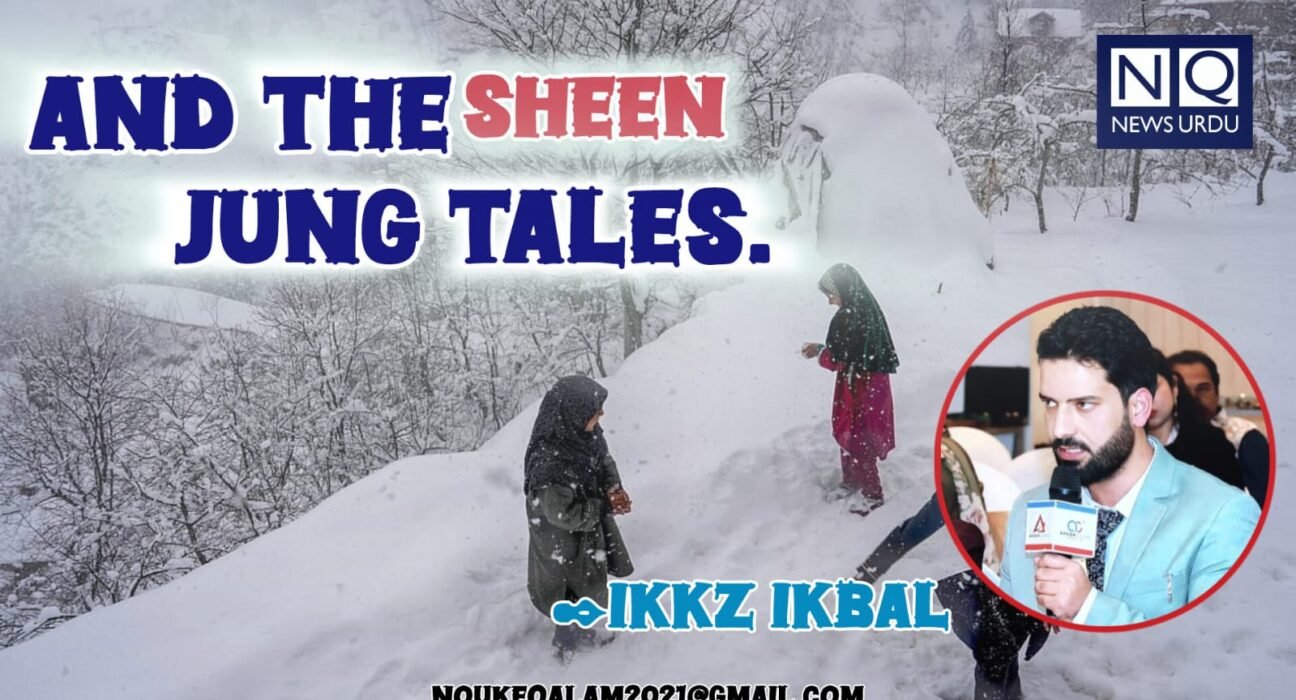
✒️:. Ikkz Ikbal
Sahipora Qaziabad Kashmir
And finally this year, came the snow. Late though. So late that waiting itself grew tired. Chillai Kalan had almost spent itself, and the sky still looked undecided—blank, distant, indifferent. But this was not the snow we used to insist upon as children. It came late, carried a certain seriousness, and arrived with the noise of restless wind. There was happiness, yes—a familiar sense of relief—but the joy lacked the carelessness that once accompanied the first snowfall. The streets turned white, the mountains wrapped themselves in quiet, and the heart paused for a moment, as if an old promise had been partially kept.
I stood by the window, holding a cup of tea in both hands, watching the mountains across the road. They stood still, patient, almost expectant—like witnesses to a promise that had been made long ago and was yet to be kept. The cold was there, but the warmth of memory was missing.
And then, from some quiet corner of the mind, a word surfaced. Sheen Jung ( The Snow Fight ).
For us, it was never just a game. It was a season. An unannounced global war—one where no ceasefire resolutions were passed, no war crimes recorded. There was only snow. And there was us. We were not children. We were soldiers. Unarmed, uniform-less, fearless.
The moment the first ball of snow touched the ground, the neighbourhood divided itself—naturally, instinctively. Friendships were suspended. Alliances shifted. Brotherhood was postponed, but never broken. Snow made the announcement for us. No whistle was needed.
And from somewhere far away, a mother’s voice would rise: “Don’t stay out too long. Your hands will go numb.” They did go numb. Hands, feet, sometimes ears. But never the heart. Snow forts rose at street corners—pressed together by bare hands, engineered by instinct. There were no architects, yet everyone knew what to do. Strategies were whispered. Traitors were identified. Sometimes someone crossed sides mid-war. (There have always been such people.)
Then the first snowball flew. Silence shattered.
And war began.
Snow stung. Laughter went deeper.
Someone slipped—everyone laughed.
Someone missed a target—he laughed at himself.
There were no winners. No losers.
Only time lost—too quickly, always too quickly.
When fingers stopped responding and noses turned stubbornly red, an unspoken truce took hold. We looked at one another, asking without words: Tomorrow?
Inside the house, we were greeted with noon chai. And its strong, milky warmth was our national medicine. Mothers pulled us close to the oven, rubbed life back into frozen hands. And in those moments, I used to wonder: could there possibly be a safer place in the world?
Today, snow does fall—but mostly on screens.
Children still exist—but their hands are occupied.
They step outside—not to play, but to document.
And the Snow War?
It seems to have been buried under Wi-Fi signals.
I take the last sip of tea. Outside, there is silence. No forts. No shouts. No collapsing laughter. The street feels older, as if it, too, remembers something it can no longer retrieve.
Maybe the Snow War has ended.
Or maybe we simply grew up.
Yet on some nights—when the cold grows sharper and the wind knocks gently on an old door—I feel it again. Somewhere, at some forgotten turn, a few children are still shaping snow into ammunition. Still laughing without fear.
And I smile. The heart settles.
Because some games never end.
They only move into memory.
And the Snow War?
It was the only war of our lives where even the defeated laughed.
The author is a prominent Columnist and Education advocate based in Kashmir. He X’s @IkkzIkbal and can be reached at ikkzikbal@gmail.com.
Support Independent and Impartial Journalism
Nouk-e-Qalam News is a free and independent journalistic platform. To maintain our ethical standards and avoid obscene advertisements, we have disabled Google Ads. We now rely on your generous financial support to continue our unbiased reporting. Our Writers and readers are kindly urged to contribute—daily, weekly, or monthly. Thank you for standing with truth.