


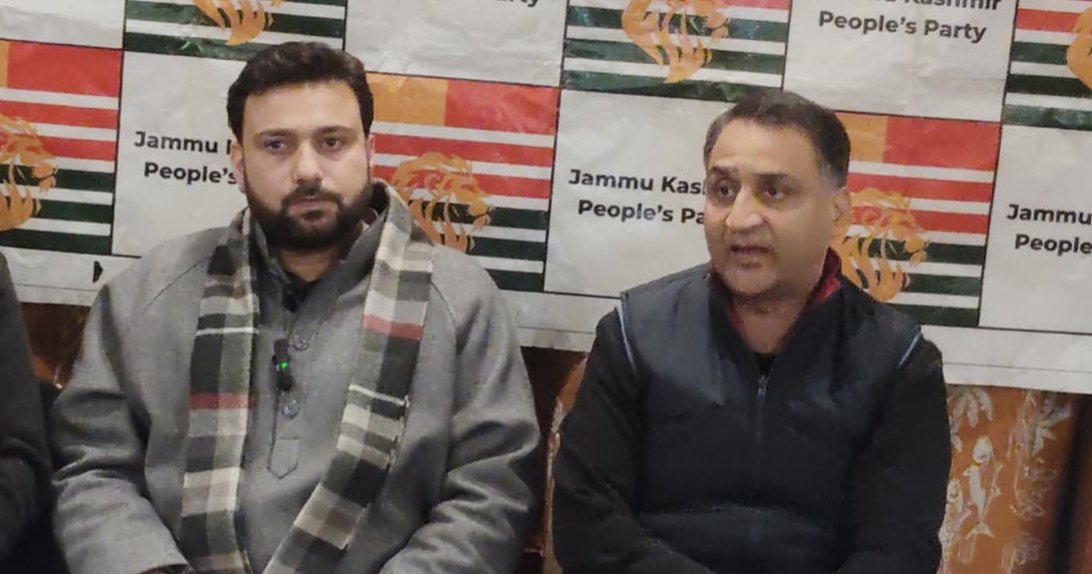
Srinagar, November 11, 2025: JK People’s Party Chief Sheeban Ashai and United People’s Party Supremo Dr. Sandeep Mawa have joined hands to provide a formidable political alternative to the people of Jammu and Kashmir. The leaders reviewed a century of Kashmir’s political trajectory from 1929 to 2025, outlining the events that shaped the region’s current situation.
Ashai blamed both local parties and New Delhi’s repeated policy blunders for the Kashmir crisis. He said that Kashmiris have suffered for nearly a century due to inconsistent and self-serving governance. Referring to key historical events, he said the arrest of Sheikh Abdullah in 1953 marked the first breach of trust between Kashmir and the rest of India. Rigged elections from 1953 to 1975, he said, eroded public faith in institutions.
He added that constitutional downgrades during G.M. Sadiq’s tenure and the replacement of the Prime Minister’s post with that of Chief Minister further deepened mistrust. According to Ashai, the real decline began after 1982 under Farooq Abdullah’s leadership, whose 1987 election manipulation triggered armed rebellion. He accused Abdullah of repeatedly compromising Kashmiri interests and collaborating with the BJP for political gain.
Ashai also criticized the PDP, Hurriyat, JKLF, and Jammat-e-Islami for double-dealing with Indian and Pakistani agencies, including the IB and ISI. He alleged that these groups built personal fortunes at the cost of innocent lives. He questioned Hurriyat leaders for their silence on their own families’ participation in mainstream politics despite earlier calling it “haram.”
He further alleged that JKLF leaders maintained secret ties with Farooq Abdullah and Indian intelligence after the group’s 1994 surrender, while some leaders enriched themselves through illegal land deals. He called out religious and separatist figures for living under BJP-provided Z+ security while thousands of Kashmiri youth died in pursuit of the cause they once championed.
Dr. Sandeep Mawa, in his address, highlighted the beneficiaries of what he termed the “conflict cottage industry.” He said that corruption and collusion had spread across politics, administration, and business. He claimed that the leadership of trade bodies such as KCCI, KTMF, and FCIK were aligned with political syndicates like the NC–JKLF and PDP–Jammat nexus.
Mawa urged the government to root out corrupt insiders who, he said, weaken institutions from within. He emphasized that his alliance with Ashai would remain transparent and people-centric, rejecting secret political deals. Both leaders pledged to engage with New Delhi constructively while remaining accountable to the public.
Support Independent and Impartial Journalism
Nouk-e-Qalam News is a free and independent journalistic platform. To maintain our ethical standards and avoid obscene advertisements, we have disabled Google Ads. We now rely on your generous financial support to continue our unbiased reporting. Our Writers and readers are kindly urged to contribute—daily, weekly, or monthly. Thank you for standing with truth.

创建Binance账户
November 11, 2025Your point of view caught my eye and was very interesting. Thanks. I have a question for you.
open a binance account
November 11, 2025I don’t think the title of your article matches the content lol. Just kidding, mainly because I had some doubts after reading the article.