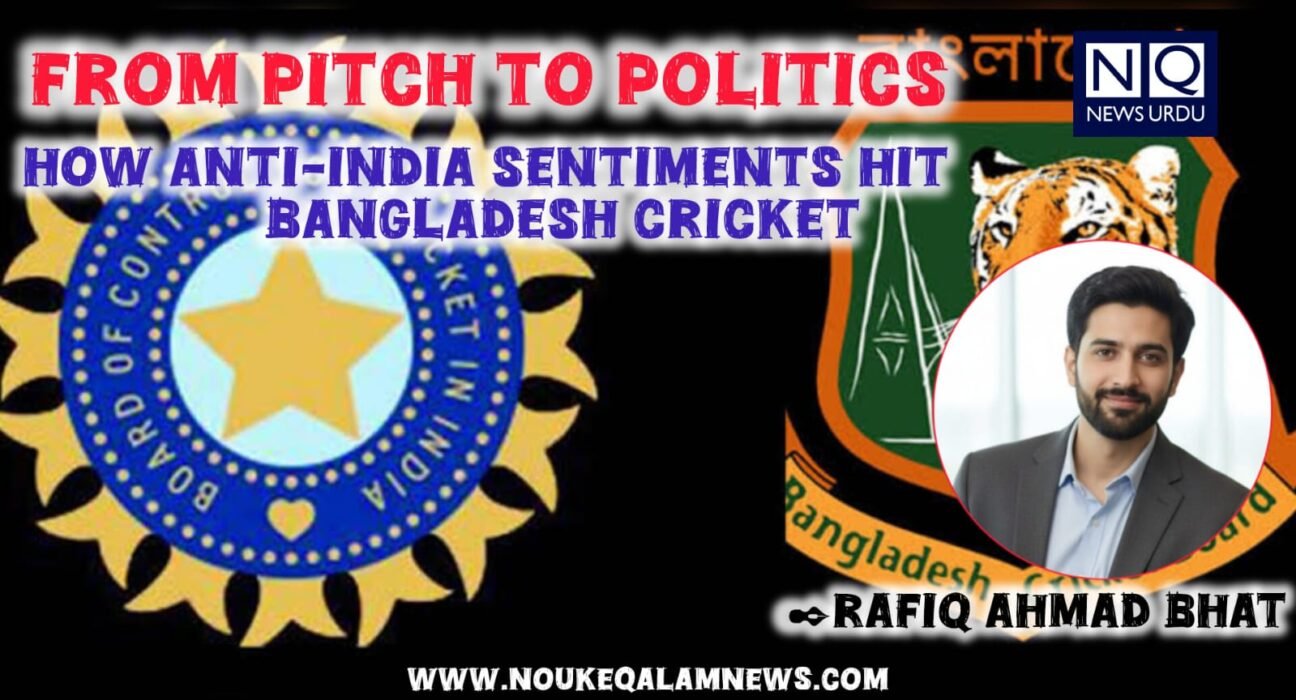
✒️:. Rafiq Ahmed Bhat
Bangladesh’s anti-India politics are now hitting the cricket pitch, with the national team paying the price. Security concerns cited appear more political than real, leaving the ICC and fans frustrated
India-Bangladesh historic low since the July Uprising, a downward trend continuing since more than 16 months. With July forces forcing Sheikh Hasina to flee Bangladesh, New Delhi woke to a surprising wave of anti-India sentiments in its neighbourhood. The Islamists resurgence and attacks on minorities, in addition to the country’s social and cultural spaces, confirmed the main force behind such sentiments. Then interim government under Muhammad Yunus took little time to gear Bangladesh’s geopolitical shift away from India and towards Pakistan in name of ‘recalibration’. There was no doubt that the Islamists forces have penetrated the present interim administration, prolonging the diplomatic lows between the two countries.
For every domestic unrest engulfing Bangladesh, the interim blamed India for ‘harboring anti-state activities.’ New Delhi’s concerns regarding the increasing atrocities on minorities have been repeatedly dismissed as ‘Indian propaganda’, despite international and Bangladesh’s rights organisations reiterating the same. Protracted winter in bilateral relations hit its lowest in December when Inqilab Moncha (an anti-India Islamist-led youth platform) leader Osman Hadi was assassinated, leading to quick blame game on India, without any evidence. The month witnessed Islamist extremists attacking Bangladesh’s significant cultural centers, as well as two of the most prominent media outlets, alleging them to be ‘pro-India’. These radical mob also organised protest marches outside Indian High Commission in Dhaka and assistant commissions in Rajshahi, Khulna, Sylhet and Chattogram, with the intention of launching similar violent attacks. Indian commissions’ security in Bangladesh, now lie compromised, which explains its recent decision to recall family members and dependents of Indian diplomats from the country as a precautionary measure, days before the 13th national election.
The Islamist extremist’s onslaught on media freedom and cultural platform coincided with another horrifying incident—the lynching of a Hindu garment worker Dipu Das, a lynching justified for Das’s alleged ‘blasphemous’ remarks and cheered and celebrated by onlookers as his naked corpse hung from a tree was burnt in public. Perhaps this was a signaling to New Delhi, of Bangladesh’s own fate of minority Hindus shielded behind the curtain of ‘non-communal’ framing. This incident prompted India summoning Bangladesh envoy, and for Bangladesh’s tit-for-tac summons. A nasty political atmosphere brewing anti-India hatred also led India to temporarily suspend its visa operations at Visa Application Centers in Bangladesh, a move also reciprocated by Bangladesh with respect to its missions in India.
Amidst this, New Delhi displayed its goodwill gesture and calibrated diplomatic protocol when India’s external affairs minister visited Dhaka to attend the funeral of Bangladesh Nationalist Party (BNP) chief Begum Khaleda Zia. Many in Bangladesh perceived this as a positive and stabilising reset of bilateral relations, a forward-looking direction before Bangladesh is to face the 13th national election in February. Then came the cricket fiasco early January.
Board of Control of Cricket in India (BCCI)’s direction to IPL team KKR to release (the only) Bangladeshi pacer Mustafizur Rahman (auctioned for $1 million) from its 2026 squad, believed to be in line with recent developments in Bangladesh (no official reason cited) did not bode well with Bangladesh, that reciprocated with the decision to not broadcast IPL matches. Just a day after BCCI’s direction to release Rahman, Bangladesh abruptly raised ‘security concerns’ for its players to play in India and asked International Cricket Council (ICC) to relocate its T20 matches to a ‘neutral’ venue such as Sri Lanka. However, after repeated assessments, ICC rejected such a request, citing lack of any credible security threats for Bangladeshi players, officials or fans and noted that such a sudden change would compromise ICC’s integrity. Following weeks of discussion, ICC gave Bangladesh a 24-hour time on 23 January to communicate its final decision.
It should be noted that of all board members present in this, Pakistan Cricket Board (PCB) was the only full-time member that expressed support for Bangladesh’s decision. In a formal letter sent before the ICC board meeting, Pakistan even assured Bangladesh to host its matches in Pakistan. PCB has also threatened to boycott T20 World Cup, in apparent solidarity with Bangladesh, to protest ICC’’s refusal for venue shift request. However, PCB chief announced its final decision to be conveyed by 30 January or 2 February. Meanwhile, Bangladesh gave no response within the 24 hours stipulated time, indicating its decision to not participate in the T20 World cup, leaving way for Scotland team to officially replace Bangladesh on 24 January. This brings into question: why Bangladesh, despite assurances of no security threat by ICC, refused to change its decision?
One obvious development in this fiasco points towards Pakistan—the only one to back Bangladesh. It is believed that Pakistan’s influence has led to BCB taking such a hardline stance. Pakistan Cricket Board argued of its own agreement with BCCI last year to play ICC matches at neutral venue until 2027. However, one cannot draw parallels as India has not shown any signs of animosity towards neighbouring country Bangladesh, although the same cannot be said for the latter. Neither has Dhaka raised security concerns with the ICC, before BCCI’s decision to withdraw the only Bangladeshi player from playing in the IPL, leaving little doubt that ‘security concerns’ are mere reciprocal actions. While one can debate on whether this was the right move on New Delhi’s part, the fact remains that India’s soil does not pose security threat for Bangladesh.
Rather, India has been a consistent support and played a pivotal role in building Bangladesh cricket. BCCI’s role, especially in the 1990s, in hosting Bangladesh, providing training and infrastructural support to Bangladesh cricket via regular matches paved way for its exposure and global recognition in the ICC. BCCI aided Bangladesh’s entry into ODI World Cup in 1999, leveraging the Asian bloc in cricket. Jagmohan Dalmiya’s tenure as ICC president (also a former BCCI chief) had also been instrumental behind Bangladesh being granted a full-time membership and test status in June 2000, overcoming skepticism of Australia and South Africa, showcasing India’s successful cultural diplomacy.
In contrast, Pakistan previously complicated Bangladesh’s cricketing journey by asking for revenues from Bangladesh team in Pakistan’s “home” series where Pakistan had hosted Bangladesh twice (2011/12-2015), despite the latter’s non-visit in 2015 series. Also, Pakistan called off its own players from Bangladesh Premier League, postponing its tour indefinitely. This time, too, Pakistan’s ‘strong’ political interference through ‘boycott call’ under the garb of cricket diplomacy is believed behind Bangladesh Cricket Board’s decision to not take part in this year’s World Cup. While it remains to be seen if Pakistan proves itself as Bangladesh’s ‘true brother’ in the cricket diplomacy, reports of PCB already scheduling its T20 squad to depart for Colombo on 2 February have been doing the rounds now, ruling out possibility of any boycott.
Bangladesh’s decision is costing its cricket team heavy. BCB will not be able to receive about $3 million participation fee, in addition to the prizes that its players could potentially earn in these matches. This also jeopardies the 4.46 per cent cut in ICC central revenue that Bangladesh receives, which amounts to more than half of BCB’s annual income. Moreover, BCB now has to pay fine for its non-participation without justified cause in the ICC.
Surely, Bangladesh cricket team, that presently ranks 9th in T20, did not agree to face such financial repercussions, and is facing the consequence of Bangladesh’s anti-India politics influencing cricket. Ironically, Bangladesh’s security concerns vanished when it approved its shooting team to visit India to participate in Asian Rifle and Pistol Championships scheduled next month. The cricket fiasco aggravated because of Pakistan’s instigation and Bangladesh’s own volatile politics now only leaves Bangladesh’s vibrant cricket team to pay the price.
Support Independent and Impartial Journalism
Nouk-e-Qalam News is a free and independent journalistic platform. To maintain our ethical standards and avoid obscene advertisements, we have disabled Google Ads. We now rely on your generous financial support to continue our unbiased reporting. Our Writers and readers are kindly urged to contribute—daily, weekly, or monthly. Thank you for standing with truth.