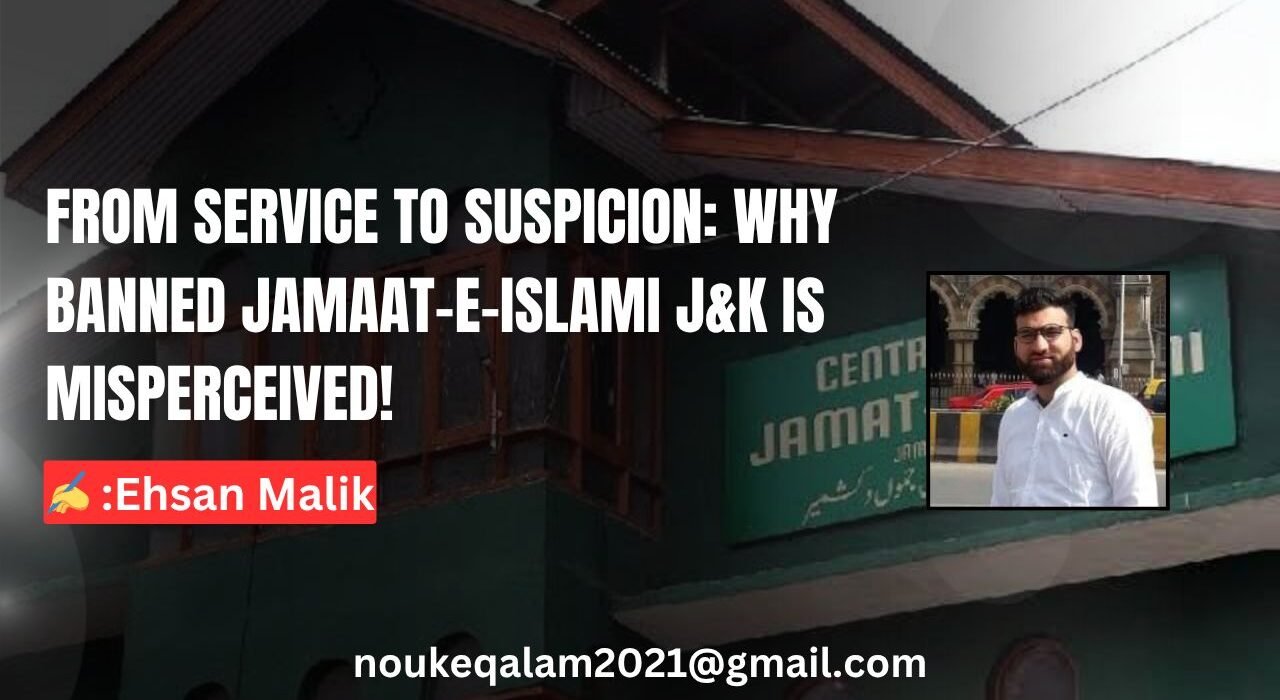
✒️:. Ehsan Malik
In the long, troubled history of Kashmir, filled with wounds, silence, ruptures, and resilience, few stories mirror the region’s emotional arc like that of Banned Jamaat e Islami Jammu and Kashmir.
It is a story shaped not merely by politics, but by faith, sacrifice, and an unbroken commitment to social reform, even as storms gathered repeatedly over its path.
When Jamaat e Islami J&K formally emerged as an independent organization in 1954 at Barzulla under the leadership of Saaduddin Tarabali, it was more than a structural separation from its Indian counterpart, it was the birth of a distinct Kashmiri voice.
A voice rooted in:
Consultation, not command
Collective wisdom, not personality cult
Education and reform, not merely politics
From the very beginning, Jamaat was not a political ambition, it was a social conscience.
Long before it fought an election, Jamaat built schools, libraries, and intellectual culture, quiet revolutions that reshaped Islamic education across Kashmir.
On objective analysis, no person can deny the fact that post 1947, the single most constructive force that brought generations of Kashmir from darkness to light was none other than JEI. Stats do not lie and the facts speak for themselves. Taking any institute or field of life and exploring the alumni of people associated with the educational network set up by Jamaat blows one’s mind. The number of teachers, doctors, engineers, civil and non civil servants, and professionals from all walks of life that this mega educational project has yielded deserves commendation of the highest order. In fact, it will not be far fetched to say that the actual nation building of Jammu and Kashmir has mostly and majorly happened at the hands of Jamaat.
Moving on, the perpetual social service of the needy and destitute, and in particular during national calamities, again makes Jamaat stand out from everybody else, even the state governments. Who did not witness these troops of God reaching almost every affected and needy person during the 2014 flood.
So, why poison coat everything about this altruistic organisation and make it not only a scapegoat but a punching bag as well in every untoward situation. Why not bring forth the undisputed positives that have stemmed from it.
Moreover, the role and requirement of such a constructive force in our society cannot be denied, so we need to put all of our disagreements and prejudices aside and raise our voice for the upliftment of the ban on this organisation and the institutes associated with it.
Its classrooms became shelters where thousands of children from ordinary families found dignity, structure, and hope.
This was the Jamaat most Kashmiris knew, not the stereotype, not the suspicion, but the mentor, the teacher, the reformer.
By the late 1960s and early 1970s, Jamaat dipped its toes into electoral politics.
It was not a pursuit of power, it was an attempt to give Kashmiri society a principled, disciplined alternative.
But politics did not welcome it gently.
And yet, in 1972, when five Jamaat candidates, including Syed Ali Shah Geelani, won assembly seats, the people’s message was clear.
Integrity still had space in Kashmiri politics.
When late Sheikh Abdullah signed the Indira Sheikh Accord, Jamaat stood almost alone in opposing the decision.
In a landscape where many voices fell silent for fear or favour, Jamaat’s persistence became an emotional anchor for thousands.
Nothing shaped modern Kashmiri politics more painfully than the 1987 elections, widely believed to be rigged, an event that altered the valley’s destiny.
For Jamaat, it was not just a political setback, it was a moral betrayal.
A generation of youth felt robbed of peaceful democratic space.
With a wounded heart, Jamaat withdrew from electoral politics.
Its members survived bans, raids, arrests, and suspicion, yet its grassroots network remained silent in respect of the ban but unbroken.
Years of suppression forced deep introspection.
The organization learned, reflected, and waited, not in fear but in patience, guided by the belief that societies cannot be changed through silence and provide space to others who have managed this all for their benefits, but through a stance, conscience, and consistency.
Even when the state banned it, even when every door seemed closed, schools continued quietly shaping futures.
Its scholars continued to influence religious discourse in their limited spaces.
Its social welfare wings continued to serve the poorest.
These were not acts of an outlawed group, these were acts of a community’s soul refusing to die.
After 37 long years, Banned Jamaat decided in 2024, after overwhelming Shura support, to step back into electoral politics.
It was a decision born not of ambition, but of responsibility.
Though still banned, its candidates filed nominations as independents, many just days before deadlines.
The response on the ground was emotional, raw, but ruthless also.
People who had grown up in schools, studied under its teachers, prayed behind its imams, and benefited from its welfare work felt that an old, trusted friend was returning home.
Even today, scrutiny surrounds every move Jamaat makes.
Its history is debated, misread, misjudged.
But beneath the layers of criticism lies an undeniable truth.
Banned Jamaat e Islami J&K shaped Kashmiri society far deeper than any political party ever did.
Even its critics admit that elections were rigged, that its social work was unmatched, that its discipline and ideology created an educated generation.
It is impossible to erase a movement woven so deeply into the cultural and intellectual fabric of the valley.
Banned JEI J&K’s journey is not a political chapter, it is a human story.
A story of:
Standing tall when misrepresented
Holding one’s ground when suppressed
Building schools when accused
Teaching values when targeted
It is a story of a people who refused to let their identity be defined by suspicion.
Because Kashmir still struggles with the wounds of broken promises.
Because electoral spaces still carry the shadows of 1987.
Because society still needs institutions focused on education, morality, and justice.
And because no meaningful conversation about Kashmir, past, present, or future, is complete without acknowledging Jamaat’s contributions and sacrifices.
In the end, Jamaat e Islami J&K’s journey is not merely a political timeline, it is a testament to endurance, identity, and hope.
A reminder that even in the harshest winters, some seeds keep their promise and bloom again.
Its story is the story of Kashmir itself. Wounded yet steadfast, misunderstood yet essential, suppressed yet unbroken.
Disclaimer :.idea’s Expressed by the Writer are his own,The NQ News Dosnt Necessarily Agree with him)
Support Independent and Impartial Journalism
Nouk-e-Qalam News is a free and independent journalistic platform. To maintain our ethical standards and avoid obscene advertisements, we have disabled Google Ads. We now rely on your generous financial support to continue our unbiased reporting. Our Writers and readers are kindly urged to contribute—daily, weekly, or monthly. Thank you for standing with truth.