


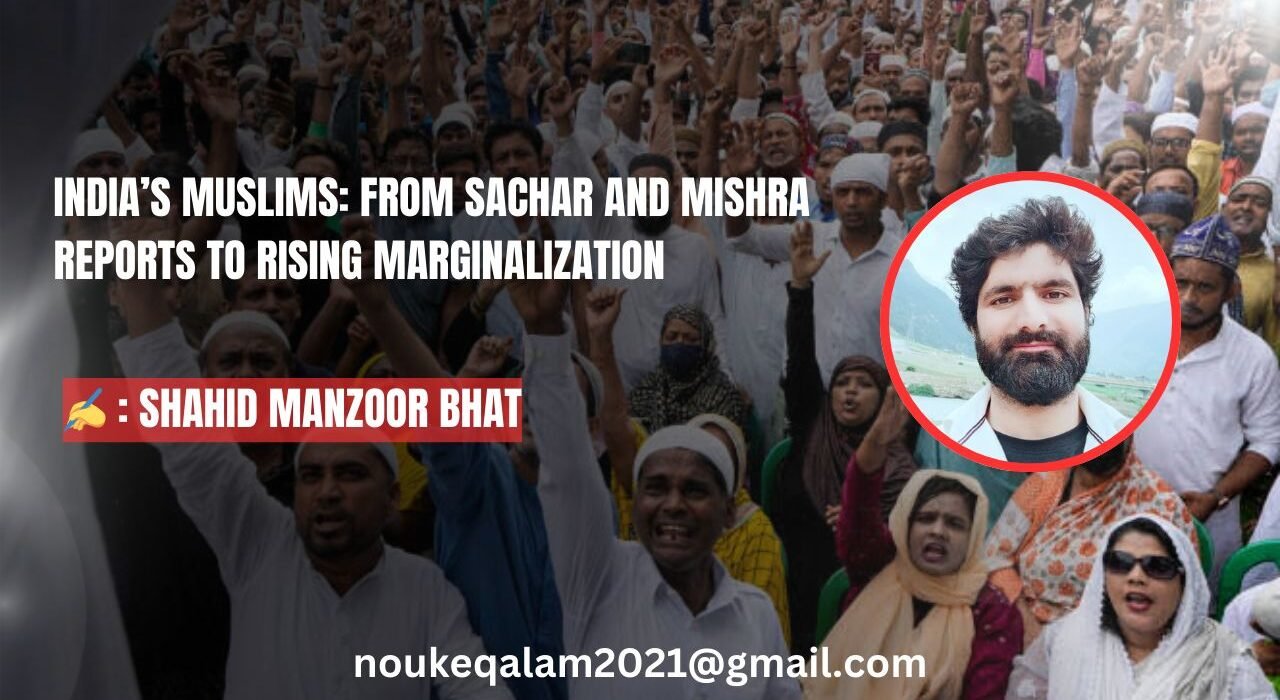
✒️:. Shahid Manzoor Bhat
India’s 200 million Muslims, forming 14.2% of the population, face a paradox in 2025: landmark reports meant to uplift them gather dust while communal tensions escalate. The Sachar Committee Report (2006) and Rangnath Mishra Commission Report (2007) exposed deep socio-economic disparities, but recent events—Babri Masjid disputes, the Fatehpur tomb demolition, and mob lynchings—signal a troubling rise in marginalization, with critics pointing to fascist undercurrents in Hindu nationalist policies.
The Sachar Committee, led by former Chief Justice Rajinder Sachar, revealed stark realities: Muslims had a literacy rate of 59% compared to the national 65%, held only 3% of Indian Administrative Service posts, and faced urban poverty worse than that of Scheduled Castes. It called for an Equal Opportunity Commission, scholarships, and better access to credit. Yet, nearly two decades later, initiatives like the 15-Point Programme for minorities remain half-hearted, leaving Muslims feeling alienated amid communal riots and biased policing.
The Rangnath Mishra Commission went further, advocating 10% reservations for Muslims in jobs and education, and Scheduled Caste status for Dalit Muslims. Met with resistance as “minority appeasement,” its recommendations were partly rejected in 2022, with little progress by 2025. Both reports underscored systemic inequities, but their limited implementation has deepened distrust.
Today, India’s Muslims face heightened challenges. The 2019 Supreme Court ruling on the Babri Masjid site, demolished in 1992, favored a Ram Temple, inaugurated in 2024, while the promised mosque remains unbuilt. In late 2024, a West Bengal MLA’s proposal for a “Babri Masjid-like” mosque sparked a BJP counter-plan for a Ram Temple, stoking polarization. In August 2025, a 200-year-old tomb in Fatehpur, Uttar Pradesh, was vandalized by a Hindu mob claiming it stood on a Shiva temple site, with BJP leaders among those booked. Clashes followed, amplifying fears of state complicity in mosque-temple disputes.
Mob lynchings further darken the picture. In 2024, 13 incidents killed 11 people, nine of them Muslims, often over cow-related allegations. By January 2025, at least five more Muslims were lynched, with weak enforcement of Supreme Court guidelines and fewer than 10 convictions from 100–150 deaths since 2015. The 2025 Waqf Act amendments, seen as state overreach into Muslim endowments, have intensified accusations of fascism. Human Rights Watch and the USCIRF note rising hate speech and anti-minority laws, though some argue these narratives overstate bias.
India’s Muslims remain the poorest religious group, with low political representation and high informal sector employment. The unfulfilled promises of Sachar and Mishra, coupled with recent violence, underscore an urgent need for equitable policies and justice to bridge the growing communal divide. Without action, the alienation of India’s largest minority risks deepening, threatening the nation’s pluralistic fabric.
Support Independent and Impartial Journalism
Nouk-e-Qalam News is a free and independent journalistic platform. To maintain our ethical standards and avoid obscene advertisements, we have disabled Google Ads. We now rely on your generous financial support to continue our unbiased reporting. Our Writers and readers are kindly urged to contribute—daily, weekly, or monthly. Thank you for standing with truth.



Inscreva-se para obter 100 USDT
August 16, 2025Your article helped me a lot, is there any more related content? Thanks!