


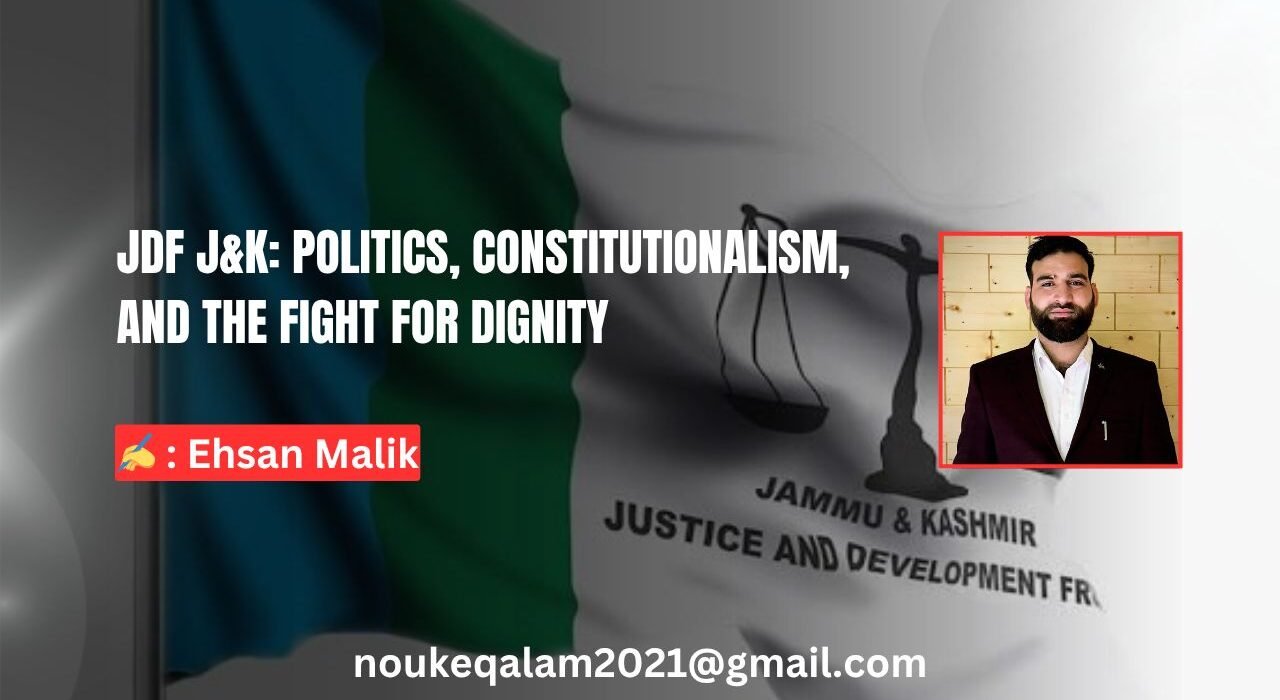
✒️:. Ehsan Malik
The recent decision of banned Jamaat-e-Islami Jammu and Kashmir (JeI J&K) to launch a political front has sparked fresh debate in the Valley. Critics and supporters alike are asking: what does secularism in India truly mean, and how should Muslims and religiously inspired movements like Jamaat position themselves within it?
For Jamaat, political engagement within the Indian system is not a novelty. From 1972 to 1987, JeI J&K actively participated in the electoral process, operating under the framework of Indian secular democracy. But history took a decisive turn in 1987, when large-scale electoral rigging robbed the people of their mandate. What was long spoken of in private is now being confirmed publicly, most recently in a revealing interview conducted by senior journalist Ahmad Ali Fayaz, in which Ali Mohammad Watali openly admitted to the manipulation of results.
That betrayal was not just against Jamaat but against the democratic aspirations of the Kashmiri people. It alienated an entire generation and pushed youth away from mainstream politics. Today, as Jamaat takes cautious steps back into the political arena, this history cannot be forgotten. It must serve as both a lesson and a warning.
The Irony of Indian Secularism!
Syed Sadatullah Husaini, Ameer-e-Jamaat of Jamaat-e-Islami Hind, has consistently reminded us that India has never truly practiced secularism in its genuine sense. From independence onward, state institutions have been infused with Hindu symbols and rituals. Yet, paradoxically, Hindu nationalist factions accuse secularism of being “pro-Muslim.” This exposes the deep hypocrisy of a system tilted toward majority dominance.
Syed Sadatullah Husaini explains two types of secularism:
- Negative secularism: token gestures, election slogans, and hollow appeasement of minorities without granting them substantive power or dignity.
- Positive secularism: a principled and consistent commitment to justice, where the state ensures equality for all citizens and everybody has the right to profess his faith.
Regarding this positive aspect, we can say that it has a point of congruence with Islamic teachings. Giants of scholarship like Maulana Abu Lais Nadvi, Maulana Syed Hamid Ali, and Maulana Muhammad Yousuf have said on record, “However, if secularism is understood to mean that no religious sect should be discriminated against in governmental affairs, and that there should be equal treatment regardless of religion or community, with equal opportunities available to everyone, then the Jamaat has never opposed this concept.”
Moreover, Jamaat firmly believes that if a viable solution to any of the entangled problems of human affairs has religious origin, that should not become the sole ground for its rejection, as long as the free will of people aspires to adopt it. This belief does not, in any sense, violate the positive concept of secularism or any of the principles of logic and justice.
Lessons for Jamaat’s Youth!
For the young members and supporters of Jamaat, this distinction is vital. Islam stands firmly for justice, equality, and dignity of all human beings. Entering political life is not about compromise, it is about upholding these principles and demanding that India fulfills its own constitutional promise without any distinction of race, region, or religion.
The experience of 1972–1987 proves that Jamaat has the capacity to engage with democratic processes. The rigging of 1987 should not be seen as a reason to permanently withdraw, but as a reminder that political engagement must be pursued with greater clarity, resilience, and vigilance.
A Call to Confidence!
The formation of Justice and Development Front is not a sign of weakness, but of courage. It is an assertion that exclusion will not silence us, that majoritarian dominance will not erase our voice, and that Muslims in Kashmir deserve equal space in the democratic framework.
To the youth: remember, participation is not surrender, it is leadership. It is the transformation of doubt into conviction, of isolation into collective strength.
If India is to remain truly a democratic country and its constitutional principles are to be followed in letter and spirit, then it is imperative that no distinction of race, region, or religion find inroads into its system. There should not be any repeats of 1987 or of the controversial decisions which tore apart the essence of federalism in the recent and remote past.
For Jamaat’s youth, the path ahead is clear: rise above confusion, engage with confidence, and stand as guardians of justice and equality.
About the Writer
Ehsan Malik
Media Coordinator
Justice and Development Front J&K
(Disclaimer :.idea’s Expressed by the Writer are his own,The NQ News Dosnt Necessarily Agree with him)
Support Independent and Impartial Journalism
Nouk-e-Qalam News is a free and independent journalistic platform. To maintain our ethical standards and avoid obscene advertisements, we have disabled Google Ads. We now rely on your generous financial support to continue our unbiased reporting. Our Writers and readers are kindly urged to contribute—daily, weekly, or monthly. Thank you for standing with truth.


binance konto skapande
September 30, 2025Thanks for sharing. I read many of your blog posts, cool, your blog is very good.