


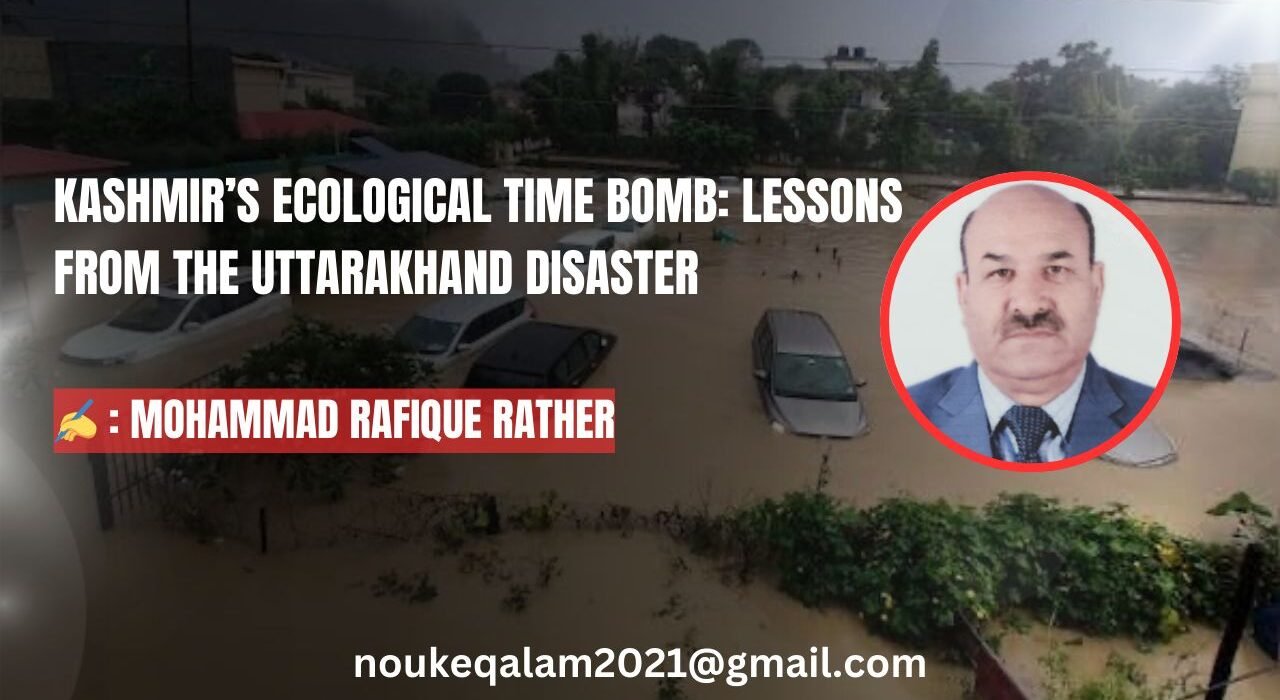
✒️:. Mohd Rafique Rather
A catastrophic landslide in Dharali, Uttarakhand, has shocked the nation. Hundreds of houses, hotels, vehicles, and commercial establishments were buried under debris as nature unleashed its fury. But beyond the destruction of property, it is the human loss that stands as the most heartbreaking tragedy—families torn apart, lives lost, dreams shattered. This wasn’t merely a natural disaster—it was a man-made tragedy born of reckless development and unchecked tourism. The devastation in Uttarakhand is not an isolated event; it is a warning that must echo all the way to Kashmir, where a similar model of unregulated expansion and ecological tampering is underway.
Uttarakhand’s once-serene hills were slowly gouged out to make way for roads, hotels, and tourist infrastructure. Forests were cleared, water channels blocked, and nature’s balance disturbed in the name of development. When we violate nature, it responds—often violently.
Today, Jammu and Kashmir, particularly the Valley, is witnessing a tourism boom. Crores of tourists have visited in just two years. While tourism supports livelihoods, it must not come at the cost of irreversible environmental damage. Sadly, that is precisely what’s happening.
Hillsides are being cut, forests cleared, and wetlands filled to accommodate more tourists. Roads are widened in landslide-prone zones without proper geological assessments. Popular destinations like Gulmarg, Pahalgam, Sonmarg, and even the alpine meadows of Gurez and Bangus are overcrowded. Vehicles choke narrow roads. Waste disposal systems are inadequate, turning pristine environments into dumping grounds.
Unregulated construction on steep slopes, forest encroachments, and illegal development along water bodies are destabilizing Kashmir’s ecological foundation. Dal Lake is choking. Wular and Manasbal are shrinking. The Lidder, Sindh, and Jhelum rivers carry more sewage and plastic than clean water.
If this continues, Kashmir is heading for an ecological catastrophe, and a disaster like the one in Uttarakhand is not a matter of if—but when.
Signs are already evident. Summers are hotter than ever; Srinagar recently recorded unprecedented temperatures. Winters have become more erratic and harsher. These extremes are symptoms of deforestation, green cover loss, water body encroachments, and rising pollution.
Kashmir’s glaciers—lifelines of our rivers—are retreating at a worrying pace. This endangers not just water availability, but agriculture, horticulture, and hydropower—critical to our survival. The consequences are not just environmental, but also economic, social, and cultural.
We must now ask: what kind of development do we want? Sustainable progress in harmony with nature—or mindless expansion that leaves destruction in its wake?
Tourism should not mean chaos. It must follow a model of planned, responsible growth. We are guests in nature’s home, not its owners. Once destroyed, no amount of money or manpower can restore nature’s original balance.
The government must act urgently and responsibly. Construction in ecologically sensitive zones—upper reaches, wetlands, and forests—must be banned outright. Environmental impact assessments should be made compulsory and strictly enforced before project approvals. Waste management infrastructure needs immediate upgrading in all major tourist hubs. A large-scale afforestation drive must be launched with public participation to revive our vanishing green cover. Most critically, tourist inflow to fragile areas must be regulated through seasonal caps or permits. Environmental rules must not remain on paper—they must be strictly implemented on the ground.
But governance alone is not enough. Citizens too must act. Locals should avoid encroaching on forests and wetlands for commercial gain. Tourists must travel responsibly—avoid littering, respect local ecology, and support eco-friendly initiatives. Trekking, camping, and religious tourism must be monitored and controlled to prevent environmental degradation.
The mindset of “more is better” must give way to “better is better.” Sustainable tourism means fewer numbers, better facilities, cleaner spaces, and happier hosts and visitors.
The landslide in Uttarakhand is more than a disaster—it is a message from nature. When we destroy forests, flatten hills, fill lakes, and block rivers, we invite ruin. Kashmir, with its beauty and fragility, is not immune. In fact, it is more vulnerable.
We must listen to this warning—not tomorrow, not next year, but today.
Let us not allow the paradise that is Kashmir to become another cautionary tale. Let it be an example of how nature and development can coexist—if we respect ecological boundaries.
Because if we fail to act now, the devastation we saw in Uttarakhand—the destruction, displacement, and above all, the tragic loss of human lives—may soon unfold in our own mountains. And by then, our regret will come far too late.
The author is a former trade union leader, columnist, television debater, and is associated with the Jammu and Kashmir Peoples Democratic Party.
Support Independent and Impartial Journalism
Nouk-e-Qalam News is a free and independent journalistic platform. To maintain our ethical standards and avoid obscene advertisements, we have disabled Google Ads. We now rely on your generous financial support to continue our unbiased reporting. Our Writers and readers are kindly urged to contribute—daily, weekly, or monthly. Thank you for standing with truth.



Bashir
August 12, 2025A sharp and urgent warning, this piece links Uttarakhand’s tragedy to Kashmir’s looming ecological risks, urging sustainable development and responsible tourism before disaster strikes.
NQ Desk
August 12, 2025Assalamualaikum Wrtwb
Thanks for your Valuable comment Keep visiting our Website.
Thanks and regards
Editor NQ News
Anm"al dig f"or att fa 100 USDT
August 12, 2025I don’t think the title of your article matches the content lol. Just kidding, mainly because I had some doubts after reading the article. https://www.binance.com/register?ref=JW3W4Y3A
Registrera
August 12, 2025Thank you for your sharing. I am worried that I lack creative ideas. It is your article that makes me full of hope. Thank you. But, I have a question, can you help me? https://www.binance.com/join?ref=IXBIAFVY