


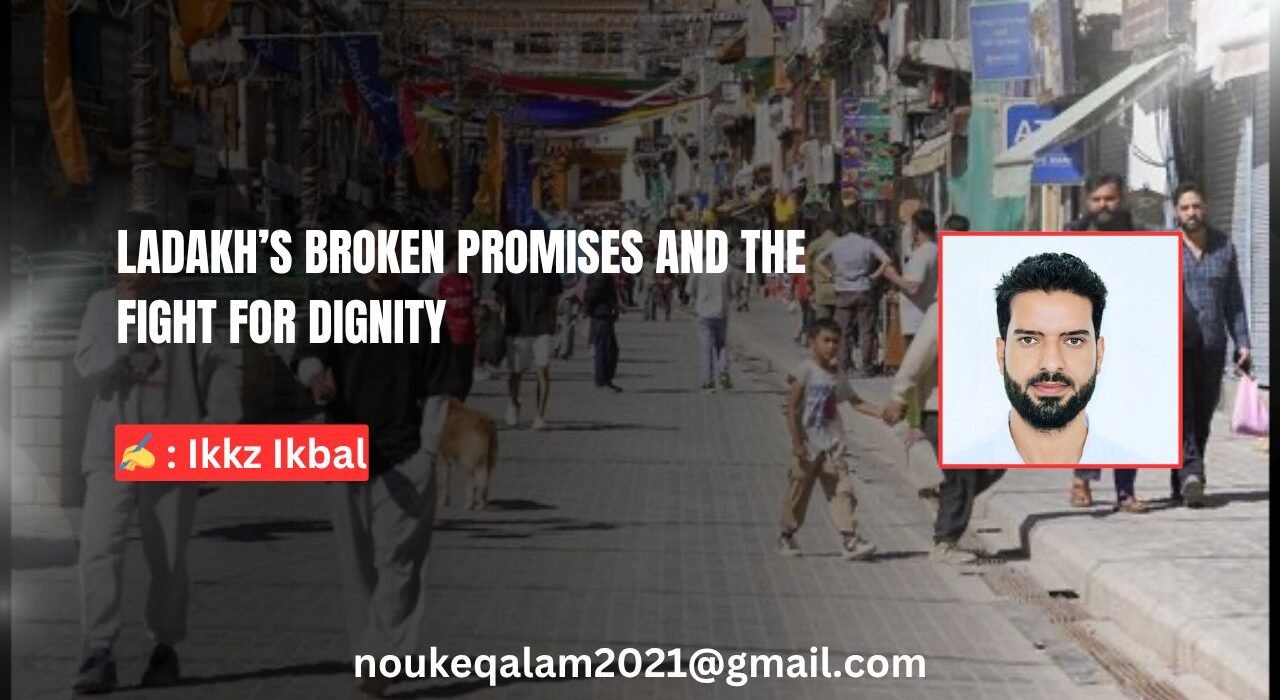
✒️:. Ikkz Ikbal
There are places in the world where silence itself becomes a language. Ladakh has long been such a place. Yet, silence has its limits. When promises are broken, when dignity is wounded, even mountains begin to speak. And when they do, the echoes are heard far beyond their valleys. The recent turmoil in Ladakh, violent protests, civilian deaths, curfew in Leh, and the detention of Sonam Wangchuk, is more than an episode of law and order. It is a story about trust, identity, and the uneasy space between power and people.
A Tale of Broken Promises
In 2019, when Ladakh was carved out as a Union Territory, the move was sold as empowerment. What was promised was direct access to the Centre, development without intermediaries, and protection for Ladakhi culture and resources. What has been delivered, however, is suspicion, curfew, and alienation.
The demand for full statehood and inclusion under the Sixth Schedule, essentially constitutional guarantees for tribal and cultural rights, has become the heart of the protest. People believe that without such protections, Ladakh’s fragile ecology and delicate demography will be bulldozed by corporate projects and political indifference.
The Apex Body in Leh and the Kargil Democratic Alliance, once willing to negotiate, have now withdrawn from talks. Their message is clear: dialogues without dignity are meaningless.
The Government’s Answer: Suspicion and Crackdown
Faced with public anger, the administration has turned not to trust-building but to surveillance and suspicion. The FCRA license of SECMOL, Wangchuk’s educational NGO, has been cancelled, blocking foreign donations. Bank accounts of allied groups are under scrutiny. Officials speak of “credible inputs” suggesting foreign influence, even hinting at links across the border.
Such narratives are not new in India. They serve two purposes: delegitimising the movement by painting it as “anti-national,” and shifting focus from the government’s own failure to fulfil promises. But Ladakhis, who have historically defended the nation’s frontiers, are deeply hurt by these insinuations. For them, the accusation of being foreign agents feels like an insult carved into their very mountains.
A Leader in Chains, a Family in Anguish
Sonam Wangchuk, engineer, environmentalist, and arguably Ladakh’s most respected public intellectual, now sits in detention in Jodhpur jail. His wife, Gitanjali Angmo, has written to the President of India pleading for his unconditional release. She writes not as a political activist but as a spouse who has not even been allowed to speak to her husband since his arrest. Her question pierces the silence: is it now a crime in India to speak of climate change, of education reform, of local autonomy?
Meanwhile, political leaders trying to meet Wangchuk have been denied access. The image is striking: while the mountains of Ladakh stand open to the winds, its most prominent voice is locked behind iron bars.
Two Funerals, and a Thousand Questions
Perhaps the most searing image is that of the two young men who lost their lives during the protests. Their funerals, attended by thousands despite curfew and restrictions, became collective ceremonies of grief and defiance. Each coffin carried more than a body, it carried questions that still echo: must aspirations be written only in blood? Must democracy respond only when silence is broken by fire?
The Shadow on Livelihoods
Beyond politics lies the everyday economy of Ladakh. Tourism, the region’s lifeline, has come to a standstill. Markets are deserted, guesthouses empty, and families dependent on seasonal visitors stare at an uncertain future. The cost of broken trust is not paid only in slogans or arrests, it is paid in lost incomes, interrupted schooling, and anxious nights.
A Wider Pattern
Ladakh’s story is not an isolated one. Across India, dissent is too often answered with detentions, NGOs face closures, and movements are branded with the convenient tag of “foreign hand.” This pattern may serve short-term control, but it erodes long-term trust in democratic institutions. When citizens no longer believe their voices will be heard, they eventually find other, less peaceful ways to be noticed.
When Silence Breaks
The mountains of Ladakh have long absorbed silence, but they cannot absorb betrayal. The protests are not just about statehood or Sixth Schedule protections; they are about respect, about being treated not as pawns in a geopolitical chessboard but as people with dignity.
If the government listens only through the language of suspicion, it will miss the deeper truth: Ladakhis are not asking for separation, they are asking for inclusion with honour. They are not rejecting India, they are asking India to keep its promises.
The Echo Beyond the Valleys
The lesson of Ladakh is simple yet urgent. Promises once broken are not easily mended, and silenced voices return with greater force. This is not just a Ladakhi struggle, it is a reminder to all of us that democracy is not sustained by curfews or allegations, but by trust and dialogue.
When the mountains begin to speak, we should listen carefully. For their echoes travel far, and they last long.
Ikkz Ikbal has a PG in Biotechnology and is Principal at MMI Pandithpora. He X’s @IkkzIkbal and can be reached at ikkzikbal@gmail.com.
Support Independent and Impartial Journalism
Nouk-e-Qalam News is a free and independent journalistic platform. To maintain our ethical standards and avoid obscene advertisements, we have disabled Google Ads. We now rely on your generous financial support to continue our unbiased reporting. Our Writers and readers are kindly urged to contribute—daily, weekly, or monthly. Thank you for standing with truth.



Registrácia na binance
October 2, 2025Your article helped me a lot, is there any more related content? Thanks!