


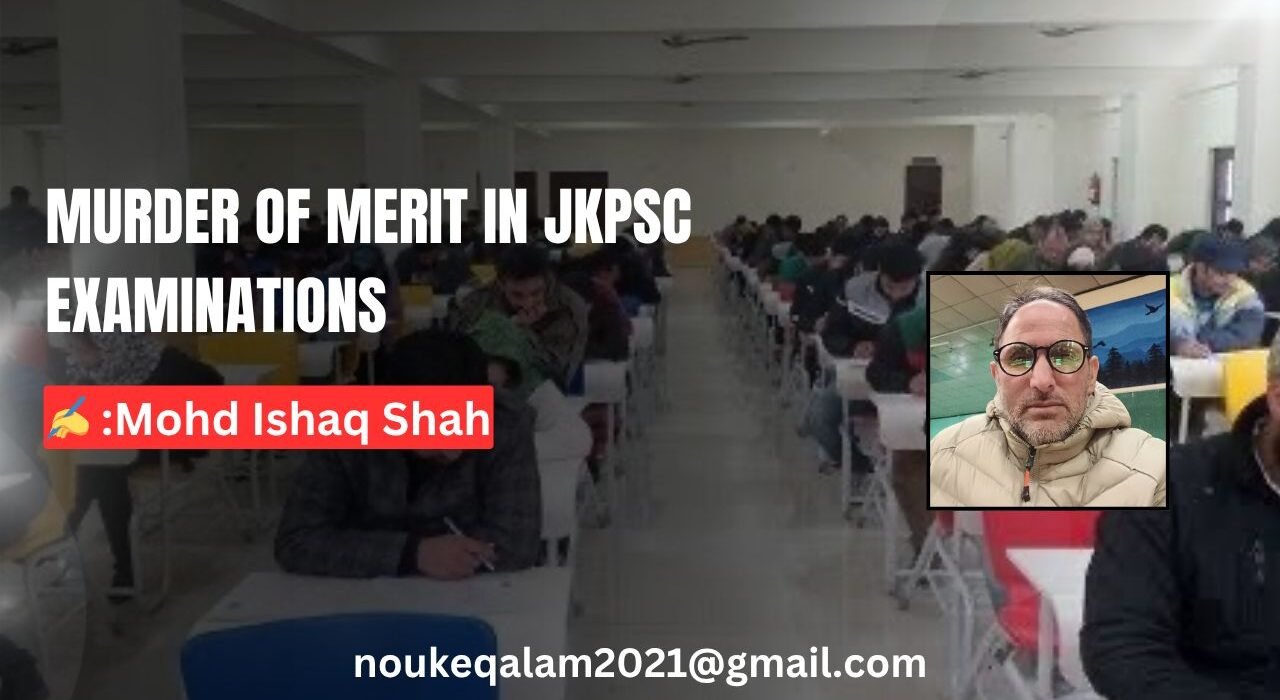
✒️:. Mohd Ishaq Shah
The recently held examinations by the Jammu and Kashmir Public Service Commission (JKPSC), the apex body responsible for conducting prestigious exams like JKAS, Assistant Professor, Lecturer, and Medical Officer, have exposed serious flaws and negligence. These lapses amount to a clear case of merit being compromised.
According to aspirants from subjects such as Urdu and History, the papers were so easy that almost anyone could answer them. In Urdu, hundreds of candidates reportedly scored a perfect 100, revealing the poor quality of paper-setting. This raises a critical question: how can JKPSC fairly shortlist candidates when the test fails to differentiate merit?
In the next phase, papers for subjects like English and Political Science were excessively difficult, matching the standard of university-level examinations rather than those meant for 10+2 Lecturers. Such exams required research-level expertise that is not expected for teaching at the higher secondary level. These questions demanded the kind of in-depth literary and theoretical understanding typically associated with Assistant Professors, who are required to possess NET, SET, or PhD qualifications.
The eligibility for 10+2 Lecturers is a postgraduate degree, without any minimum percentage bar. Expecting postgraduate candidates, many of whom have not pursued higher research, to perform at a research or doctoral level is unrealistic. The knowledge gap between a postgraduate and a PhD holder is significant, and this mismatch exposes the flawed approach of the Commission.
This inconsistency shows either deep incompetence or deliberate manipulation to benefit selected candidates. Reports that some coaching academies had access to papers resembling the actual exams further reinforce suspicions of corruption.
In 2016, an exam paper was reportedly copied word-for-word from the R. Gupta NET/SET Guide, including even the printing errors, which points to a pre-arranged setup. Genuine aspirants who worked hard were left disappointed while favoritism triumphed.
It is time for intellectuals, academicians, and educationists to raise their voices against such malpractice. Allowing such systems to persist will only breed mediocrity and rob deserving students of fair opportunities.
Support Independent and Impartial Journalism
Nouk-e-Qalam News is a free and independent journalistic platform. To maintain our ethical standards and avoid obscene advertisements, we have disabled Google Ads. We now rely on your generous financial support to continue our unbiased reporting. Our Writers and readers are kindly urged to contribute—daily, weekly, or monthly. Thank you for standing with truth.


