✒️:. Shahid Manzoor Bhat
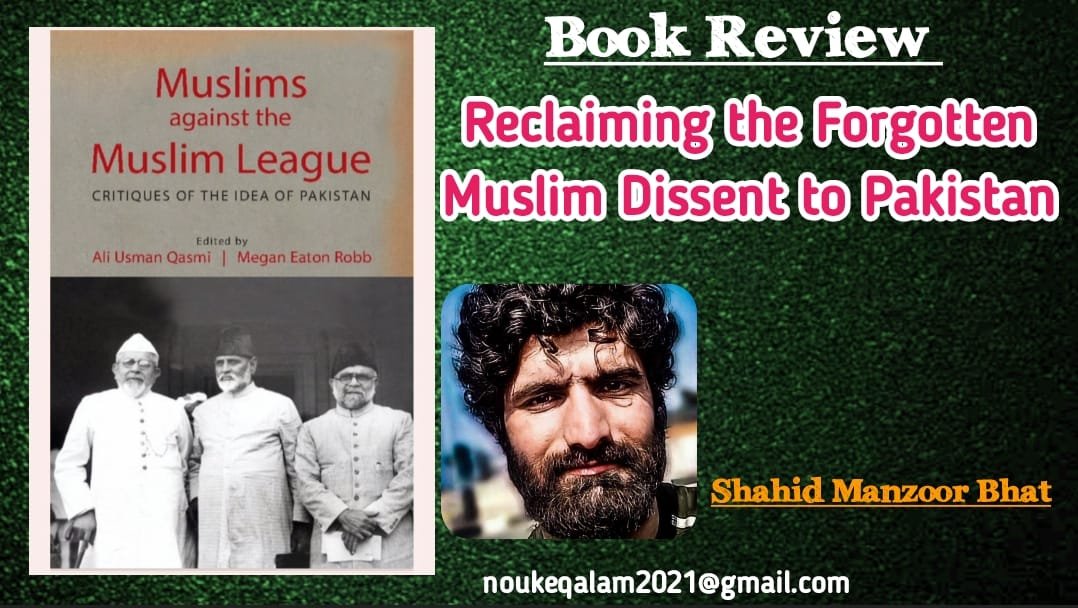
In the crowded scholarship on the Partition of 1947, this edited volume by Ali Usman Qasmi and Megan Eaton Robb makes a decisive intervention. Muslims against the Muslim League Critiques of the Idea of Pakistan recovers the voices that mainstream histories often ignore. It challenges the notion that the demand for Pakistan moved along a single, uncontested path led by the Muslim League and Muhammad Ali Jinnah.
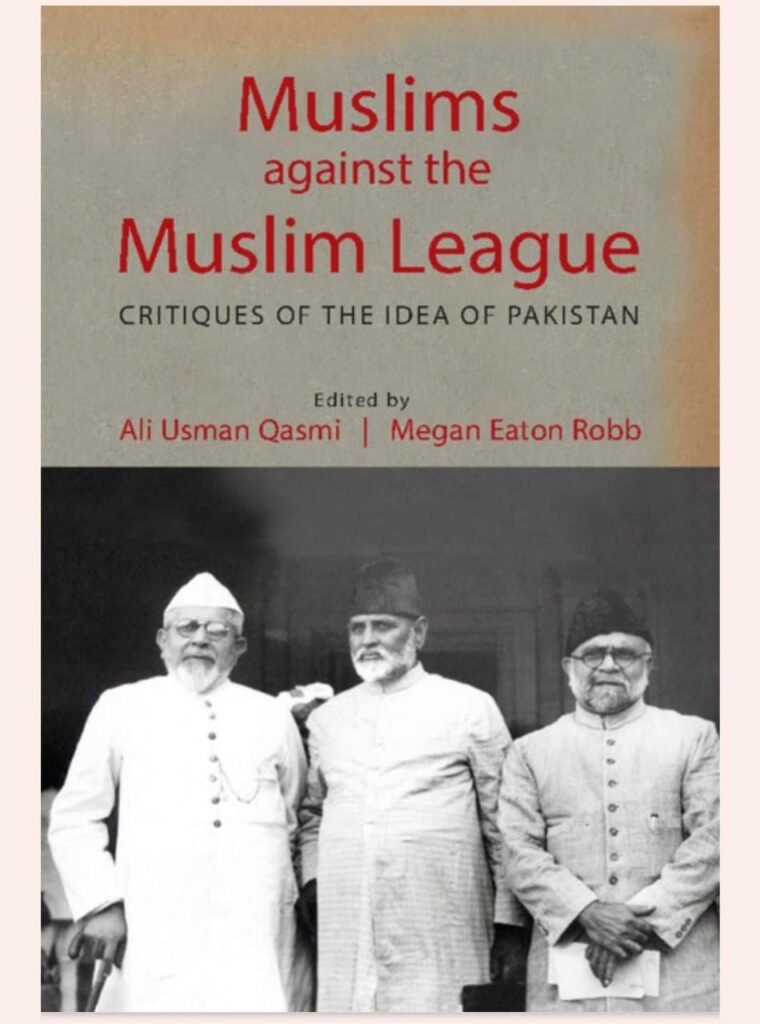
The book shifts the frame of analysis. Instead of treating Pakistan as an inevitable outcome, it presents Partition as a product of intense debate, disagreement, and political struggle among Muslims themselves. The editors show that opposition to Pakistan did not stem from intellectual weakness. It emerged from competing visions shaped by electoral realities, class interests, and colonial state structures. By foregrounding those who lost the political battle, the volume explains why Pakistan succeeded despite strong and, at times, persuasive critiques.
The strength of the book lies in its range. Across fourteen chapters, it examines individuals, movements, and regions that resisted the two nation theory. Religious scholars such as Maulana Husain Ahmad Madani argued for composite nationalism rooted in Islamic tradition, drawing on the Covenant of Medina. Maulana Abul Ala Maududi initially rejected the Muslim League project as lacking Islamic substance, offering a critique that unsettles later assumptions about Islamist support for Pakistan.
Regional case studies further dismantle the idea of a unified Muslim political will. From Allah Bakhsh Soomro in Sindh to Abdul Ghaffar Khan and the Khuda’i Khidmatgar movement in the North West Frontier, the book shows how local politics and social realities shaped distinct Muslim responses. Justin Jones’s discussion of Shia anxieties is especially striking. It records early fears that Pakistan could become a Sunnistan, a concern that echoes in contemporary sectarian tensions.
This work has clear relevance beyond historical debate. It invites reflection on Indian nationalism, Muslim political identity, and secularism as unresolved questions rather than settled outcomes of 1947. By revisiting the arguments of the 1940s, the book helps explain the layered identities and political uncertainties that persist in both India and Pakistan.
Muslims against the Muslim League is an essential contribution to South Asian history. It moves attention away from elite negotiations and high politics to discussions held in towns, mosques, and community spaces. For readers interested in Partition, political dissent, or the making of Muslim political thought, this book offers clarity and depth. It reminds you that behind every claim of sole representation stood many Muslim voices who disagreed and who still matter for understanding the present.
Support Independent and Impartial Journalism
Nouk-e-Qalam News is a free and independent journalistic platform. To maintain our ethical standards and avoid obscene advertisements, we have disabled Google Ads. We now rely on your generous financial support to continue our unbiased reporting. Our Writers and readers are kindly urged to contribute—daily, weekly, or monthly. Thank you for standing with truth.