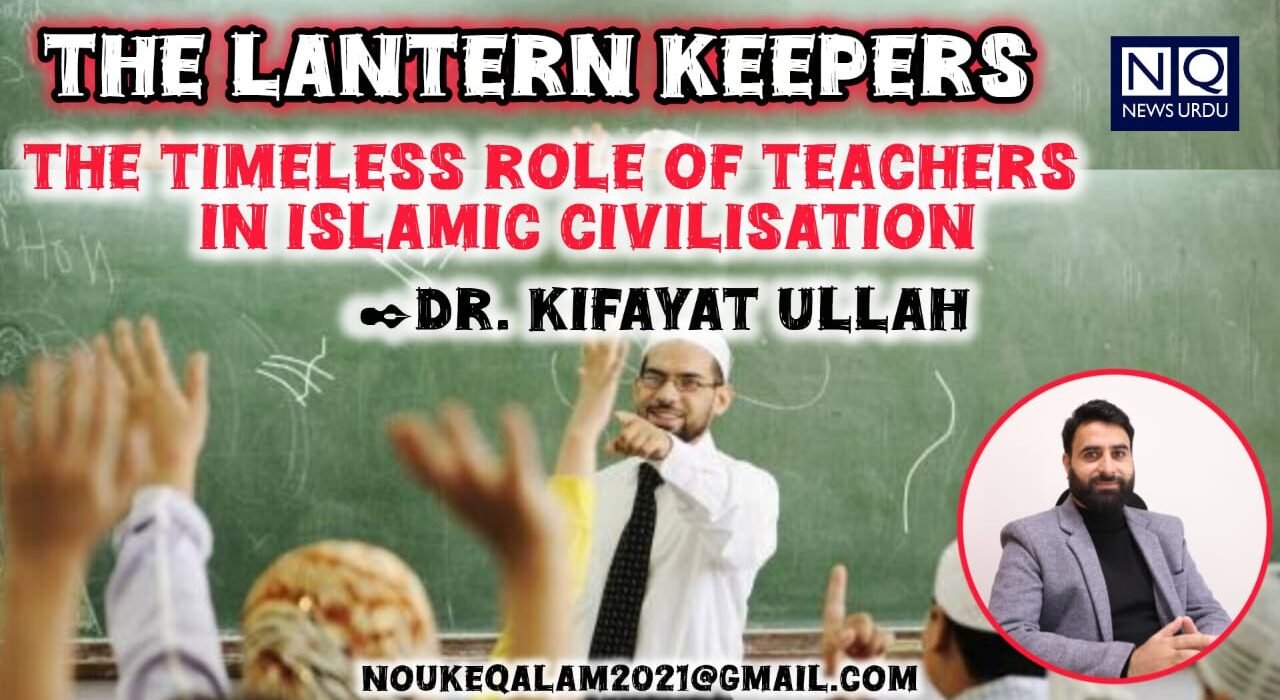
✒️:. Dr. Kifayat Ullah
When the first word “Iqra” echoed through the Cave of Hira, it didn’t just mark the birth of an ideology—it ignited a civilisation built on learning. From that moment onward, knowledge was no longer a luxury or a symbol of power. It became a divine calling. And those who carried its flame—the teachers—became the quiet architects of the Muslim world.
Their story stretches across centuries, through dusty desert circles and magnificent libraries, through the humble voices of village imams and the brilliant minds of scholars whose works shaped the course of humanity. This is the story of the teacher in Islam—the lantern keeper of hearts and minds.
In Medina’s courtyards, under the soft glow of oil lamps, a small circle of companions sat, their eyes fixed on the man who changed everything. Prophet Muhammad (SAW) wasn’t simply a leader; he (SAW) was a teacher in the truest sense. He (SAW) taught with gentleness, with stories, with questions, with silence. His lessons weren’t confined to parchment—they were etched into moments, glances, acts of kindness.
When he (SAW) said, “Seeking knowledge is an obligation upon every Muslim,” a seed was planted—one that would blossom into the great gardens of Islamic learning. A few generations later, in cities like Baghdad, Cordoba, Cairo, and Nishapur, students gathered around scholars whose names would later glow in history.
Walk into a 10th-century madrasah in Baghdad and you would find: A geometry teacher drawing perfect circles in the sand. A Qur’an instructor guiding young voices in melodic recitation. A philosopher debating ethics with eager pupils. Students copying manuscripts late into the night, their lamps flickering with devotion
These institutions weren’t just schools—they were worlds. Worlds where religion and reason sat side by side, where astronomy was learned with the same seriousness as scripture, and where teachers stood at the centre like sturdy pillars.
Men like Al-Ghazālī, who wrote about the delicate marriage between knowledge and the soul, and Ibn Khaldūn, who saw education as the engine of civilisation itself, gave Islamic pedagogy a depth that would survive centuries.
Muslims saw knowledge as flowing through two great rivers. The first river: revealed knowledge The Qur’an. The Prophet’s teachings. The laws of justice, mercy, humility, and worship. This river purified the heart. The second river: acquired knowledge Medicine to heal. Mathematics to understand the world. Language to communicate. Governance to build justice. This river empowered societies.
A teacher in Islam was expected to drink from both rivers—and help others drink too. They taught the soul and the world, the heart and the mind.
You would find The Qur’an Teacher sitting cross-legged, correcting a young student’s tajweed, smiling at every small improvement. His work wasn’t just teaching words—it was shaping character. In another corner, an Arabic scholar opens doors to classical texts. With each lesson, he gives students the key to centuries of wisdom preserved in a single language. In the golden age, The Scientist or Mathematician stood at the forefront of discovery—studying the stars, medicine, and philosophy. Their classrooms bridged the heavens and the earth. Not every teacher used books. Some taught through companionship (Mentors). They listened, advised, and corrected gently. Their teaching seeped into the heart like quiet rain. Across fields and formats, every teacher carried the same mission: shape minds, shape souls, shape societies.
In the past, students sat in circles. They memorised. Debated. Repeated. Reflected. Lessons were oral, woven into stories, parables, and poetic lines. A teacher wasn’t just an instructor—he was a walking curriculum. And in the present, Blackboards replaced palm leaves. Projectors replaced parchment. Interactive lessons replaced long dictations. Flipped classrooms, games, discussions, and technology now enrich learning. But beneath all these changes, the spirit remains the same: To teach is to touch eternity.
The modern world brings its own challenges. A teacher may pour love and wisdom into a classroom, only to find society pulling students in the opposite direction—media, distractions, peer influences. Some students come without family support, carrying emotional burdens no child should bear. Teachers must hold patience in one hand and perseverance in the other. They also face the pressure to keep upgrading their skills—to stay relevant in a fast-changing world—while still nurturing their own spiritual and moral growth. Yet, the heart of the teacher remains strong. Because they know that one inspired child can change a family, a community, a nation.
In Islam, teachers are not simply people who transfer information. They are sculptors of human beings. They are guardians of ethics. They are guides through confusion. They are the bridges between past wisdom and future hope. Walk through any Muslim community and you’ll hear it spoken with pride: “My teacher changed my life.” Teachers ignite curiosity. They heal wounded confidence. They awaken moral courage. They help students see themselves not as passive learners but as builders of the world.
Islamic education adapts to every place it touches. In Indonesia, teachers blend national curricula with local Islamic traditions. In West Africa, pioneers like Nana Asma’u used poetry to educate women in villages. In the Middle East, modern e-learning is transforming classrooms.
In South Asia, tajweed and literature are taught alongside science and humanities.
The diversity is vast—but the mission is identical. Wherever Islam travelled, teachers went first. Wherever Islam settled, schools rose next. Wherever Muslims lived, learning became a way of life. The story of teachers in Islam is the story of civilisation itself. They are the unseen hands behind flourishing societies, the soft voices that echo across generations, the ones who ignite the lamp of knowledge and pass it from heart to heart.
Centuries may change classrooms, technologies, or methods—but the Islamic vision of the teacher remains timeless: A guide. A nurturer. A moral compass. A seeker. A giver. A lantern keeper.
And as long as teachers continue to carry this lantern—lighting one child, one mind, one heart at a time—the story of Islamic education will continue to shine across the world.
Support Independent and Impartial Journalism
Nouk-e-Qalam News is a free and independent journalistic platform. To maintain our ethical standards and avoid obscene advertisements, we have disabled Google Ads. We now rely on your generous financial support to continue our unbiased reporting. Our Writers and readers are kindly urged to contribute—daily, weekly, or monthly. Thank you for standing with truth.