


✒️:. Adv. Ghazi Rahil Banday
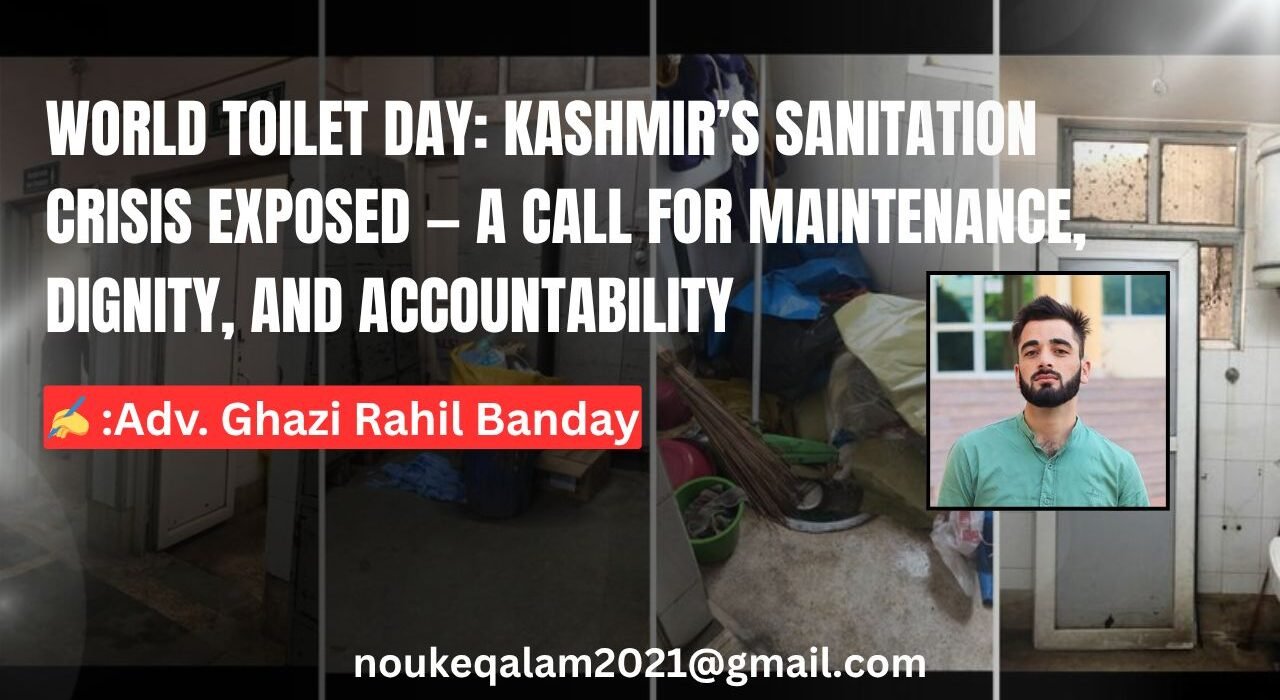
As the world marks World Toilet Day, Kashmir finds itself confronting a sanitation crisis that stretches across hospitals, schools, parks, local trains, markets, shrines, and major public spaces. Toilets — one of the most basic elements of public health and human dignity — remain an unfinished and neglected chapter in the Valley’s development. Despite new construction under different government schemes, the on-ground reality shows that many facilities are unusable due to poor maintenance, weak monitoring, and lack of accountability. What looks successful on paper often fails in practice, leaving residents and visitors without clean and functional toilets.
In hospitals, where sanitation directly affects patient recovery, the situation is deeply concerning. At institutions like SMHS, Lal Ded, GB Pant, and SKIMS Soura, patients and attendants frequently encounter broken commodes, leaking pipelines, non-functional taps, and an alarming absence of running water. Washrooms reek due to irregular cleaning, and overflowing trash bins expose vulnerable patients to infection risks. For new mothers, infants, elderly patients, and those recovering from surgeries, this becomes not just an inconvenience but a direct threat to health. Hospital staff often admit that while infrastructure exists, it remains futile without proper manpower, regular cleaning schedules, and immediate repair mechanisms.
The crisis extends to Kashmir’s schools, where poor sanitation threatens children’s health and educational participation. Many rural schools still lack separate toilets for boys and girls, and in some cases, the only existing toilet remains locked or unusable due to neglected maintenance. Several schools face water shortages, damaged washrooms, no handwashing facilities, and no dustbins. Teachers say that many girl students avoid school during menstruation because the toilets are unsafe or unhygienic. Even urban schools, despite better infrastructure, face high usage and inconsistent cleaning, leaving students to use overburdened toilets. Education experts stress that sanitation is not optional — it is central to learning, attendance, and dignity.
Public parks — intended to be spaces of relaxation — also expose the Valley’s sanitation failures. From the Mughal gardens of Nishat and Shalimar to Iqbal Park, Badamwari, Chinar Bagh, and numerous local parks, visitors regularly find locked, broken, or waterless toilets. Many toilets lack lighting, privacy, or basic cleanliness. Families with children, senior citizens, and tourists often cut their visits short due to the unavailability of usable washrooms. This neglect not only affects locals but also undermines Kashmir’s reputation as a global tourist destination.
The sanitation crisis is equally severe along the Valley’s main railway line. The Baramulla–Banihal train route, used by thousands of commuters daily, suffers from toilets that are not totally working at all. Passengers repeatedly complain that the train washrooms are either completely non-functional or in such poor condition that people avoid using them altogether. Many coaches have toilets with no water, no flush systems, broken fixtures, and no soap. Commuters say the problem is not occasional — it is constant. For students, professionals, patients, and labourers who depend on this daily service, the experience becomes uncomfortable, unhealthy, and undignified. Despite being a lifeline for the Valley, the train system has yet to develop even basic sanitation standards, raising serious questions about maintenance and oversight.
Markets, transportation hubs, and key tourist centres also mirror this neglect. High-footfall areas such as Lal Chowk, Old City bazaars, Batamaloo bus stand, Hazratbal shrine, and major tourist sites like Gulmarg, Pahalgam, and Sonmarg continue to suffer from unhygienic, broken, or inaccessible toilets. While new washrooms have been built under the Swachh Bharat Mission, many remain locked, damaged, or without water. Fixtures are frequently stolen or left unrepaired, and cleaning staff are often absent, resulting in unhygienic conditions that fail both locals and visitors.
Government departments — including SMC, municipal committees, district authorities, and railway officials — highlight various projects aimed at improving sanitation. These include eco-friendly toilets in markets, additional washrooms in hospitals, mobile toilets in busy areas, and new maintenance contracts for parks and tourist routes. However, the real and most critical problem is not construction but maintenance. Toilets are created with enthusiasm but forgotten soon after inauguration. Without daily cleaning, proper staffing, regular water supply, repairs, and strict supervision, these facilities quickly deteriorate and become unusable.
The government must take full responsibility for maintaining every public toilet across Kashmir. This means ensuring daily cleaning, repairing damaged units promptly, guaranteeing water availability, appointing sufficient sanitation workers, and enforcing accountability mechanisms. Maintenance must be treated as a priority — not an afterthought. Without it, even the most well-designed facilities will fail.
As World Toilet Day reminds us, access to clean toilets is a basic human right. For Kashmir, real progress depends on transforming sanitation from a neglected issue into a sustained commitment. Only through proper maintenance, stronger monitoring, and collective responsibility — led firmly by the government — can the Valley ensure hygiene, dignity, and a healthier future for all.
Support Independent and Impartial Journalism
Nouk-e-Qalam News is a free and independent journalistic platform. To maintain our ethical standards and avoid obscene advertisements, we have disabled Google Ads. We now rely on your generous financial support to continue our unbiased reporting. Our Writers and readers are kindly urged to contribute—daily, weekly, or monthly. Thank you for standing with truth.



binance referal code
November 20, 2025I don’t think the title of your article matches the content lol. Just kidding, mainly because I had some doubts after reading the article. https://www.binance.info/en-NG/register?ref=YY80CKRN