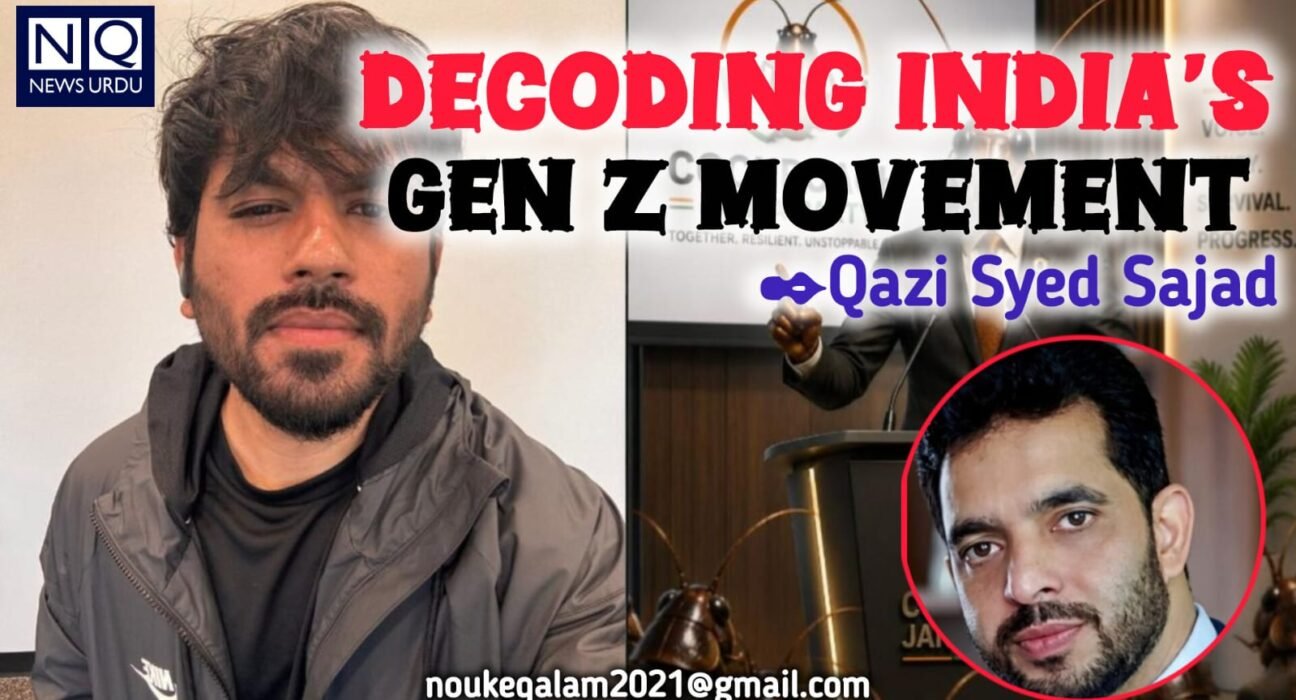
✒️ :. Qazi Syed Sajad
“A successful man is one who can lay a firm foundation with the bricks others have thrown at him.” The famous quote by David Brinkley appears remarkably relevant to the present political tsunami unfolding in India.
Abhijeet Dipke, a journalism postgraduate, seems to have done precisely that. Although the Chief Justice of India later clarified that his statement wherein he has used words like “cockroach” and “lazy” had been misquoted, Abhijeet took those words to heart. In response, he channelled his anger into creating an online platform with the tagline “Cockroach Janta Party.”
What began as a satirical expression of frustration quickly transformed into a social media phenomenon. By 21st May, the platform had reportedly amassed nearly 1 crore 40 lakh followers on Instagram. The extraordinary rise in followers within just five days has surpassed the online popularity of several established political parties in India. Right now when I am writing these, a wave of support for this movement is spreading across digital platforms.
Despite its satirical tone and certain political shortcomings, the movement has succeeded in highlighting several important realities about contemporary Indian youth.
First, the younger generation, especially Gen Z, has started recognising its political power. They no longer want their aspirations and anxieties to go unheard.
Second, this generation feels deeply neglected. Many believe that the current system offers them little hope or security for the future.
Third, they are unwilling to accept the narratives imposed upon them by older generations such as the Baby Boomers and Gen X.
Fourth, many among them feel that the existing political class, largely belonging to “silent generation” neither understands nor adequately represents the needs and aspirations of Gen Z and Generation Alpha.
It is therefore becoming increasingly clear that this generation is a force to reckon with. Contrary to the long-held belief that young people are politically indifferent, the post-2005 generation appears highly conscious and politically aware. They possess a considerable understanding of constitutional values, institutional functioning, and the division of powers among various organs of government. They openly discuss rights, equality, justice, and representation.
They are disturbed by the growing concentration of wealth in a few hands. They are frustrated by institutions that, in their view, are failing to function effectively. This explains why issues such as the recent NEET paper leak have become rallying points for Cockroach movement.
This generation is educated. Their parents have invested heavily in their education, and many possess professional qualifications and degrees. Yet, despite these credentials, employment opportunities remain scarce. Many feel exploited by corporate sector. They feel economic structures undervalue both their labour and their opinions. They are frequently ridiculed as immature or inexperienced, while their representation within mainstream politics remains minimal. This has created a deep sense of alienation.
It is in this backdrop that the Cockroach Janta Party which I prefer to call “Gen Z movement” is an important political development in India. If this movement continues to grow at its present pace, it could potentially reshape the political landscape of the country. Given India’s size and influence in South Asia, such a movement may eventually inspire similar youth-led assertions across the region.
As a student of political science, I view this development positively. So long as the movement remains disciplined and does not succumb to violence or illegal methods, it deserves to be taken seriously by society, institutions, and the political establishment alike.
Even if political power cannot be handed over to this tender generation, their aspirations and demands must at least be acknowledged and addressed. After all, Millennials and Gen Z together constitute nearly 47% of India’s population. A generation that proudly and ironically calls itself “lazy cockroaches” can no longer be ignored.
They are the future of India, so they must be allowed to make their future bright.
Support Independent and Impartial Journalism
Nouk-e-Qalam News is a free and independent journalistic platform. To maintain our ethical standards and avoid obscene advertisements, we have disabled Google Ads. We now rely on your generous financial support to continue our unbiased reporting. Our Writers and readers are kindly urged to contribute—daily, weekly, or monthly. Thank you for standing with truth.