


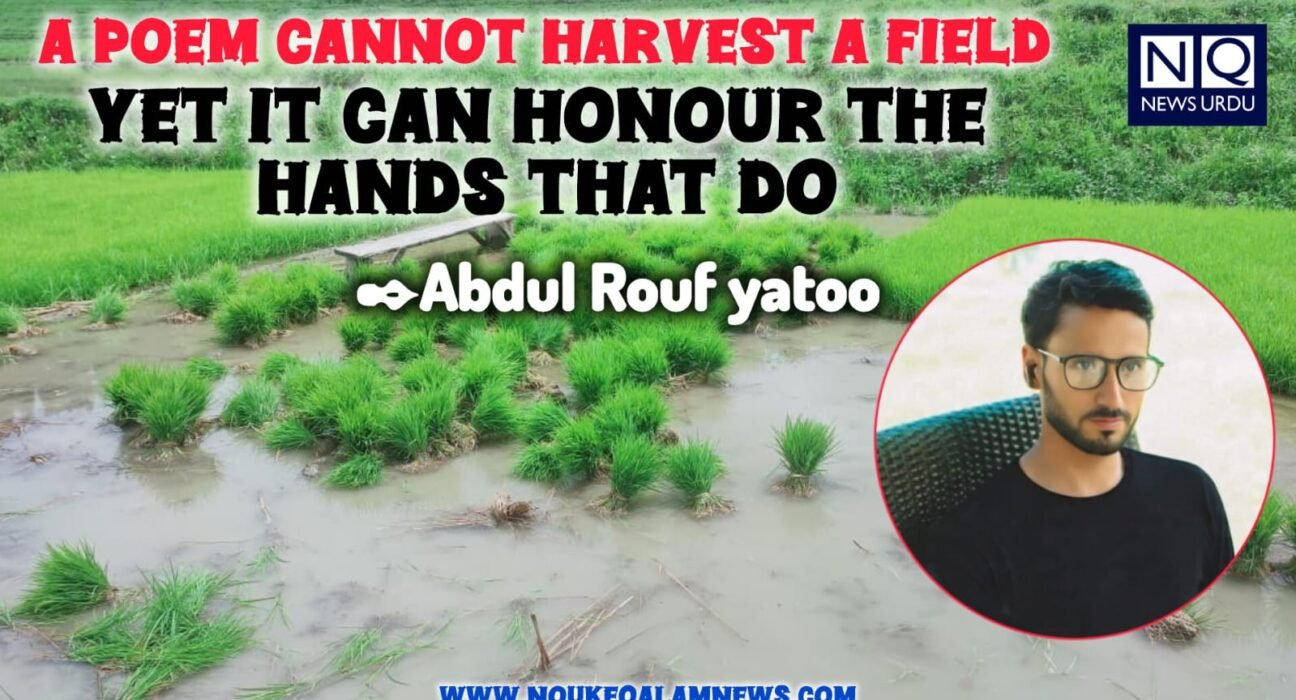
✒️ :. Abdul Rouf yatoo
When we were children, most of us looked at work as a burden. Whether it was cultivation, apple-picking, harvesting, or helping at home, everything felt exhausting. We tried to avoid it whenever we could.
But as I grew older and passed through literature, something within me changed.
When I read the georgic poets like Robert Frost, Virgil, William Wordsworth, John Clare, and Thomas Hardy labour no longer appeared harsh to me. Through Frost’s After Apple-Picking and Mending Wall, through Virgil’s reflections upon cultivation and seasons, through Wordsworth’s shepherds and lonely village paths, i began to feel that rural life possessed a strange beauty and dignity of its own.
I no longer felt as though I was merely working in orchards or fields. It began to feel as though I was living inside those poems. These poems had changed the lens of my perception. The work in the fields carries meaning, peace, and even beauty. It has shed the burden from ordinary life by giving it depth.
Yet alongside this beauty, there is also a painful reality within our society.
Many of us are educated. We peak of progress, yet we increasingly distance ourselves from labour. Thinkers like Ralph Waldo Emerson spoke of self-reliance and trusting one’s own effort. Leo Tolstoy believed that even educated people should work with their own hands and live simply. Henry David Thoreau wrote about self-sufficiency and closeness to nature in Walden.
Yet despite reading such ideas, our society often moves in the opposite direction.
During winters, many spend months indoors doing little beyond eating, sleeping, and passing time, while our orchards, fields, and cultivation increasingly depend upon labourers from outside Kashmir. People have begun to feel ashamed of manual work, as though dignity lies only in avoiding it. Working with one’s own hands is quietly looked down upon, not because the work lacks honour, but because society has attached a false sense of inferiority to it.
Meanwhile, thousands of workers from Bihar and West Bengal travel to Kashmir every year for apple-picking, cultivation, construction, and other labour. Much of Kashmir’s seasonal economy now depends upon them. But at the same time, it forces us to ask ourselves an uncomfortable question.
how did we become strangers to the very labour that once defined village life?
Perhaps the real tragedy is not economic, but psychological. We have slowly disconnected ourselves from the soil, from labour, and from the dignity of self-reliance.
And perhaps that is why literature matters so deeply. It reminds us that there is nothing small about honest work. Sometimes a poem can do what society cannot it can make a man fall in love with the very life he once wished to escape.
Support Independent and Impartial Journalism
Nouk-e-Qalam News is a free and independent journalistic platform. To maintain our ethical standards and avoid obscene advertisements, we have disabled Google Ads. We now rely on your generous financial support to continue our unbiased reporting. Our Writers and readers are kindly urged to contribute—daily, weekly, or monthly. Thank you for standing with truth.


