
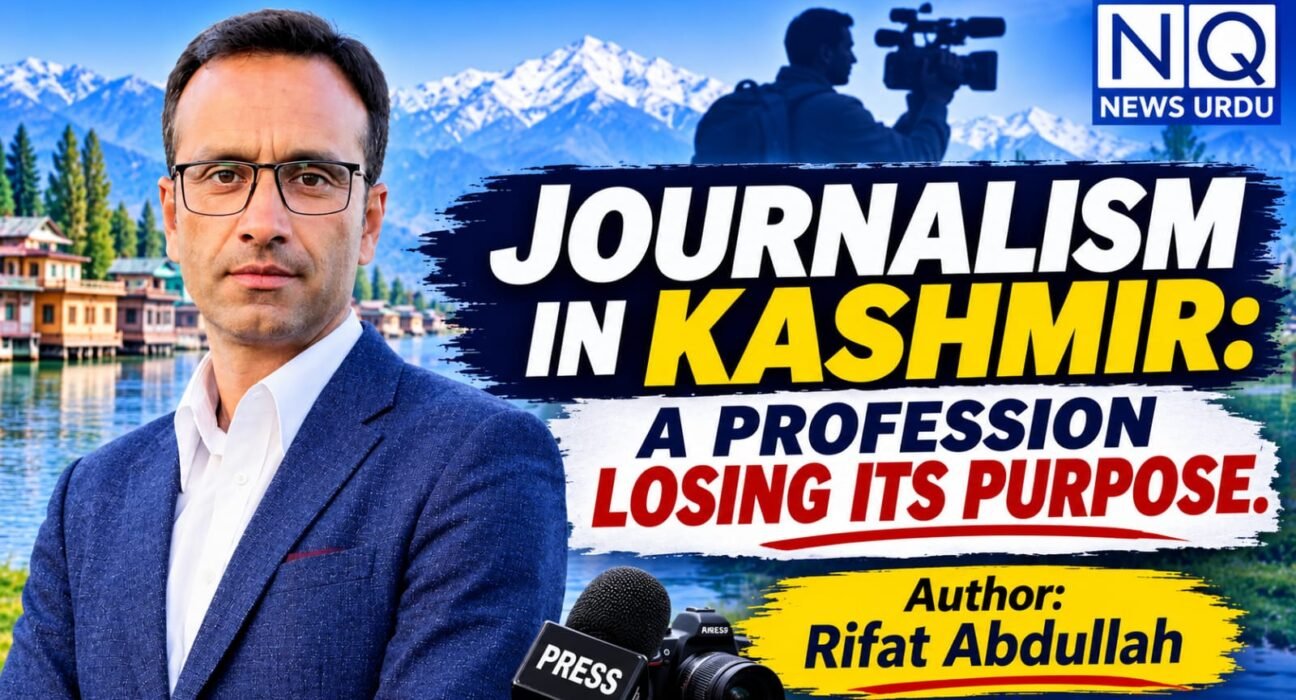
✒️ : Rifat Abdullah
There was a time when journalism was considered a mission, a responsibility and a powerful instrument to speak truth to power. A journalist was expected to be the voice of the voiceless, question authority, expose wrongdoing and bring issues of public importance to the forefront.
Unfortunately,the situation in Kashmir has become increasingly concerning.
Today, it appears that almost every second person has become a journalist. Social media platforms are flooded with self-proclaimed reporters, news pages and so-called media outlets. There is nothing wrong with new people entering journalism, and social media has certainly democratised the flow of information. However, the real concern is the absence of professional standards, journalistic ethics, training, accountability and a sense of responsibility.
The biggest concern is the growing commercialisation of journalism.
Some individuals are simultaneously presenting themselves as reporters while advertising shops, restaurants, hotels, coaching centres, private businesses and commercial establishments. They report on public issues on one hand and promote private businesses on the other, often without distinguishing between independent journalism and paid promotion.
This is not merely a question of personal choice; it raises serious ethical concerns. Journalism must maintain a clear boundary between editorial content and commercial interests. A journalist cannot expect the public to trust independent reporting when the same platform is being used to promote commercial interests without transparency.
Advertising is not wrong. Media organisations need revenue to survive, and journalists deserve to earn their livelihood. But paid advertisements must be clearly identified as advertisements. News reporting must remain independent, impartial and free from commercial influence.
Sadly, the damage is not limited to those who claim to be journalists. Society is equally responsible for the declining standards.
Look at our own viewing habits. How many people genuinely show interest in stories about education, public health, unemployment, environmental degradation, civic problems, corruption, governance and issues affecting ordinary families?
Unfortunately, sensationalism, personal controversies, confrontations, unnecessary arguments and entertainment-oriented content often attract far more attention than meaningful journalism.
A journalist who raises serious public issues may struggle to find an audience, while an individual creating sensational content can attract thousands of views within hours.
We cannot demand responsible journalism while rewarding irresponsible content with our views, likes, shares and subscriptions.
The audience shapes the media landscape as much as the media shapes public opinion.
If we continue rewarding sensationalism, sensationalism will continue to dominate. If we value responsible reporting, meaningful journalism will have a better chance of surviving.
Kashmir needs journalism that investigates rather than promotes, questions rather than flatters, informs rather than manipulates, and exposes public-interest issues rather than chasing popularity.
We need journalists who have the courage to question those in power, regardless of their position or influence. We need reporters who give space to the struggles of ordinary people, highlight the problems of remote villages, investigate administrative failures and bring neglected issues to the attention of policymakers.
We also need to understand that holding a microphone, operating a camera, running a Facebook page or uploading videos does not automatically make someone a journalist.
Journalism is not about having a microphone in your hand; it is about having integrity in your work.
A journalist’s credibility is his or her biggest asset. Once credibility is compromised, even the truth becomes difficult for people to believe.
It is equally important that genuine journalists, media organisations and professional bodies reflect on the situation and work towards restoring public confidence. Professional training, ethical guidelines, fact-checking, transparency in commercial arrangements and accountability should be non-negotiable.
Let us not confuse popularity with credibility, visibility with professionalism, or commercial promotion with journalism.
Kashmir does not need more people simply calling themselves journalists. It needs more people who understand the responsibility that comes with this profession.
Because when journalism loses its credibility, society loses one of its most important instruments of accountability.
And perhaps the most important question we all need to ask ourselves is:
Are we consuming journalism that informs and empowers us, or content that merely entertains and distracts us?
The future of journalism in Kashmir depends not only on those behind the camera but also on those sitting in front of the screen.
Rifat Abdullah is a prominent journalist and political analyst from Jammu and Kashmir.
Support Independent and Impartial Journalism
Nouk-e-Qalam News is a free and independent journalistic platform. To maintain our ethical standards and avoid obscene advertisements, we have disabled Google Ads. We now rely on your generous financial support to continue our unbiased reporting. Our Writers and readers are kindly urged to contribute—daily, weekly, or monthly. Thank you for standing with truth.