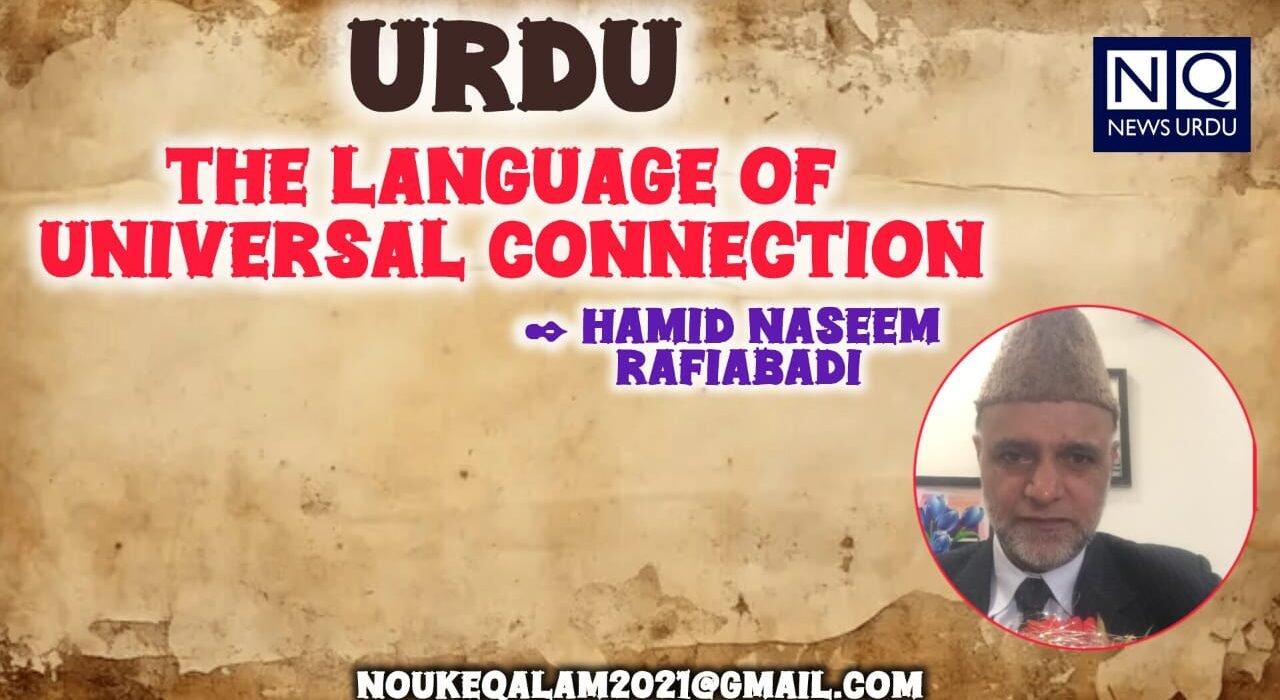
✒️ :. Hamid Naseem Rafiabadi
At the centenary celebrations of the historic seminary Darul Uloom Deoband, the late Prime Minister Indira Gandhi made a striking observation: “The Mughals have given India two enduring gifts—Urdu and the Taj Mahal.” This statement, though simple in its phrasing, carries profound civilizational meaning. It places Urdu alongside the Taj Mahal—a timeless symbol of beauty, harmony, and artistic excellence—and suggests that Urdu, like the Taj Mahal, is not merely a historical artifact but a living embodiment of India’s composite culture.
To understand Urdu in this light is to move beyond narrow definitions. Urdu is not a “local language” confined to a region or a community; rather, it is a global cultural platform, a linguistic bridge that has connected civilizations, facilitated intellectual exchange, and nurtured a shared aesthetic sensibility across centuries. Its story is not just linguistic—it is civilizational.
The Birth Of Urdu| A Language of Encounter, Synthesis: Urdu emerged not through royal decree or artificial construction, but through organic interaction. As Maulvi Abdul Haq famously argued, languages are born out of human need, cultural contact, and social evolution. In the bustling marketplaces, military camps, and urban centers of medieval India, diverse communities—speaking local Prakrits, Khari Boli, Persian, Arabic, and Turkish—interacted daily. Out of this interaction arose a new linguistic form: flexible, inclusive, and expressive. The contribution of Amir Khusrau is often highlighted in this early phase. His blending of Persian and Hindavi poetic forms created a linguistic aesthetic that would later mature into Urdu. What is crucial here is that Urdu was never imposed; it evolved as a shared medium of communication. It belonged to everyone who spoke it.
Thus, from its inception, Urdu carried within it the DNA of plurality. It absorbed vocabulary from Arabic and Persian, borrowed syntax and idioms from local dialects, and developed a literary style that could accommodate both mysticism and everyday life. This capacity for synthesis is what made Urdu a civilizational language rather than a mere linguistic tool.
Sweetness, Elegance, Cultural Refinement: One of the most celebrated qualities of Urdu is its sweetness—its sheerini and nazakat. Poets across generations have expressed their love for its musicality and emotional depth. Daagh Dehlvi famously declared:
“Urdu hai jiska naam hamein jaante hain Daagh,
Saare jahan mein dhoom hamari zubaan ki hai.”
This sweetness is not superficial; it reflects a deeper cultural refinement. Urdu is a language where etiquette (tehzeeb) is embedded in expression, where even disagreement can be articulated with grace. As Rasheed Ahmad Siddiqui observed, Urdu is essentially the “soul of Indian culture.” Its survival, therefore, is tied to the survival of a shared civilizational ethos. The poetic imagination of Munawwar Rana captures this beautifully:
“Abhi tehzeeb ka chashma labalab chhalakta hai,
Ke jab tak shehar mein Urdu bolne wale zinda hain.”
Here, Urdu is not just a language—it is the flowing spring of culture itself. Urdu as the Language of Love and Human Connection. Urdu has often been called the “language of love,” and not without reason. Its structure allows for subtlety, its vocabulary for emotional nuance, and its rhythm for lyrical expression. Iftikhar Arif captures this sentiment:
“Meri khush qismati hai main Urdu bolta hoon,
Mohabbat ki zubaan hai, main jadoo bolta hoon.”
This association with love is not limited to romantic expression; it extends to a broader humanism. Urdu has historically served as a medium through which people of different faiths and backgrounds communicated, collaborated, and coexisted. It softened boundaries and created shared spaces of dialogue. In this sense, Urdu functioned as a social adhesive—binding communities together without erasing their distinct identities. It allowed diversity to flourish within unity, making it a powerful instrument of cultural integration in the Indian subcontinent and beyond.
Intellectual, Literary Zenith| Ghalib, Iqbal: The intellectual maturity of Urdu reached new heights with figures like Mirza Ghalib and Muhammad Iqbal. Ghalib revolutionized Urdu prose and poetry by introducing conversational ease and philosophical depth. His letters transformed rigid literary conventions into living dialogue, making Urdu more accessible and dynamic.
Iqbal, on the other hand, elevated Urdu into a vehicle of philosophical and spiritual reflection. His poetry addressed universal questions of selfhood, destiny, and divine purpose. His famous line:
“Gesu-e-Urdu abhi muntazir-e-shana hai”
Suggests that Urdu still possesses untapped potential—that it is capable of becoming a global language of knowledge and thought if nurtured properly.
Together, Ghalib and Iqbal demonstrate that Urdu is not merely ornamental; it is intellectually robust, capable of engaging with the deepest questions of existence.
Urdu And The Freedom Struggle: Urdu played a significant role in the political awakening of the subcontinent. Leaders like Abul Kalam Azad used Urdu journalism to mobilize public opinion against colonial rule. His journal Al-Hilal combined religious insight with political critique, reaching a wide audience and inspiring resistance. Similarly, Sir Syed Ahmad Khan recognized the importance of Urdu in shaping collective identity. During the Hindi-Urdu controversy of 1867, he warned that linguistic divisions could lead to deeper communal fractures—a warning that history would later validate during the Partition of India. Urdu, therefore, was not just a cultural medium; it was also a political force—a language through which ideas of freedom, reform, and unity were articulated.
“Urdu is a vital “civilizational archive” and a monument to cultural harmony, akin to the Taj Mahal. Beyond its history, it remains a crucial bridge for coexistence and creativity that must be actively preserved to protect our collective identity.”
Urdu As A Global Platform: Contrary to the perception of Urdu as a regional language, its influence extends far beyond South Asia. Urdu literature is read and appreciated in the Middle East, Central Asia, Europe, and North America. Its poetic traditions have inspired translations and adaptations in multiple languages. Moreover, Urdu has served as a bridge between Islamic and Indian intellectual traditions. Scholars used it to translate religious texts, scientific works, and philosophical treatises, making knowledge accessible to wider audiences. Institutions like Osmania University demonstrated that Urdu could function as a medium for higher education in science, law, and medicine. In this sense, Urdu is not confined by geography; it is a transnational cultural resource.
Beyond Communalism|Urdu as Shared Heritage: One of the greatest tragedies of modern times has been the communalization of Urdu. To associate it exclusively with a particular religious community is to misunderstand its history. Urdu was shaped by Hindus, Muslims, Sikhs, and others alike. Its literary canon includes contributions from diverse voices, reflecting a shared cultural inheritance. As Maulvi Abdul Haq emphasized, Urdu belongs to the entire nation, not to any single group. To view it through a communal lens is to diminish its universal character. Urdu embodies the ethos of the Indian subcontinent—its plurality, its adaptability, and its capacity for coexistence. It is a language that does not divide; it connects.
Contemporary Challenges And The Kashmiri Context: Despite its rich heritage, Urdu today faces significant challenges. In regions like Kashmir, where it once flourished as a language of administration and culture, its presence is gradually diminishing. The dominance of English in education and public discourse has marginalized Urdu, even among those who traditionally upheld it. This decline is not merely linguistic; it represents a weakening of cultural continuity. As Saadat Hasan Manto observed, languages are not created artificially—they grow organically. But they can also fade if neglected.
Efforts by local literary groups and forums offer some hope, but sustained commitment is needed to revive Urdu in both formal and informal spaces.
The Role of Scholars, Religious Tradition: Urdu’s association with Islamic scholarship has further enriched its intellectual depth. The first Urdu translation of the Qur’an by Shah Abdul Qadir Dehlavi made religious knowledge accessible to the masses. Later scholars like Abul Hasan Ali Nadwi emphasized Urdu’s role as a repository of Islamic learning. Nadwi famously stated that after Arabic, Urdu is perhaps the most capable language for expressing Islamic thought. This underscores its importance not just as a cultural medium but as an intellectual one.
The Crisis of Script, Identity: One of the pressing concerns today is the shift toward Roman Urdu and the neglect of the traditional script. Scholars like Gopi Chand Narang have warned that changing the script risks severing the connection with centuries of literary heritage. Language is not just about words; it is about memory. The script carries within it the history of a civilization. To abandon it is to lose access to a vast intellectual treasure.
Conclusion: Urdu As Past, Present, Future: Urdu is not merely a language—it is a civilizational archive, a cultural bridge, and a living tradition. From its humble beginnings in the streets of medieval India to its status as a global literary medium, Urdu has consistently served as a connector—between people, ideas, and cultures. Indira Gandhi’s comparison of Urdu with the Taj Mahal is therefore deeply symbolic. Just as the Taj Mahal stands as a monument of aesthetic harmony, Urdu stands as a monument of cultural harmony. Both are reminders of what the subcontinent can achieve when diversity is embraced rather than feared.
The future of Urdu depends on our willingness to recognize its value—not as a relic of the past, but as a resource for the future. It must be taught, spoken, and celebrated. More importantly, it must be understood in its true spirit: as a language that transcends boundaries and unites hearts. To lose Urdu would be to lose a part of ourselves. To preserve it is to preserve a legacy of coexistence, creativity, and collective wisdom.
(The author a veteran academician is a former Professor and Head Department of Islamic Studies, Kashmir University.
hamidnaseem@gmail.com
Courtesy :. Kashmir Horizon
Support Independent and Impartial Journalism
Nouk-e-Qalam News is a free and independent journalistic platform. To maintain our ethical standards and avoid obscene advertisements, we have disabled Google Ads. We now rely on your generous financial support to continue our unbiased reporting. Our Writers and readers are kindly urged to contribute—daily, weekly, or monthly. Thank you for standing with truth.