✒️ :. Shahid Manzoor Bhat
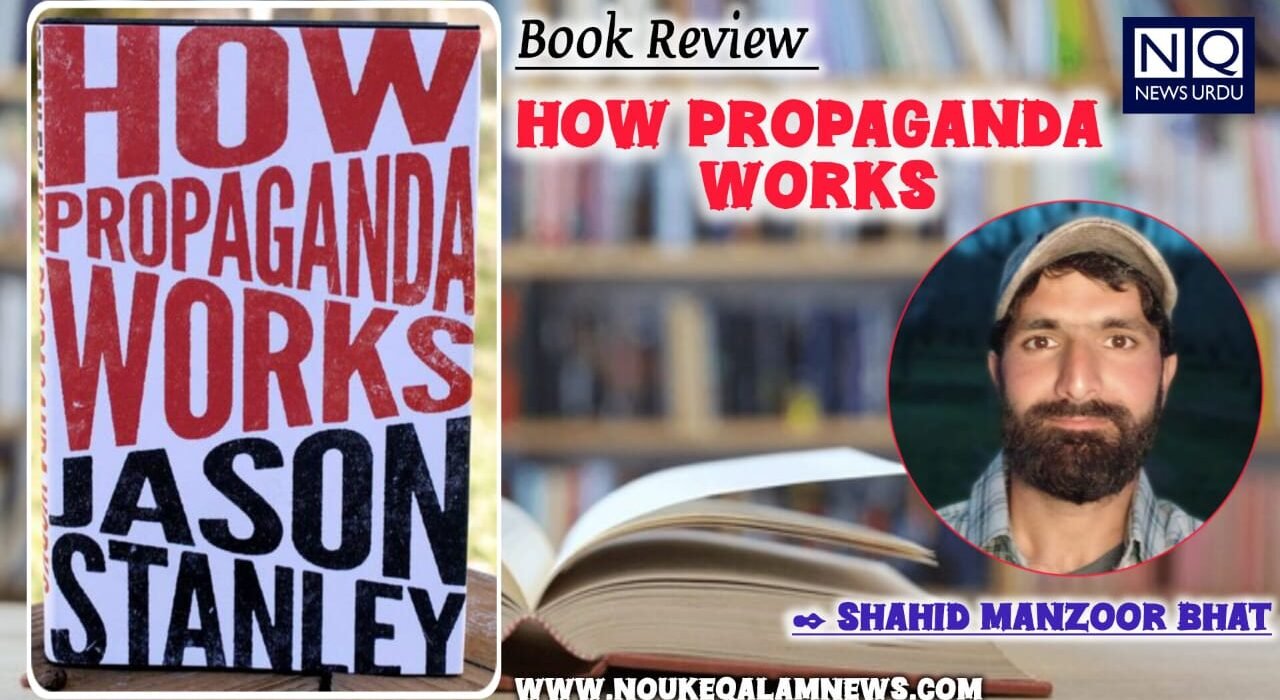
Few books written in the last decade feel as urgently relevant today as How Propaganda Works. Published in 2015, before many of the political shocks that reshaped the world in the late 2010s and early 2020s, Jason Stanley’s work now reads almost prophetic. From misinformation on social media to rising polarization, culture wars, manipulated nationalism, online hate campaigns, and the weakening of democratic trust across countries, the book explains not only what propaganda is, but how ordinary societies slowly begin to accept it as normal.
What makes this book especially powerful is that Stanley does not treat propaganda as something used only by dictators or extremist regimes. Instead, he argues that propaganda can flourish even inside democracies that proudly claim to support freedom, equality, and rational debate. That argument alone makes the book deeply important for modern readers.
At first glance, the word “propaganda” usually brings to mind wartime posters, authoritarian speeches, or state-controlled media. Stanley challenges this narrow understanding. He shows that propaganda often appears in subtle and respectable forms. It can hide behind patriotic language, economic arguments, slogans about security, or even appeals to freedom itself. According to Stanley, propaganda becomes dangerous when democratic ideals are used against democracy.
One of the strongest features of the book is its intellectual seriousness combined with readability. Stanley is a philosopher, yet he avoids overly technical language for much of the discussion. He draws examples from history, politics, race relations, media studies, sociology, and psychology. The result is a book that feels academically rigorous without becoming inaccessible. Even readers without a background in political theory can understand the main arguments if they read carefully.
A particularly fascinating aspect of the book is Stanley’s discussion of language itself. He explains how words are not neutral tools. Political language carries emotional associations, cultural memories, stereotypes, and hidden assumptions. When certain phrases are repeated again and again, they begin shaping how citizens think about entire groups of people. Stanley references the work of Victor Klemperer, who studied Nazi language and observed how propaganda reshaped ordinary thinking through repeated emotional associations.
This insight is extremely relevant today. Around the world, political communication increasingly depends on emotionally loaded terms rather than reasoned debate. Social media platforms reward outrage, fear, and tribal loyalty more than careful discussion. In many countries, immigrants are described using language associated with danger or invasion. Religious minorities are portrayed as threats to national identity. Protesters are labeled enemies. Journalists are called traitors. Intellectuals are mocked as disconnected elites. Even basic humanitarian discussions are often transformed into emotional identity battles.
Stanley’s framework helps explain why this happens. Propaganda works not merely because people are ignorant, but because societies already contain underlying fears, prejudices, and inequalities. Propaganda activates these existing tensions.
Another major strength of the book is its focus on ideology. Stanley argues that propaganda succeeds when societies hold flawed ideological assumptions that people no longer question. This is perhaps the most academically significant contribution of the book. Rather than portraying propaganda as simple lying, Stanley explains that it often depends on partial truths mixed with social myths.
For example, many societies claim to value equality while maintaining systems that deeply privilege some groups over others. When inequalities become normalized, propaganda emerges to justify them. According to Stanley, people may sincerely believe they are defending fairness even while supporting unjust systems.
This argument becomes especially powerful when Stanley discusses race and economic inequality in the United States. He analyzes how scientific language, media narratives, and political messaging were used historically to justify discrimination against Black Americans. He explores examples such as the “super-predator” myth and distorted discussions about crime and drugs. Stanley demonstrates how supposedly objective discussions were often influenced by hidden ideological assumptions.
Although these examples are American, the broader lesson is universal. Nearly every society creates narratives that divide “deserving” and “undeserving” citizens. Sometimes the division is based on race, caste, religion, language, ethnicity, nationality, or class. Propaganda strengthens these divisions by making them appear natural or inevitable.
This becomes highly relevant in the current global climate. Across Europe, right-wing populist movements have gained strength partly through anti-immigrant rhetoric. In parts of Asia, political discourse increasingly frames minorities as demographic or cultural threats. In the Middle East and South Asia, sectarian narratives often dominate public conversations. Online disinformation campaigns manipulate elections and public emotions. Deepfake technology and AI-generated misinformation are creating new challenges for democratic societies.
Stanley’s book helps readers understand that these are not isolated incidents. They are connected through broader mechanisms of political manipulation.
One of the most important ideas in the book is the concept that propaganda can damage democracy without openly attacking democratic values. Instead, propaganda often claims to defend freedom, patriotism, law, order, or tradition. This makes propaganda especially difficult to recognize. When authoritarian ideas present themselves as protectors of democracy, many citizens fail to notice the contradiction.
Recent global events strongly support Stanley’s argument. In many countries, leaders accused independent media of spreading lies while simultaneously spreading misinformation themselves. Political movements claimed to defend “the people” while weakening institutions that protect public accountability. Citizens increasingly trusted emotional narratives over factual evidence.
The rise of algorithm-driven media ecosystems has intensified this problem dramatically. Social media platforms create information bubbles where users mostly encounter views similar to their own. Repetition strengthens belief. Emotional content spreads faster than balanced analysis. Stanley’s work becomes even more valuable in understanding this environment because he emphasizes that propaganda is deeply connected to emotion, identity, and belonging—not just factual accuracy.
Another academically impressive feature of the book is Stanley’s interdisciplinary approach. He draws from philosophy, cognitive science, sociology, linguistics, and political theory. This gives the book unusual depth. Rather than offering simplistic political commentary, Stanley builds a systematic theory of propaganda.
His philosophical background is especially visible in the way he analyzes knowledge and belief. He explores how inequality affects people’s ability to participate equally in democratic discussion. Those with social power often control which voices are considered credible. Meanwhile, marginalized groups struggle to have their experiences recognized as valid knowledge.
This idea resonates strongly today. Around the world, marginalized communities frequently complain that their concerns are dismissed until crises become unavoidable. Climate activists warned for decades about environmental collapse before governments responded seriously. Minority communities often report discrimination long before institutions acknowledge systemic problems. Stanley’s work explains how propaganda and ideology contribute to these patterns.
The book is also admirable because it avoids simplistic moral division. Stanley does not portray propaganda as something created only by evil individuals. He repeatedly emphasizes that well-meaning people can unknowingly spread propaganda when they are shaped by flawed ideological systems.
This nuance is intellectually honest and important. In polarized times, people often assume propaganda exists only on the opposing side. Stanley instead encourages readers to critically examine the assumptions within their own societies and belief systems. This makes the book more credible and philosophically mature.
At the same time, the book is not perfect. Some readers may feel that Stanley focuses too heavily on examples from the United States. Although the theoretical framework is universal, the case studies are largely American. Readers from Asia, Africa, or Latin America may wish for more global examples.
Additionally, certain chapters become philosophically dense. Readers unfamiliar with political philosophy or epistemology may occasionally struggle with the theoretical discussions. However, this difficulty is understandable because Stanley is attempting something ambitious: combining academic philosophy with real-world political analysis.
Another possible criticism is that the book sometimes emphasizes ideological manipulation more than individual responsibility. While propaganda certainly shapes public thinking, citizens are not completely powerless. Some readers may feel the book could place greater emphasis on civic education, media literacy, and individual critical thinking as solutions.
Still, these criticisms are relatively minor compared to the book’s achievements.
What ultimately makes How Propaganda Works so valuable is its timeliness. The book feels more important today than when it was first published. Modern societies face an unprecedented information crisis. Artificial intelligence can generate convincing fake videos and articles. Social media influencers shape political opinions more than traditional institutions. Conspiracy theories spread globally within hours. Political polarization has weakened trust in expertise, journalism, and even democratic procedures themselves.
In such an environment, Stanley’s central warning becomes deeply significant: democracy cannot survive if citizens lose the ability to engage in honest public reasoning.
The book therefore serves not only as an academic study, but also as a civic warning. It reminds readers that democracy depends on shared standards of truth, empathy, and rational discussion. When language becomes dominated by manipulation, fear, and dehumanization, democratic culture begins to erode from within.
Perhaps the most remarkable aspect of Stanley’s work is that it encourages vigilance without promoting hopelessness. The book does not claim democracy is doomed. Instead, it argues that understanding propaganda is the first step toward resisting it. Citizens must learn to question emotionally manipulative rhetoric, examine hidden assumptions, and recognize when political language is being used to divide rather than inform.
This message is especially important for younger generations growing up in digital media environments saturated with competing narratives. The ability to critically analyze information is no longer just an academic skill; it is becoming a democratic necessity.
Academically speaking, How Propaganda Works deserves recognition as one of the most significant works of political philosophy in the 21st century. It successfully bridges theory and reality. It explains abstract philosophical ideas through concrete political examples. It revives classical concerns about rhetoric, democracy, and public reasoning while connecting them to modern technological and political conditions.
For ordinary readers, the book offers something equally valuable: a framework for understanding why public discourse around the world feels increasingly hostile, polarized, and emotionally exhausting.
In conclusion, Jason Stanley’s How Propaganda Works is a brilliant, unsettling, and urgently necessary book. It combines philosophical depth with political relevance in a way few modern works achieve. The book explains how propaganda operates not only through lies, but through emotional manipulation, ideological assumptions, and the corruption of democratic language itself.
In today’s global environment—marked by misinformation, political extremism, digital manipulation, rising authoritarian tendencies, and growing distrust between communities—the book feels indispensable. It challenges readers to think more critically about political language, media narratives, and their own assumptions. Most importantly, it reminds us that democracy is not sustained merely by elections or constitutions, but by a culture of honest communication and intellectual responsibility.
For students, educators, journalists, policymakers, and ordinary citizens alike, this book is not merely worth reading—it is essential reading for understanding the modern world.
Support Independent and Impartial Journalism
Nouk-e-Qalam News is a free and independent journalistic platform. To maintain our ethical standards and avoid obscene advertisements, we have disabled Google Ads. We now rely on your generous financial support to continue our unbiased reporting. Our Writers and readers are kindly urged to contribute—daily, weekly, or monthly. Thank you for standing with truth.