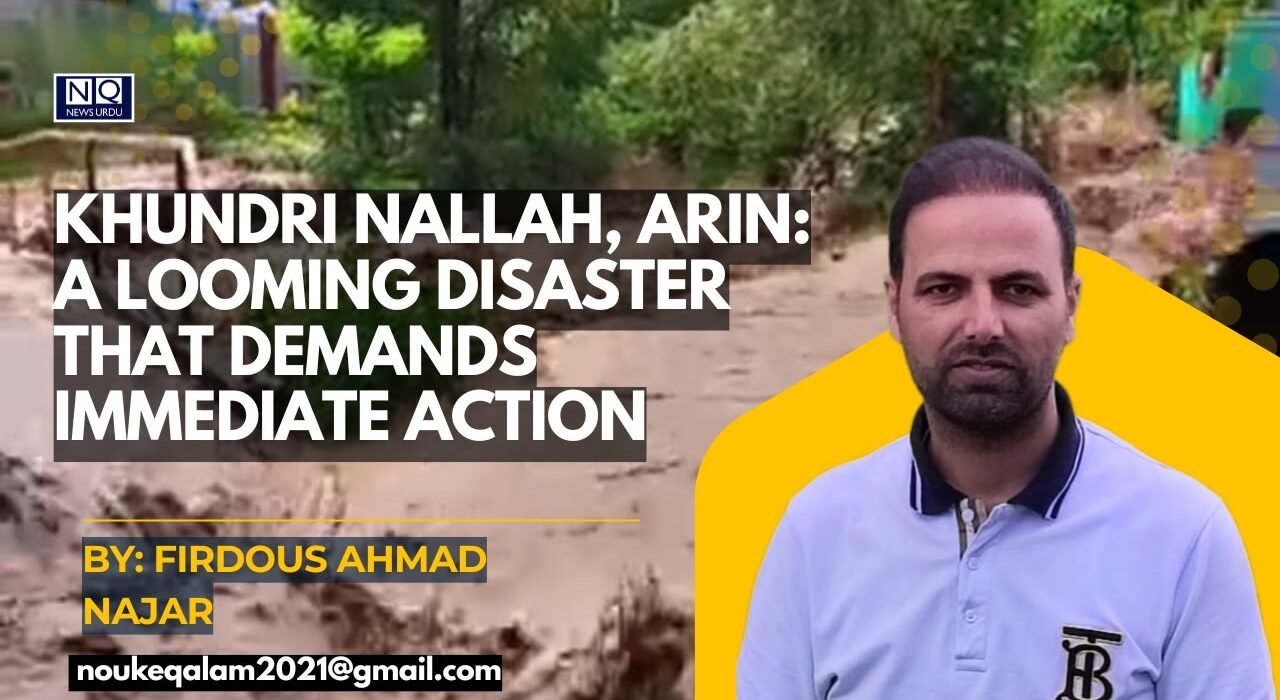
✒️ :. Firdous Ahmad Najar
Arin, Bandipora
Nature has always provided humanity with resources that sustain life, but it has also established boundaries that must never be violated. Rivers, streams and nallahs are not merely channels of flowing water; they are natural floodways designed to carry enormous volumes of water during periods of heavy rainfall. Whenever human greed interferes with these natural systems through encroachment and unplanned construction, nature eventually reclaims its space, often with devastating consequences. The recent flooding of Khundri Nallah at Arin is a timely reminder that ignoring nature’s warnings can prove disastrous.
Khundri Nallah originates from the vast and dense forests of Mava. Numerous mountain streams and brooks emerge from these pristine woodlands, meandering through thick forests before converging at Arin to form the main Khundri Nallah. For generations, this nallah has served as the principal drainage channel for the entire catchment area, carrying rainwater and floodwater safely towards its destination.
The elders of Arin and Dardapora recall that Khundri Nallah once possessed an impressive natural width. Throughout most of its course, it measured more than fifty metres across, while at several locations it exceeded one hundred metres. Such a vast channel was not a coincidence; it was nature’s own engineering, created over centuries to accommodate the enormous discharge caused by cloudbursts and torrential rainfall. Although Khundri Nallah has always been known for sudden and unpredictable floods, its original width enabled it to absorb these powerful floodwaters without posing a significant threat to the lives, homes and agricultural lands of the people residing along its banks.
Unfortunately, this natural balance has been severely disturbed during recent decades. Driven by greed and unchecked encroachments, humans have gradually occupied the very space that once belonged to the nallah. Today, the width of Khundri Nallah has been reduced to nearly ten metres at many places, while in certain stretches it is even narrower. What was once a mighty flood channel has been squeezed into a confined passage incapable of carrying the enormous volumes of water generated during extreme weather events.
Equally concerning is the growing practice of using Khundri Nallah as a dumping site for household and other waste. This not only reduces its flood-carrying capacity but also contaminates its water. The elders recall that the water of Khundri Nallah was once so clean and pure that it was commonly used for cooking and washing. Nowadays, there is no question of using it for either purpose. It has become so contaminated that people do not even feel comfortable putting their feet in it.
The consequences of this reckless interference are now becoming increasingly visible. By reducing the width of the nallah, we have drastically diminished its flood-carrying capacity. Water that once flowed harmlessly within its natural course now spills over its banks, threatening human settlements, schools, roads and agricultural fields. The danger is no longer theoretical; it has become a frightening reality.
Khundri Nallah contains numerous large stones and boulders along its course that significantly reduce its flood-carrying capacity. During periods of heavy flooding, these boulders often obstruct the natural flow of water, forcing it to change its course and overflow into nearby settlements, thereby posing a serious threat to life and property.These boulders can be broken into usable material and utilised in the construction of permanent bunds and protection walls along both banks of the nallah, thereby enhancing its capacity while simultaneously strengthening flood protection measures.
The recent floods in Khundri Nallah, widely reported on social media and in mainstream news outlets, stand as undeniable evidence of this growing threat. The raging waters breached temporary embankments and protective walls, entered numerous houses and educational institutions, and forced several families to abandon their homes and seek refuge in neighbouring houses. Fortunately, the rainfall subsided before the situation escalated further. Had the rain continued for a few more hours, the region could have witnessed a catastrophe involving immense destruction of life and property. This narrow escape should not be viewed as a sign of safety but rather as a final warning from nature.
The responsibility for preventing future disasters does not rest solely with the government. The people of Arin and Dardapora must also acknowledge that illegal encroachments along the banks of Khundri Nallah and its use as a dumping site for waste have significantly contributed to the present crisis. Every encroachment, however small it may appear, reduces the capacity of the nallah to carry floodwaters. Protecting lives and property, therefore, demands collective responsibility. Encroached land must be voluntarily restored wherever possible so that the nallah can regain the space it naturally requires to discharge floodwaters safely.
The administration can no longer afford to remain a silent spectator. Khundri Nallah lacks adequate protection walls and requires urgent dredging along much of its course through Arin and Dardapora. Hundreds of residents, educational institutions, public infrastructure, and agricultural and horticultural lands remain vulnerable to every major spell of rainfall. The District Administration of Bandipora, particularly the Honourable Deputy Commissioner, who has earned appreciation for her dynamic leadership and responsive governance, is earnestly requested to treat this issue as a matter of utmost public importance. A comprehensive scientific survey should be undertaken to identify and remove illegal encroachments, restore the original width of the nallah wherever feasible, carry out scientific dredging, and construct durable embankments and protection walls along both banks at vulnerable stretches. Temporary bunds may provide momentary relief, but they cannot withstand the fury of a major flood. A permanent engineering solution is the need of the hour to safeguard lives, public institutions, and valuable property.
At the same time, the administration should launch a sustained public awareness campaign and strictly enforce the relevant laws against illegal dumping and encroachments. Such measures will help preserve this vital natural watercourse for future generations, enhance its flood-carrying capacity, and significantly reduce the risk of future flood-related disasters.
Climate change has increased the frequency and intensity of extreme weather events across jammu and kashmir. Cloudbursts and unusually heavy rainfall, once considered rare, are becoming increasingly common. Waiting for another devastating flood before taking corrective measures would be both irresponsible and costly. Disaster management begins long before disaster strikes. Every rupee invested today in prevention can save countless lives and crores of rupees in relief and reconstruction tomorrow.
Khundri Nallah is not merely a seasonal stream; it is a powerful natural flood channel that drains the runoff from the vast forests and numerous mountains surrounding Arin and Dardapora. Its history commands respect. Nature has repeatedly demonstrated that it cannot be permanently confined by human encroachment. The choice before us is clear: we can either restore the nallah to its rightful course, strengthen its embankments, and protect our communities, or continue ignoring the warning signs until a future flood results in an irreversible tragedy.
The recent flood should serve as a wake-up call, not only for the administration but also for every resident of Arin and Dardapora. Let this moment become the beginning of collective action rather than another forgotten episode. The time to act is now, before Khundri Nallah writes a far more painful chapter in the history of our region.
The writer can be reached at njfirdous090@gmail.com.
Support Independent and Impartial Journalism
Nouk-e-Qalam News is a free and independent journalistic platform. To maintain our ethical standards and avoid obscene advertisements, we have disabled Google Ads. We now rely on your generous financial support to continue our unbiased reporting. Our Writers and readers are kindly urged to contribute—daily, weekly, or monthly. Thank you for standing with truth.