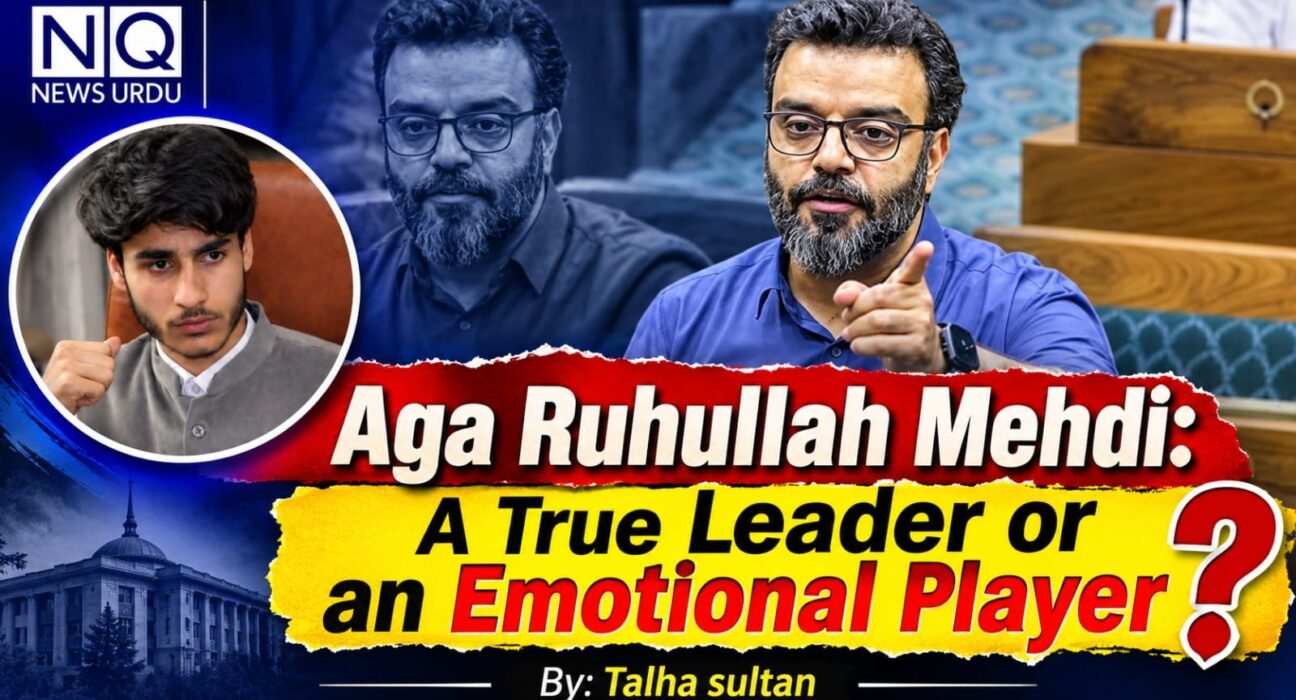
✒️ :. Talha Sultan
Student / social & political activist/ founder TCT
For years, Aga Syed Ruhullah Mehdi remained a relatively low-profile figure within the National Conference. After three terms as MLA from Budgam and a stint as Cabinet Minister, he was not widely known even in large parts of his own constituency. Then, after nearly 16 years inside the party, he began openly attacking it. The shift was sudden. Overnight he became a prominent voice, especially among the youth, by speaking the language of emotion, injustice, and resistance. The question that now hangs over his politics is simple: is this the rise of a true leader, or the calculated performance of an emotional player who knows how to play with public sentiment?
The timing of his break with the National Conference raises serious doubts. For more than a decade and a half he stayed within the party structure, contested elections on its ticket, and held ministerial office. Only when he chose to distance himself did the criticism of the party become sharp and continuous. Was this a principled realisation that arrived after 16 years, or a political move designed to carve out an independent identity and capture the anger that already existed among young people?
His recent resignation has been projected as an act of conscience. He has spoken about Article 370, about young people languishing in jails, and about the long suffering of ordinary Kashmiris. These are real wounds. Yet the same issues existed long before 2026. Tufail Mattoo was killed in 2010. At that time Ruhullah was a Cabinet Minister. Prolonged detentions of young Kashmiris did not begin yesterday. The question is unavoidable: why did these concerns become politically urgent only after he decided to leave the National Conference? Why did 16 years of silence end precisely when an independent political space opened up?
Performance offers another test. In Budgam, the constituency he represented for three terms, development remained slow. Many residents say their MLA was barely visible on the ground. As Srinagar MP, the pattern continued. Data reported in January 2026 showed that of roughly 130 recommended MPLADS works, only about 5.4 per cent were fully completed, and actual spending was a small fraction of the funds available. Later figures showed modest improvement, but the overall completion rate stayed poor. Emotional speeches about injustice lose force when the measurable record of work in one’s own constituency remains weak.
There are also unresolved questions that sit on the public record. In April 2025 the Anti-Corruption Bureau filed a chargesheet in FIR No. 18/2009 against 22 people, including Ruhullah and several relatives, alleging tampering of revenue records in the Rakh-e-Aerth area of Budgam that led to excess compensation of about ₹38.20 lakh. The case had been registered in 2009. Ruhullah has called it vendetta and said he only received a small amount as a legal heir. The matter remains pending in court. Separately, a long-standing discrepancy exists between the 1977 birth year shown in his election affidavits since 2002 and the 1982 date that appears in an RTI response from the Registrar of Births and Deaths, Srinagar, as well as in other official records. None of these points has been finally decided by a court, but they form part of the record that any serious evaluation must consider.
A true leader is tested by consistency, not by the volume of emotional speeches. An emotional player knows when to raise the pitch, which wounds to touch, and when silence is more useful than speech. Aga Ruhullah Mehdi has mastered the second skill. Whether he possesses the first remains an open question that can only be answered by facts, timelines, and performance — not by narrative.
Don’t follow narratives blindly. Seek the truth.
Support Independent and Impartial Journalism
Nouk-e-Qalam News is a free and independent journalistic platform. To maintain our ethical standards and avoid obscene advertisements, we have disabled Google Ads. We now rely on your generous financial support to continue our unbiased reporting. Our Writers and readers are kindly urged to contribute—daily, weekly, or monthly. Thank you for standing with truth.