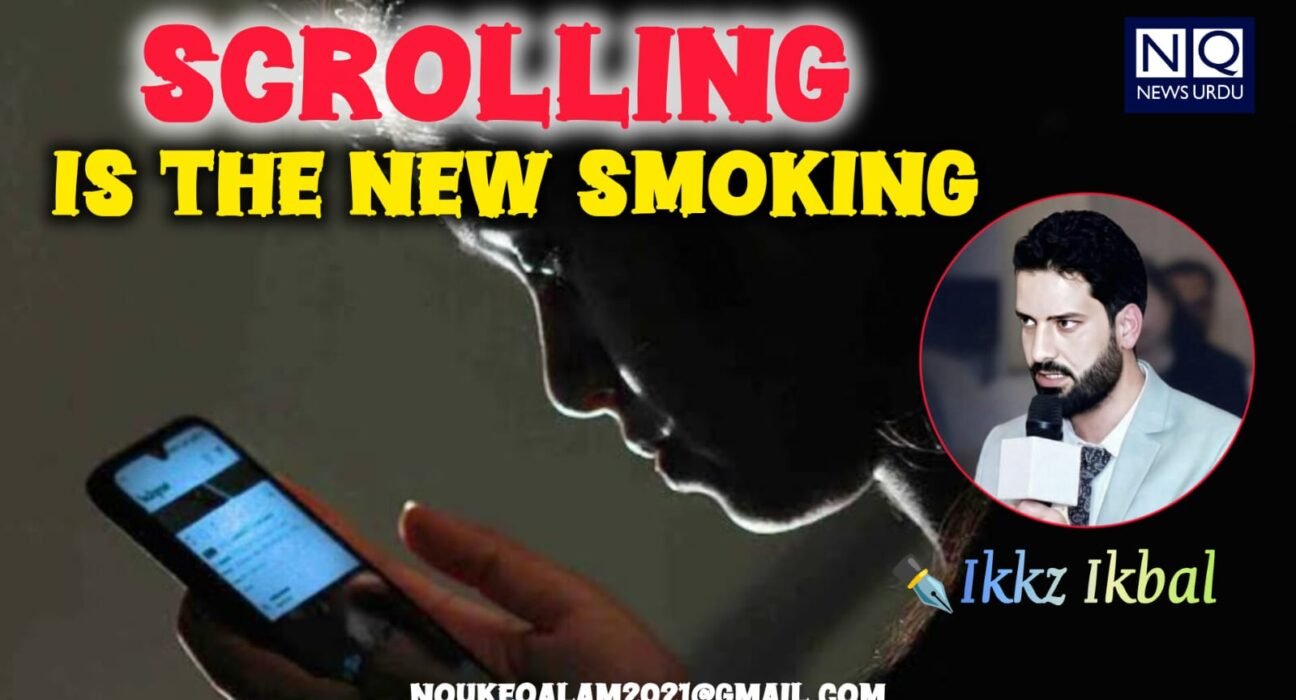
✒️ :. Ikkz Ikbal
There was a time when addiction had a face. You could smell it on a person’s clothes. You could see it in trembling hands. Parents warned their children to stay away from cigarettes, alcohol, and drugs because the danger was visible.
Today, addiction is different. It slips quietly into our hands every morning and rests beside our pillows every night. It arrives without smoke, without smell, and without suspicion. We call it a smartphone. More specifically, we call it scrolling.
Most of us unlock our phones with a purpose. We want to check a message, read an email, or reply to a friend. But somewhere along the way, that purpose quietly disappears. A short visit turns into an endless journey through reels, videos, opinions, advertisements, and carefully crafted distractions.
Before we realize it, half an hour has vanished. Nothing urgent happened. Nothing truly meaningful was accomplished. Yet our minds somehow feel exhausted. That is because modern social media is not simply a platform. It is an attention industry.
Every second you spend online teaches the algorithm something about you. It observes what you watch, how long your eyes stay on a video, what makes you pause, what makes you laugh, what makes you angry, and what keeps you scrolling. The more it learns, the more accurately it predicts what will capture your attention next. In a strange way, we are not only watching our screens. Our screens are watching us.
The greatest change brought by social media is that it has replaced searching with scrolling. Searching begins with intention. You know what you want, and you go looking for it. Scrolling asks for nothing except your time. It makes decisions on your behalf. You watch one video, and twenty more appear before you. You read one opinion, and suddenly you are surrounded by similar voices, louder and more emotional than the last. It is like sitting in a restaurant where invisible waiters keep placing new dishes on your table before you have even decided whether you are hungry.
The problem is not only psychological. It is biological. Scientists have found that unpredictable rewards—likes, comments, notifications, and endless new content—activate the same dopamine pathways involved in gambling and other addictive behaviours. That is why scrolling often feels relaxing in the beginning, irresistible after a while, and mentally draining in the end.
Many teenagers today say they have hundreds of online friends but still feel lonely. Adults complain that they can no longer read a book for twenty uninterrupted minutes. Conversations become shorter. Attention spans shrink. Silence begins to feel uncomfortable. Ironically, we have never been more connected, yet many people have never felt more disconnected from themselves.
This is why scrolling has become the new smoking. Not because the two are identical, but because both became socially acceptable long before society fully understood their consequences. One damaged the lungs. The other quietly consumes attention, patience, peace of mind, and precious hours that never return.
The answer, however, is not to abandon technology. Technology has transformed education, healthcare, business, and communication in remarkable ways. The challenge is not the phone in our pocket but the relationship we build with it.
Perhaps we should treat social media the way responsible people treat a casino.
Go in with a purpose.
Decide beforehand how much time you are willing to spend.
And most importantly, know when to leave.
Small habits can make a surprising difference. Turn off unnecessary notifications. Keep your phone away during meals. Switch the display to greyscale to reduce visual temptation. Leave the device in another room while working or spending time with family.
One simple habit is especially powerful: if you want to use your phone, stand while using it. Standing breaks the comfort of endless scrolling and naturally shortens the time you spend online. These are not acts of rejection. They are acts of self-respect.
In an age where billions of dollars are invested in capturing our attention, protecting that attention becomes an act of freedom. Our minds are not products. Our time is not an unlimited resource.
Every hour spent scrolling is an hour taken from conversations that could have been held, books that could have been read, skills that could have been learned, and memories that could have been created. Every hour spent on aimless scrolling means you have wasted 3600 seconds of your life.
Perhaps the greatest act of rebellion in the digital age is not deleting every app or disconnecting from the world. It is something much simpler.
To pause. To look up. To reclaim our attention. And to remember that life is happening beyond the screen.
Think Responsibly! Act Immediately.
Ikkz Ikbal holds Masters in Biotechnology and is Principal & Academic Head at Maryam Memorial Institute, Pandithpora Qaziabad. He X’s @IkkzIkbal.
Support Independent and Impartial Journalism
Nouk-e-Qalam News is a free and independent journalistic platform. To maintain our ethical standards and avoid obscene advertisements, we have disabled Google Ads. We now rely on your generous financial support to continue our unbiased reporting. Our Writers and readers are kindly urged to contribute—daily, weekly, or monthly. Thank you for standing with truth.