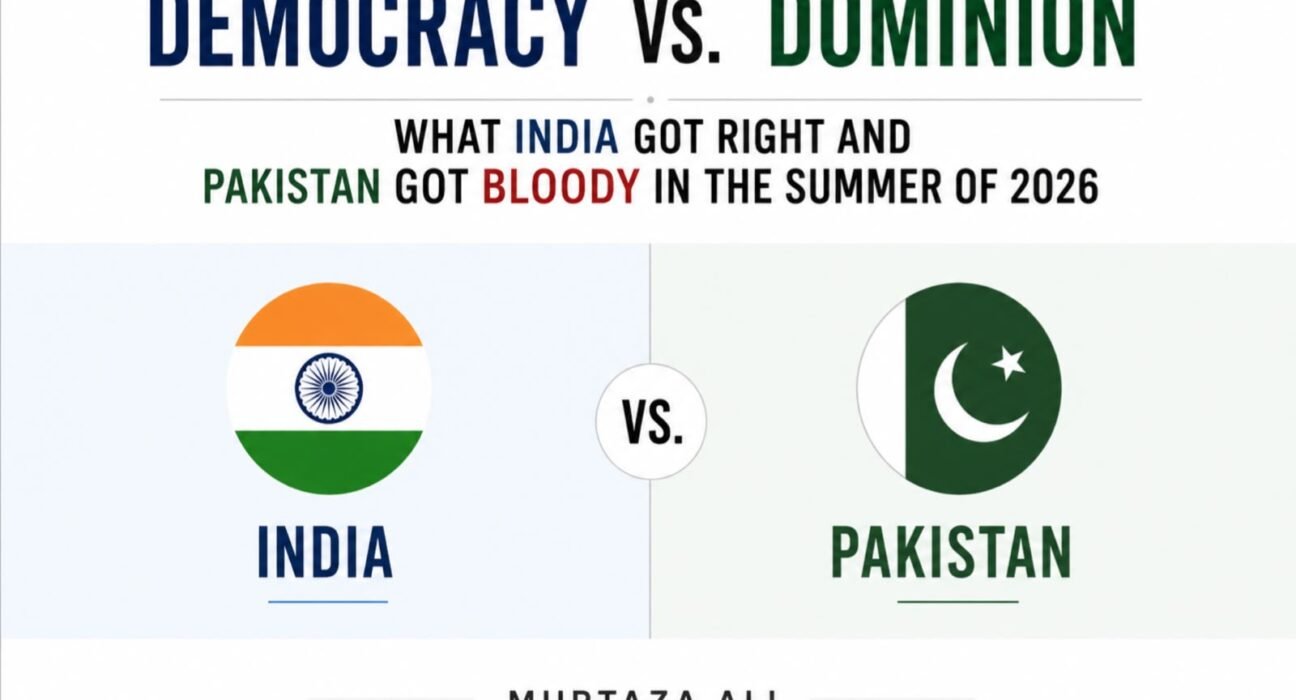
✒️ :. Murtaza ali
Two protests broke out in the same summer, on either side of a militarised border, and together they form the clearest test yet of which state actually treats its people — and the Kashmiris it claims to speak for — as citizens rather than subjects.
In Delhi, thousands of students under the banner of the youth-led Cockroach Janta Party rose against Union Education Minister Dharmendra Pradhan after irregularities compromised the NEET-UG 2026 medical entrance exam. This was not a movement conveniently aimed at an opposition figure to score political points. It targeted a sitting minister from the ruling party itself — the party in power, confronted head-on by its own citizens, with no political cover to hide behind. The protest was loud, sustained, and occupied central public space in the national capital for weeks. Delhi Police did use tear gas at points to manage crowds, a fact that deserves to be stated honestly rather than airbrushed. But the essential test of a democracy is not whether force is ever used — it is whether the system absorbs the shock, listens, and changes course. India’s did. The National Testing Agency cancelled the compromised examination and conducted a re-examination for over two million candidates. A CBI investigation was opened. Talks were held between protest leaders and the government at the Constitution Club. The Leader of the Opposition joined the demonstrators without being arrested, banned, or shot at. And on July 25, the minister resigned, describing his decision as a matter of principle rather than survival, expressing concern that the unrest not be exploited by forces working against India’s interest. Compensation for affected students and the dropping of cases against protesters followed. Whatever one’s view of the government otherwise, the mechanism functioned exactly as a constitutional democracy is meant to: grievance voiced, pressure applied, institutions responded, accountability delivered — all without a single life lost to state violence.
Now cross the Line of Control into the territory Pakistan euphemistically calls “Azad” Jammu and Kashmir — a name that translates to “free” Kashmir, and which the events of this summer have exposed as one of the great cruel ironies of South Asian politics. For nearly two years, the Jammu Kashmir Joint Awami Action Committee, a broad coalition of traders, civil society leaders, and ordinary residents, pursued dialogue with the Pakistani-backed administration over flour subsidies, electricity pricing, and a long trail of broken government promises. This was not a fringe insurgency. It was the same kind of grievance-and-negotiation process that Delhi’s protesters were engaged in — except the response could not have been more different. On June 5, 2026, the administration’s answer to two years of patient civil dialogue was to declare JAAC a proscribed terrorist organisation. Within seventy-two hours, more than a hundred activists were arrested and JAAC’s central office in Muzaffarabad was raided and sealed. A communications blackout was imposed on the region before a shot was even fired, cutting off independent scrutiny at precisely the moment it was most needed.
What followed was not crowd control. It was a massacre by any honest reading of the term. On June 8, as protests over price hikes collided with a PoJK Supreme Court ruling on reserved refugee seats, security forces opened fire on demonstrators in Rawalakot. Between eleven and fifteen civilians were killed within hours, with hundreds more wounded. The killing did not stop there. Pakistan Rangers fired on sit-in protesters near Abbaspur weeks later. Thousands of demonstrators — including women, children, and the elderly — gathered peacefully at a sports stadium demanding basic rights and the release of detained leaders, only to be met with gunfire and shelling. Drones were deployed to surveil the sit-ins. More than six hundred civil-rights activists were detained. A political delegation attempting to visit the region in solidarity was turned back at the boundary by Islamabad’s own administration. And when the long-delayed PoJK legislative elections finally opened on July 27 — elections meant to be the very proof of the “choice” and “representation” Pakistan claims to offer Kashmiris — the day itself was marred by violence. A Pakistan Peoples Party worker was killed in Kotli. Rival parties traded accusations of armed intimidation influencing the vote. Independent reporting recorded dozens killed in the weeks of protest leading up to that single day of polling. Two districts had their elections postponed outright because the state could not guarantee even the pretence of safety.
This is the comparison that should settle any honest conscience. In Delhi, a minister from the ruling party was forced to resign by students holding placards. In Muzaffarabad and Rawalakot, an unelected, establishment-controlled administration met identical economic grievances — bread, electricity, dignity — with a terrorism proscription, a media blackout, and live ammunition against the very Kashmiri population that Pakistan has spent seventy-eight years invoking as its central grievance against India. The same Rangers who fire on demonstrators demanding subsidised flour are wielded by a state that insists to the United Nations it cannot rest until Kashmiris are free. There is no subtler way to say it: Pakistan has turned its own Kashmiris into hostages of a cause it uses against India, while denying those same Kashmiris the resources, the representation, and now the right to protest peacefully on their own soil.
India’s institutions are not flawless, and tear gas on a Delhi street is not nothing. But the difference is not one of degree — it is a difference in kind. One system responds to dissent with resignation and reform. The other responds with proscription and gunfire, even as it uses the word “Kashmiri” as a rhetorical weapon on the world stage.
And it is here that a second, quieter betrayal deserves scrutiny: the role of Pakistan-based Kashmiri figures who have built entire careers amplifying grievances against India while staying conspicuously silent about what happened in Rawalakot and Kotli this summer. Syed Salahuddin, the Muzaffarabad-based chief of Hizbul Mujahideen and the United Jihad Council, has for decades been designated a global terrorist by the United States and named in over fifty cases by Indian investigators, his organisation formed with backing from Pakistan’s Inter-Services Intelligence to wage an armed campaign inside Jammu and Kashmir. Ghulam Muhammad Safi, the Pakistan-based convener of the APHC’s Azad Jammu and Kashmir chapter, spent this same summer touring Karachi, Sindh, and Gilgit-Baltistan, meeting Pakistani ministers and religious bodies, and publicly praising the leadership of Pakistan’s army chief — even as his own organisation’s namesake territory buried its dead and endured a communications blackout barely miles from where he was speaking. Neither man built a career questioning why bread and electricity subsidies in PoJK triggered live fire. Both built careers insisting that self-determination is being denied only east of the Line of Control.
That is the blurred line worth exposing. A movement that claims to speak for “Kashmiri self-determination” cannot credibly do so while its most prominent voices are based in, funded by, and politically aligned with the very establishment now firing on Kashmiris in Rawalakot, banning their civic organisations, and blacking out their communications. The residents of PoJK are increasingly drawing this distinction themselves — the JAAC’s break from two years of managed dialogue into open confrontation in June was itself a sign that ordinary Kashmiris on that side of the line no longer see Islamabad’s proxies as speaking for their interests. It should be acknowledged that Islamabad and figures like Safi dispute this framing entirely, insisting their focus on Indian-administered Kashmir reflects UN resolutions on the territory’s disputed status rather than indifference to PoJK — and that Pakistan’s government maintains it acted against JAAC for security reasons, not suppression. But for the Kashmiris who buried their dead in Rawalakot this June, and for those who could not safely cast a vote in Kotli this July, the line between being used as a cause and being treated as a citizen has never been clearer — nor more starkly drawn. Their own peaceful assertion of that distinction, not any outside call to arms, is the story this summer actually tells.
Disclaimer: The views and opinions expressed in this article are solely those of the author and do not necessarily reflect the views of NQ News.
Support Independent and Impartial Journalism
Nouk-e-Qalam News is a free and independent journalistic platform. To maintain our ethical standards and avoid obscene advertisements, we have disabled Google Ads. We now rely on your generous financial support to continue our unbiased reporting. Our Writers and readers are kindly urged to contribute—daily, weekly, or monthly. Thank you for standing with truth.