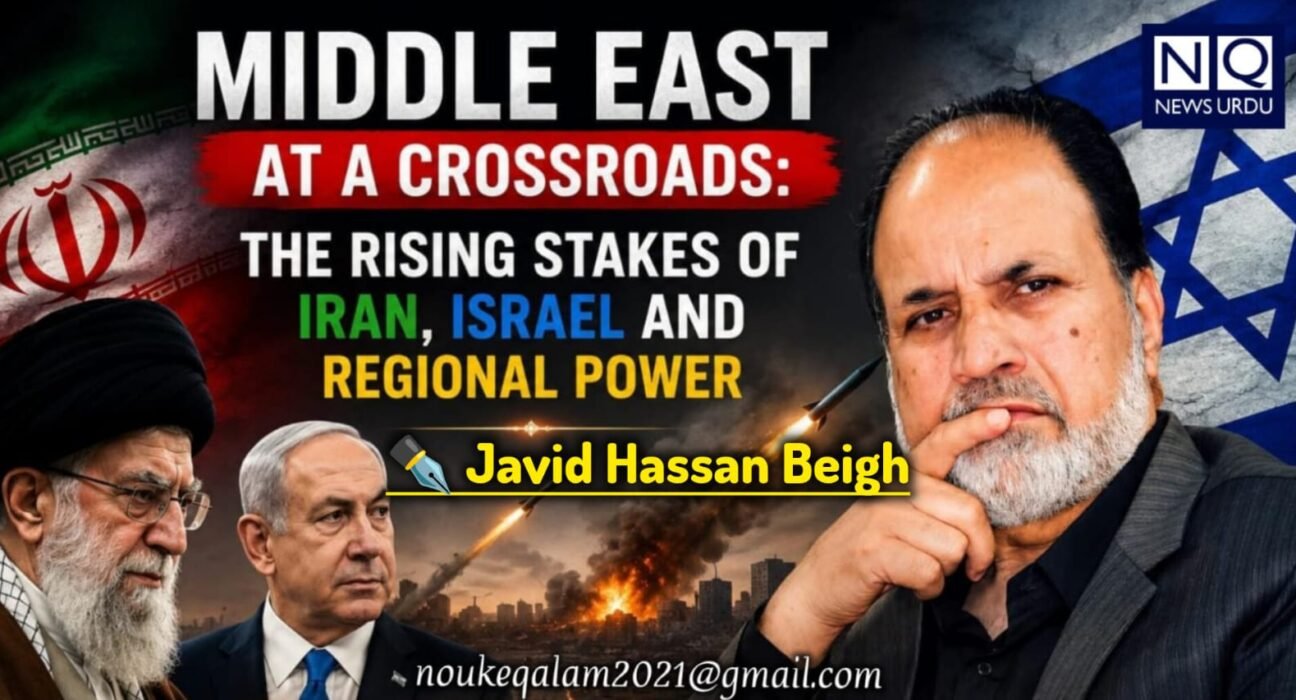
✒️ :. Javid Hassan Beigh
I am not a conflict expert, nor do I pretend to understand every political and military calculation taking place in the world today. These are simply my personal thoughts, based largely on how I see the situation and on what I consider to be common sense. And, unfortunately, common sense seems to be in short supply these days.
I don’t think the current conflict in the Middle East can be understood by looking only at what happened yesterday or last month. There is a much longer history behind it. The establishment of Israel in 1948 changed the political landscape of the region permanently, and the consequences of that decision are still being felt today.
There are many different views about why Israel was established and what role the United States has played in the region. Some argue that Israel eventually became an important strategic partner for America in a part of the world that is extremely important because of its geography, energy resources and political significance. Whatever one’s view may be, it is difficult to deny that the relationship between Israel and the United States has become one of the most important alliances in the Middle East.
Israel itself, despite being a relatively small country, has developed into a very powerful state. It has achieved remarkable things in science, technology, medicine and innovation, while at the same time building one of the strongest militaries in the region.
But Israel has also lived with a deep sense of insecurity from the beginning. Many of its neighbours opposed its creation, and for decades the region has been trapped in wars, occupation, terrorism, retaliation and enormous human suffering. There is responsibility on different sides for different parts of this history, and reducing everything to one simple explanation does not do justice to the people who have suffered.
What concerns me is what happens when military power becomes the main language through which countries deal with one another.
Over the years, we have seen several Middle Eastern countries weakened by wars and foreign intervention. Iraq, Libya and Syria are obvious examples, although each of these cases had its own history and cannot simply be treated as identical. The wider Muslim world has often appeared divided and unable to respond collectively to these developments.
That is why Iran is important in the present situation.
Whatever one’s opinion of the Iranian government, Iran is not a small or insignificant country that can simply be pushed aside. It has a large population, considerable resources, a long history and a strong sense of national identity. More importantly, it has spent decades preparing itself for the possibility of confrontation with Israel and the United States.
If Iran had collapsed in the same way that some other countries in the region did, I believe the consequences would have been enormous. It could have fundamentally changed the balance of power in the Middle East.
And then the question would naturally arise: who would be next?
Some people fear that Turkey could eventually find itself under pressure as well. Others go even further and worry about countries such as Pakistan. I am not saying that such a chain of events is inevitable, because international politics is far too complicated for anyone to predict with certainty. But I do think these possibilities deserve to be discussed rather than dismissed.
For me, this is not simply about Iran, Israel or America. It is about whether countries in this region will be allowed to remain independent and make their own decisions, or whether military strength and foreign alliances will determine who gets to have a voice.
Iran has shown that it is willing to stand and fight when it believes its national survival is at stake. There is also a deep historical and cultural tradition of resistance within Iranian society. For many Iranians, that history goes back centuries. The legacy associated with figures such as Hazrat Ali is not merely a religious reference; it is also part of a broader cultural understanding of courage, sacrifice and standing against oppression.
That does not mean Iran is always right. No country is.
But I think it is a mistake to underestimate a country simply because we disagree with its government.
This is also why I believe the recent Mecca Agreement deserves attention. Agreements between major Muslim countries are Significant because they can change the calculations of everyone else in the region. If countries that have historically had differences can find ways to cooperate, it becomes much more difficult for an outside power to deal with them one at a time.
Perhaps the biggest change is psychological.
If Israel knows that any major military action could trigger a much wider regional confrontation, the cost of taking such a decision becomes considerably higher. That should encourage caution.
I don’t know where all of this will end. Nobody honestly does.
But I do believe one lesson from the last few decades is clear: destroying a country is usually much easier than rebuilding it. Wars may remove governments, but they rarely remove the underlying grievances, identities and historical memories of the people who live there.
The Middle East has already paid an enormous price.
The hope should not be for another war. The hope should be that countries in the region become strong enough, united enough and wise enough that war is no longer the first option available to anyone.
Perhaps the balance is changing. Perhaps it isn’t.
But one thing is certain: the cost of miscalculation in the Middle East has become far too high.
The author is a senior National Conference leader and MLA from Baramulla.
Support Independent and Impartial Journalism
Nouk-e-Qalam News is a free and independent journalistic platform. To maintain our ethical standards and avoid obscene advertisements, we have disabled Google Ads. We now rely on your generous financial support to continue our unbiased reporting. Our Writers and readers are kindly urged to contribute—daily, weekly, or monthly. Thank you for standing with truth.