
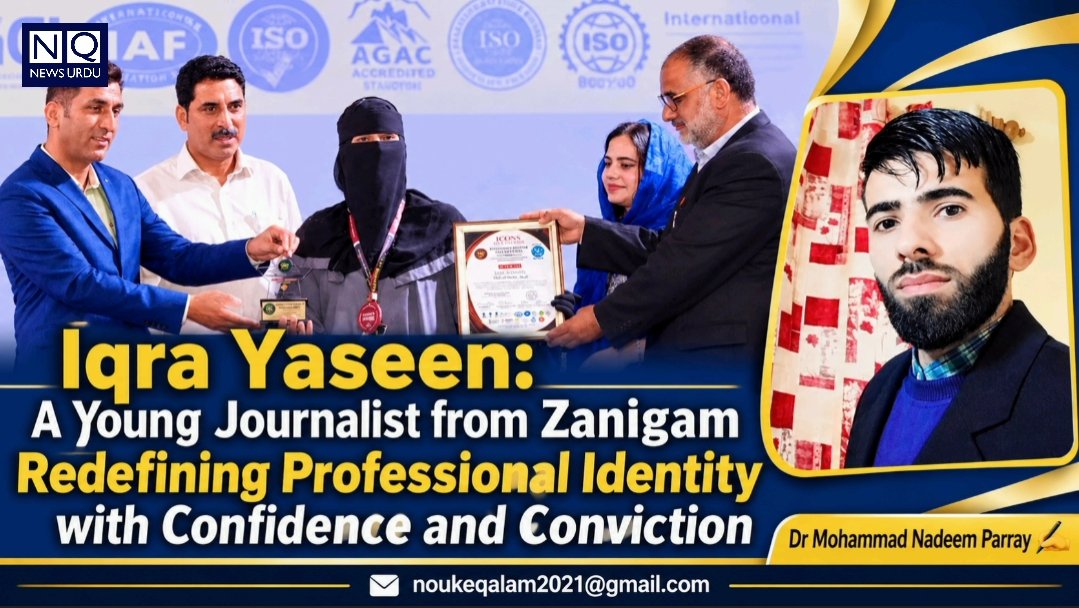
✒️ :. Dr Mohd Nadeem Parray
A Young Voice from Beerwah, Budgam, Demonstrating That Professional Ambition and Personal Values Can Go Hand in Hand
In a society where professional identities are often shaped by established conventions and public expectations, some individuals invite us to look beyond stereotypes and reconsider what defines success. Iqra Yaseen, a young journalist hailing from the beautiful village of Zanigam in Beerwah, Budgam district of Jammu and Kashmir, represents a perspective that deserves thoughtful attention. Her association with journalism, alongside her decision to observe Parda, reflects the possibility of pursuing professional aspirations while remaining committed to personal beliefs and values.
Her story offers more than an account of a young woman entering the world of journalism. It opens a wider discussion about individual choice, women’s participation in public life, and the need to recognise professional ability beyond outward appearance. At a time when young people are exploring new opportunities and redefining traditional career paths, her profile provides an opportunity to reflect on the changing aspirations of women in Kashmir.
Roots in Zanigam, Aspirations Beyond Boundaries
Nestled in the Beerwah area of Budgam district, Zanigam is a village whose identity is connected to the cultural landscape and social traditions of Kashmir. From such places emerge young individuals who look beyond geographical boundaries in pursuit of knowledge, meaningful work, and personal development.
Iqra Yaseen’s association with journalism places her within a generation that is increasingly exploring opportunities in fields once considered unfamiliar or challenging for women from smaller communities. Her professional direction reflects the broader importance of ensuring that talent and ambition receive encouragement, regardless of where an individual comes from.
For young people growing up in villages and small towns, establishing a professional identity often requires determination, continuous learning, and the confidence to explore unfamiliar environments. The journey becomes particularly significant when it involves entering a profession that demands public engagement, independent thinking, and a strong sense of responsibility.
Journalism is one such profession. It requires curiosity, patience, communication skills, and a commitment to presenting information accurately. Beyond reporting events, a journalist must understand the social realities behind them, listen to different perspectives, and recognise the impact that words can have on individuals and communities.
Journalism and the Choice to Observe Parda
One of the distinctive aspects of Iqra Yaseen’s profile is her decision to pursue journalism while observing Parda. This combination challenges the assumption that professional visibility must necessarily be defined by a particular style of dress or outward presentation.
Journalism is fundamentally concerned with facts, public awareness, investigation, and communication. Its credibility depends on the quality of reporting, the accuracy of information, the fairness of presentation, and the integrity of the journalist.
A person’s clothing does not determine their ability to investigate an issue, analyse information, ask meaningful questions, or communicate an important story. Professional competence develops through knowledge, experience, discipline, and ethical conduct.
For many women, personal beliefs and professional aspirations are important and complementary parts of their identity. They should not be forced to choose between participating in public life and maintaining practices that hold personal significance for them.
Iqra’s profile therefore invites society to move beyond narrow assumptions about how a woman in journalism should look or present herself. It encourages a more thoughtful understanding of professional identity, one that allows room for individual differences while maintaining the standards required by the profession.
The larger principle is straightforward: women should have the opportunity to pursue their ambitions without facing unnecessary judgments about their appearance or personal choices.
Challenging Stereotypes Through Professional Participation
Women’s participation in journalism has expanded the range of voices contributing to public discussions on education, governance, culture, social justice, healthcare, and human rights. Women journalists have brought attention to issues affecting families and communities while contributing to a more diverse media landscape.
Yet, stereotypes about women’s roles continue to influence professional opportunities in different parts of society. Some women encounter questions about their appearance, while others face expectations regarding the careers they should pursue or the environments in which they should work.
Such attitudes can unnecessarily limit opportunities and discourage capable individuals from exploring their potential.
The presence of women in journalism challenges these assumptions by demonstrating that professional ability cannot be measured through gender, clothing, or social background. It is reflected in the quality of one’s work, the depth of one’s understanding, and the willingness to fulfil professional responsibilities.
For aspiring women journalists in Kashmir, the example of a young woman from Zanigam pursuing a professional identity while observing Parda can contribute to a broader conversation about opportunity and individual freedom.
However, meaningful recognition must always be grounded in professional merit. Journalism demands competence, credibility, and accountability from everyone who enters the field. Personal identity may shape an individual’s journey, but the quality and integrity of their work ultimately determine their professional standing.
Journalism: A Profession Built on Truth and Responsibility
In the modern world, journalism holds a significant place in shaping public understanding. A responsible journalist does more than communicate information; they help people make sense of events, understand social challenges, and engage with issues that affect their lives.
This responsibility has become even more important in the digital age, when information travels rapidly across social media platforms. Unverified claims, misleading headlines, and sensationalised content can spread widely before facts are properly established.
For young journalists, developing a strong ethical foundation is therefore essential. Accuracy must take precedence over speed, fairness over personal prejudice, and public interest over the pursuit of attention.
A journalist must verify information before publishing it, distinguish facts from opinions, respect the dignity of individuals, and provide context rather than encouraging unnecessary controversy. Equally important is the ability to acknowledge mistakes and correct them transparently.
Professional credibility is not established through visibility alone. It is earned through consistent performance, responsible communication, and a commitment to truth.
As Iqra Yaseen continues to establish her identity in journalism, these principles remain relevant to the larger discussion surrounding young media professionals. They serve as a reminder that the real strength of journalism lies not in how a journalist appears before an audience, but in the integrity with which they fulfil their responsibilities.
A Message for the Next Generation of Kashmiri Women
Across Kashmir, young women are pursuing education and exploring opportunities in journalism, academia, entrepreneurship, public administration, and other professional fields. Their aspirations reflect a growing determination to participate actively in society and shape their own futures.
For many of them, the journey begins with a simple but important question: Can I pursue my ambitions while remaining true to myself?
The answer should be yes.
A progressive society is not one in which everyone makes identical choices. It is one in which individuals are encouraged to develop their abilities, make informed decisions, and contribute meaningfully without facing unnecessary barriers because of their background or personal convictions.
The experiences of young women entering professional fields can help broaden the aspirations of those who follow them. Their journeys can encourage students to value education, develop communication skills, build confidence, and approach their chosen professions with seriousness and dedication.
For aspiring journalists in particular, inspiration must be accompanied by preparation. Reading widely, understanding current affairs, learning digital media skills, developing analytical thinking, and following ethical reporting practices are essential steps towards building a sustainable career.
The media industry requires individuals who are not only confident communicators but also careful observers of society. Young journalists must recognise that their responsibility extends beyond personal achievement to the communities whose stories they help tell.
Beyond Stereotypes: Recognising the Individual
Iqra Yaseen’s association with journalism and her decision to observe Parda offer a useful perspective on the relationship between professional ambition and personal identity. Her profile encourages a conversation in which women are recognised for their abilities and aspirations rather than judged through assumptions about their appearance.
At the same time, professional recognition should remain rooted in the quality of one’s work. Respect for personal choices and commitment to professional standards are not competing ideals; they are principles that can strengthen a more inclusive and responsible society.
Her connection to Zanigam, Beerwah, also highlights the importance of recognising talent and ambition emerging from Kashmir’s villages and smaller communities. Opportunities should not be limited by geography, and a person’s place of origin should never become a measure of their potential.
Ultimately, every professional journey is shaped by individual effort, learning, opportunity, and perseverance. The most meaningful contribution a young journalist can make is to develop the skills and integrity necessary to inform society responsibly.
Iqra Yaseen’s story, viewed in this wider context, becomes part of an important conversation about women’s participation, freedom of choice, professional responsibility, and the evolving aspirations of young Kashmiris.
The message is clear: a person’s values need not stand in the way of their ambitions, and professional ability should never be judged by appearance alone.
As society continues to evolve, it must create space for individuals to pursue their chosen paths with dignity and confidence. For young women from Zanigam, Beerwah, and across Kashmir, the opportunity to learn, work, and contribute should be determined by their abilities, dedication, and commitment to their goals.
A truly progressive society is one that does not ask individuals to abandon their identity to prove their capability, but gives them the freedom to demonstrate that capability through their work.
About the Author
Dr Mohammad Nadeem Parray
Chemistry mentor/ Author of the book “DARK SOULZ”
Columnist /Poet
Support Independent and Impartial Journalism
Nouk-e-Qalam News is a free and independent journalistic platform. To maintain our ethical standards and avoid obscene advertisements, we have disabled Google Ads. We now rely on your generous financial support to continue our unbiased reporting. Our Writers and readers are kindly urged to contribute—daily, weekly, or monthly. Thank you for standing with truth.