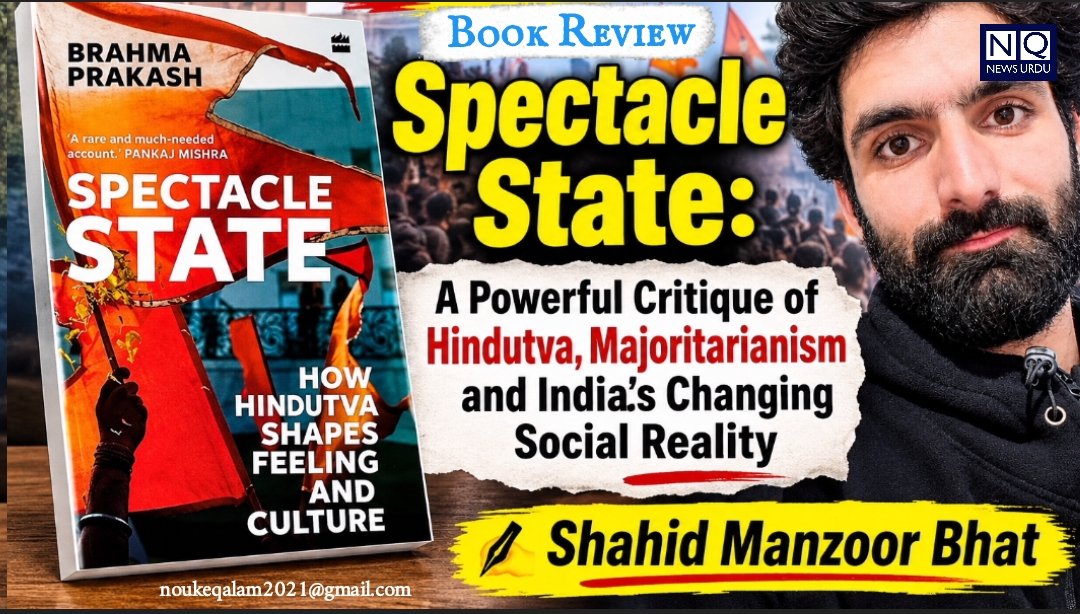
✒️ :. Shahid Manzoor Bhat
Very long ago, we used to hear “Gai ek paltu janwar hai” (“The cow is a domestic animal”), but that sentiment seems nowhere to be found today.
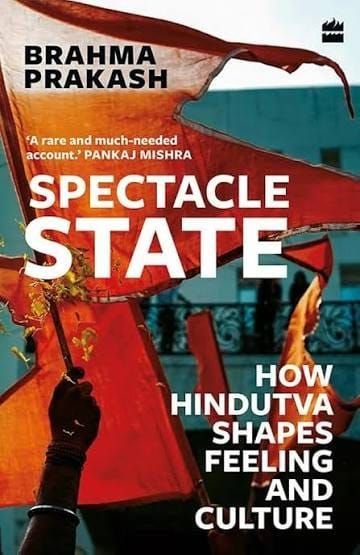
Read Spectacle State by Brahma Prakash. It invites all who suffer to read about their own plight; every victim receives an invitation through this write-up—be it Dalits, Muslims, or any minority suffering under majoritarianism!
Brahma Prakash’s work has rightly gained global recognition. It was praised by Pankaj Mishra—author of The World After Gaza—who called it “a rare and much-needed account.”
Thomas Blom Hansen, Professor of Anthropology at Stanford University, stated:
“Spectacle State is an incisive and wide-ranging examination of how the mainstreaming of Hindutva across Indian society has dramatically transformed cultural sensibilities, public aesthetics…”
Shahrukh Alam, Advocate at the Supreme Court of India, called it Prakash’s biggest achievement. Similarly, it has received praise from Anand Teltumbde, T.M. Krishna, Zara Choudhary, and Soumyabrata Choudhury (Professor at JNU), among others. All of them have commended Prakash for documenting the reality of the streets and corners of India. It is not a novel, but once you start reading, you will not regret missing a meal to finish it!
Chapterization & Insights
The book is structured into 7 chapters, each packed with insights into how Hindutva is dominating India’s mainstream: through screaming, singing, wearing saffron, proudly displaying swords during festivals and quiet moments alike, propaganda, and the aestheticization of lynching, killing, and demolishings—targeting Dalits and Muslims.
Whether through H-Pop blaring on loudspeakers, DJs played outside mosques, or digital campaigns, certain elements of society are justifying these acts to tag themselves as “heroes” and the sole owners of the nation—even justifying “bulldozer justice” in the name of national security.
As page 92 succinctly states:
“A tank runs along national borders and a bulldozer runs on a social level. One aims to destroy national threats; the other aims to destroy ‘anti-social elements’.”
This reflects a deep understanding of India’s current social order and the courage to call a spade a spade—a courage most lack. We recognize this social reality, yet we are afraid to speak up:
Kaun kehta nahi khuda ko khuda,
Jab humne keh diya toh saza paayi.
We face threats simply for asking questions. Sharjeel Imam spoke his truth and was jailed, whereas Dhruv Rathee faced a single night of controversy and remained free.
These are the horizons of Indian administration today. I strongly invite all my friends to read this book at least once.
Support Independent and Impartial Journalism
Nouk-e-Qalam News is a free and independent journalistic platform. To maintain our ethical standards and avoid obscene advertisements, we have disabled Google Ads. We now rely on your generous financial support to continue our unbiased reporting. Our Writers and readers are kindly urged to contribute—daily, weekly, or monthly. Thank you for standing with truth.