✒️ :. Ikkz Ikbal
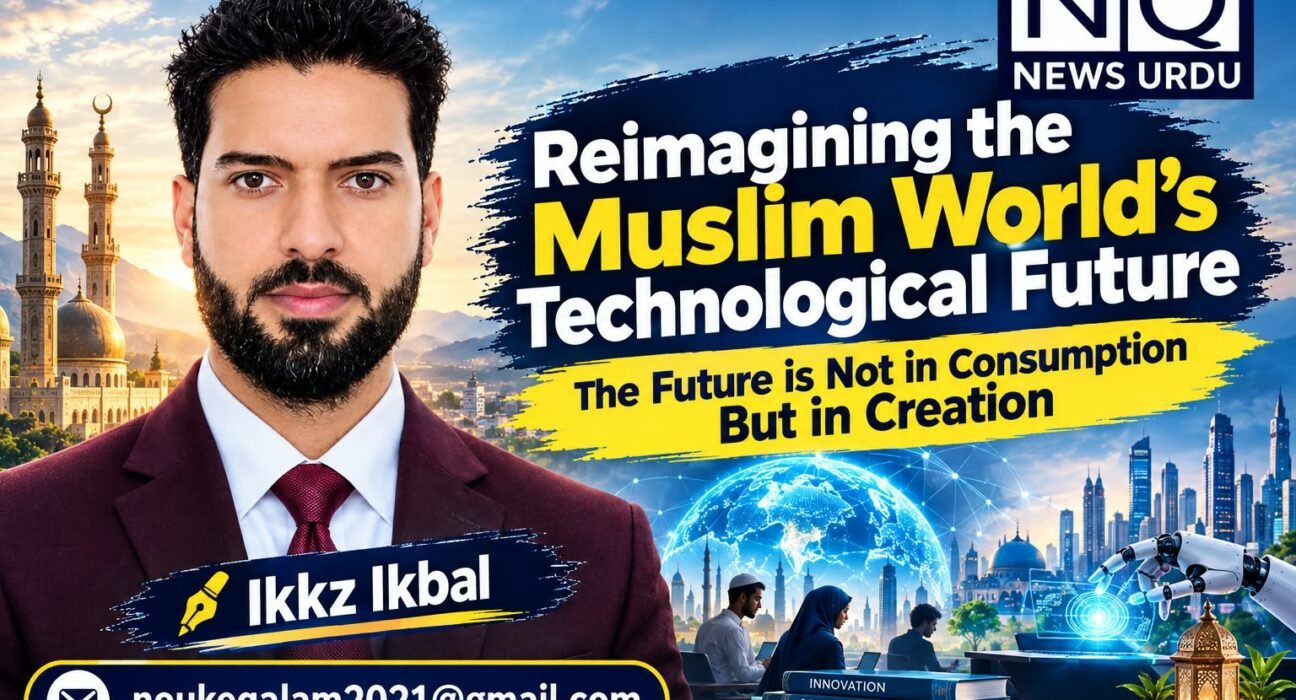
For too long, Muslims have often approached technology primarily as consumers rather than as creators, innovators and leaders. We buy the latest smartphones, use sophisticated software, depend on digital platforms, consume artificial intelligence-generated content and live inside technological ecosystems largely designed and developed elsewhere. Technology has become deeply embedded in our daily lives, yet our participation in building the foundations of that technology remains comparatively limited.
This is not a question of talent. The Muslim world has no shortage of intelligent students, scientists, engineers, entrepreneurs and creative minds. The deeper question is whether our educational institutions, economies and societies are creating the conditions in which that talent can move from learning to discovery, from employment to entrepreneurship, and from consumption to creation.
History offers an important lesson: technological leadership is rarely confined to laboratories. The societies that lead in science and technology often acquire advantages far beyond technology itself. Innovation can generate industries, employment, wealth and economic resilience. It can strengthen education and research, improve healthcare and infrastructure, enhance communication and mobility, and increase a country’s ability to shape its own future. That is why the technology question is ultimately also an economic and civilisational question.
The Muslim world does not need to imitate another civilisation or abandon its own intellectual and ethical traditions to become technologically capable. It needs to cultivate a culture in which asking questions is encouraged, experimentation is respected, failure is treated as part of learning, research is adequately funded, and young people are given opportunities to build rather than merely consume.
Our children should not grow up believing that technology means only owning the newest device. They should also ask:
Who designed it? Who built it? Who owns the company behind it? Who developed the underlying algorithm? Who controls the data? And, most importantly—why can’t we build something of our own?
The transition from consumer to creator begins with a change in mindset. It requires investment in mathematics, science, engineering, computing, research and entrepreneurship. It requires universities that reward original research rather than merely degrees, schools that nurture curiosity rather than rote learning, and institutions willing to support young innovators with resources, mentorship and patience.
It also requires recognising that not every young person needs to become a scientist. Technological civilisation is built by a vast ecosystem of programmers, designers, researchers, technicians, entrepreneurs, educators, investors, policy-makers and skilled workers.
The objective, therefore, should not be technological competition for the sake of prestige. It should be technological capability for the sake of human development, economic independence and a stronger contribution to the world.
The Muslim world has produced great scholars in mathematics, medicine, astronomy, optics and engineering in different periods of history. That legacy deserves respect—but merely celebrating the achievements of our predecessors cannot substitute for producing achievements of our own.
The real tribute to a scientific legacy is not remembering what was built centuries ago. It is building what the next generation will remember centuries from now. The question before us is therefore not whether Muslims are capable of innovation. The more important question is whether we are prepared to create the educational culture, institutions, investment and intellectual courage required to turn that capability into reality.
The future will not belong merely to those who consume the most advanced technology. It will increasingly belong to those who understand it, improve it and build it. And perhaps it is time for the Muslim world to move decisively—from the screen in our hands to the ideas in our minds, from consumption to creation, and from being users of the future to becoming contributors to it.
Ikkz Ikbal holds a Masters in Biotechnology and is Principal & Academic Head at Maryam Memorial Institute, Pandithpora Qaziabad. He X’s @IkkzIkbal.
Support Independent and Impartial Journalism
Nouk-e-Qalam News is a free and independent journalistic platform. To maintain our ethical standards and avoid obscene advertisements, we have disabled Google Ads. We now rely on your generous financial support to continue our unbiased reporting. Our Writers and readers are kindly urged to contribute—daily, weekly, or monthly. Thank you for standing with truth.