
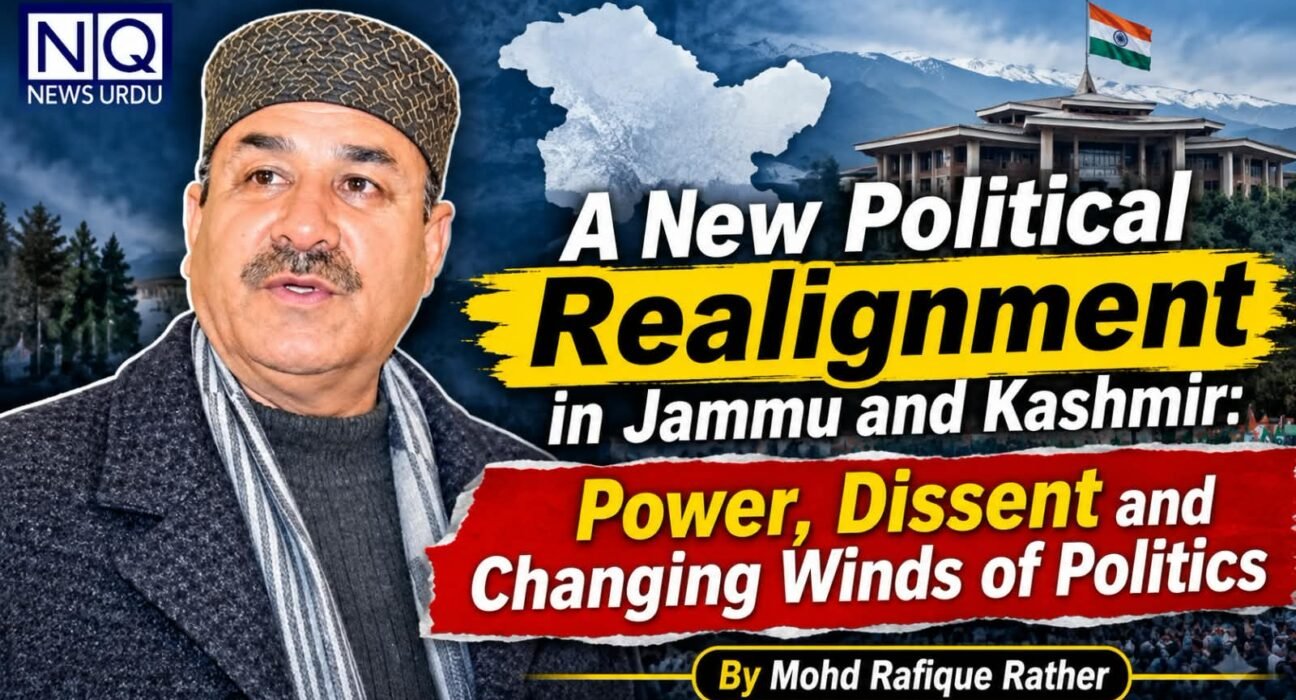
✒️ :. Mohd Rafique Rather
Jammu and Kashmir’s political landscape appears to be entering another significant phase of transition. A series of recent developments, including the impressive PDP workers’ convention on November 2, the formal departure of Srinagar MP Aga Syed Ruhullah Mehdi from the National Conference and his decision to tender his resignation from Parliament, along with growing discontent within the ruling National Conference following the recent Cabinet expansion, have brought the region’s shifting political equations into sharper focus.
Individually, these developments may represent different political circumstances. Collectively, however, they reflect a deeper reality: political authority is increasingly being tested by questions of credibility, ideological consistency, internal democracy and the ability of leadership to respond to public expectations.
The November 2 PDP convention at Sher-e-Kashmir Park, Srinagar, organised to mark the party’s Foundation Day, was undoubtedly one of the most visible political gatherings in recent days. The impressive participation of workers and supporters from different parts of Jammu and Kashmir demonstrated that the party continues to retain an active organisational presence despite having remained outside the corridors of power for several years.
For the Peoples Democratic Party, the convention was more than an organisational exercise. It was an opportunity to reaffirm its political relevance and reconnect with the foundational vision of its founder, Mufti Mohammad Sayeed. The principles of dignity, reconciliation, dialogue and protection of Jammu and Kashmir’s political identity remain central to the party’s political narrative.
Addressing the gathering, PDP president Mehbooba Mufti raised issues concerning the growing trust deficit between the Centre and the people of Jammu and Kashmir, the treatment of local youth, termination of government employees and concerns affecting tribal communities. Her emphasis on meaningful dialogue also reflected the party’s longstanding argument that lasting peace cannot be achieved through coercion or administrative measures alone.
The significance of the gathering, however, should not be measured merely by the size of the audience. Political organisations are often tested most severely when they are out of power. Sustaining cadre morale, preserving organisational unity and maintaining a credible political voice during difficult circumstances are equally important. The convention demonstrated that the PDP has not disappeared from the political landscape and continues to possess a constituency that deserves serious attention.
Perhaps the most consequential development in this emerging political situation is the decision of Aga Syed Ruhullah Mehdi to formally sever his association with the National Conference and tender his resignation from the Lok Sabha. On November 3, he announced his departure from the party and submitted his parliamentary resignation to Speaker Om Birla, bringing an end to his long political association with the National Conference.
His decision is particularly significant because it comes after months of public disagreement with the party leadership over issues concerning Article 370, constitutional rights, reservation policy, the release of prisoners and what he considers the failure to honour important electoral commitments.
Ruhullah was among the prominent political faces of the National Conference during the 2024 Assembly elections. His political standing and electoral influence, particularly in central Kashmir, make his departure considerably more significant than an ordinary instance of internal disagreement.
In his resignation communication, Ruhullah accused the party leadership of abandoning the political struggle that he believed was necessary following the abrogation of Articles 370 and 35A. His central argument was that the National Conference had sought public support on the promise of defending the political and constitutional rights of Jammu and Kashmir but had subsequently shifted its priorities towards the exercise of governmental power.
Whether one agrees with his political assessment or not, his departure has brought an uncomfortable but important question to the forefront: what happens when electoral promises collide with the realities of governance?
An electoral mandate is not simply an authorisation to occupy public office; it carries moral and political responsibilities towards those who extend that mandate. When an elected representative chooses to relinquish his party affiliation and parliamentary position rather than continue with an approach he considers inconsistent with the promises made to voters, the development deserves serious political examination.
Ruhullah’s decision also raises questions about the future of political opposition in Jammu and Kashmir. His indication that he intends to bring together committed young people and build a new political movement could potentially open another space in the region’s political landscape. Whether this initiative develops into a structured political platform or remains a movement of dissent will depend on its organisational direction, ideological clarity and ability to connect with people beyond his immediate support base.
His resignation may also compel other political formations to revisit their positions on constitutional rights, political commitments and public accountability. It would be premature to predict the emergence of an entirely new political force, but it would equally be unwise to underestimate the implications of such a significant political departure.
Meanwhile, the National Conference is confronting another challenge within its own organisational structure. The recent Cabinet expansion by Chief Minister Omar Abdullah, instead of fully satisfying political expectations, appears to have exposed underlying differences within the ruling party.
Cabinet formation is invariably a difficult exercise involving political accommodation, regional considerations and individual aspirations. However, reports of dissatisfaction among approximately 18 to 20 legislators, along with demands for changes in the party organisation, indicate that the discontent may extend beyond disappointment over ministerial berths.
Questions of internal democracy, consultation, regional representation and the functioning of the party leadership have reportedly contributed to the unease. Senior legislators who believe their experience and political contribution have not received due recognition may increasingly seek a greater say in organisational affairs.
It would be premature to interpret this discontent as an immediate threat to the government’s survival. Nevertheless, a ruling party cannot afford to ignore sustained dissatisfaction within its own ranks. Legislative strength may secure a government’s position, but organisational confidence and political cohesion are essential for effective governance.
The simultaneous emergence of these developments presents an interesting political contrast. While the PDP is attempting to consolidate its organisational strength outside government, the National Conference is managing the competing expectations that accompany the exercise of power. At the same time, Ruhullah’s departure has transformed what was previously an internal disagreement into a major political development with potentially wider consequences.
It also places the National Conference leadership in a difficult political position. The party must now address not only dissatisfaction among its legislators but also questions raised by a prominent leader who was once among its strongest campaigners. The political challenge is no longer confined to managing internal differences; it also involves defending the credibility of the commitments on which the party sought and secured public support.
Jammu and Kashmir is passing through a sensitive political period. Restoration of statehood, constitutional safeguards, employment opportunities, reservation policy, political dignity and meaningful representation remain among the principal concerns of its people. These aspirations cannot be addressed merely through Cabinet reshuffles, political appointments or organisational adjustments. They demand sincerity, sustained engagement and leadership capable of communicating honestly with the public.
The emerging situation also reinforces an important democratic distinction: political stability does not necessarily mean political satisfaction. A government may enjoy a comfortable legislative majority and still face dissatisfaction within its own organisation and among sections of the electorate. Similarly, a party outside power can remain politically relevant if it maintains its ideological clarity, organisational discipline and connection with the people.
For the PDP, the challenge now is to translate the enthusiasm witnessed on November 2 into sustained grassroots mobilisation and a constructive political alternative. The impressive gathering has created an opportunity, but converting public enthusiasm into lasting political confidence will require consistent engagement, organisational discipline and a clear political direction.
For the National Conference, the immediate challenge is to address internal grievances, respond to questions surrounding its electoral commitments and restore confidence among sections of its own political constituency. For Ruhullah, the real test begins after his resignation. Political dissent can attract public attention, but transforming that dissent into a credible and sustainable political alternative requires organisation, leadership, clarity of purpose and a wider public agenda.
Ultimately, Jammu and Kashmir may be witnessing the early signs of a new political realignment. The departure of a prominent National Conference leader, growing unease within the ruling party and the PDP’s renewed organisational assertion have together created a political situation that deserves close attention.
Whether these developments lead to a substantial reshaping of political equations or remain temporary episodes will depend on how the respective leaderships respond in the coming weeks and months.
One thing, however, is increasingly evident: political positions, electoral victories and ministerial portfolios cannot indefinitely substitute for public trust. In a democracy, the real strength of a political party lies not merely in the power it exercises, but in the promises it honours, the dissent it accommodates and the people it continues to represent.
Mohd Rafique Rather
Educationist, author, teacher-turned-politician and television debater.
Can be reached at: mrafiqr65@gmail.com
Support Independent and Impartial Journalism
Nouk-e-Qalam News is a free and independent journalistic platform. To maintain our ethical standards and avoid obscene advertisements, we have disabled Google Ads. We now rely on your generous financial support to continue our unbiased reporting. Our Writers and readers are kindly urged to contribute—daily, weekly, or monthly. Thank you for standing with truth.