


✒️ :. Murtaza Ali
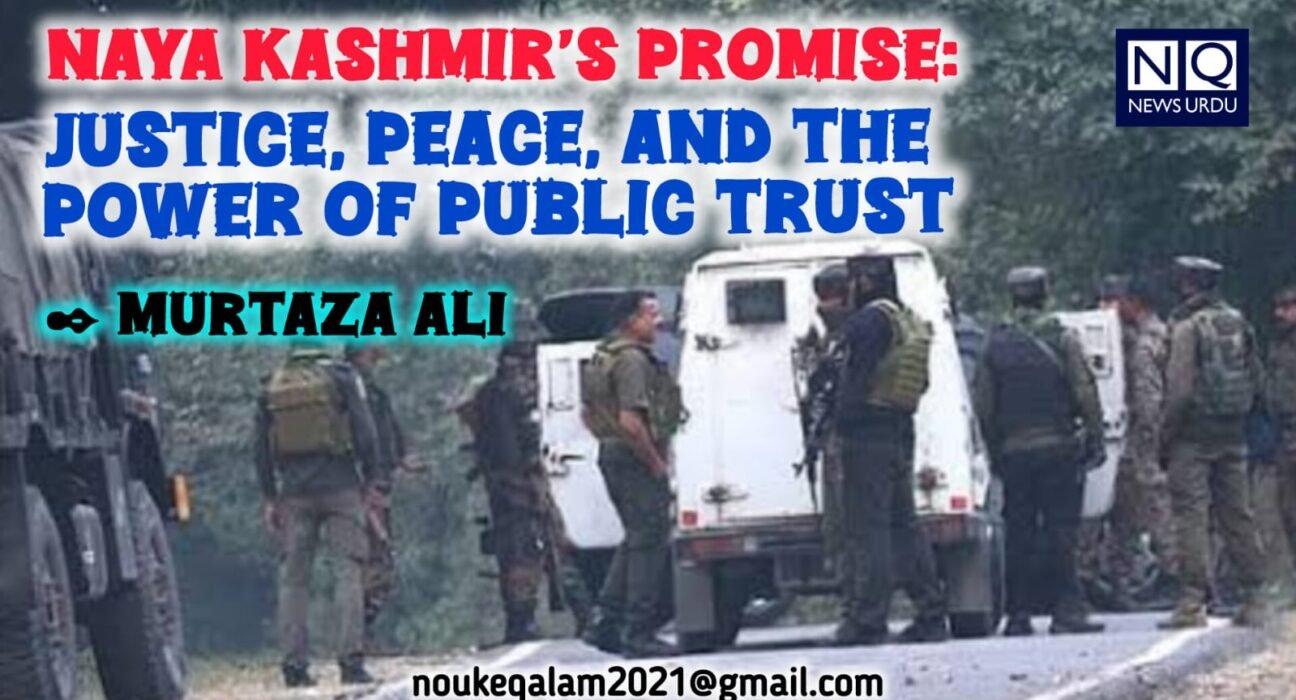
The recent incident in Ganderbal, involving the alleged killing of a civilian during a security operation, has once again brought attention to the sensitive balance between maintaining security and safeguarding civilian lives in Jammu & Kashmir. The reaction from political leaders, civil society, and the media—calling for transparency and accountability—is both necessary and appropriate in a democratic society.
The Lieutenant Governor’s directive for a magisterial inquiry is a step in the right direction. However, the true value of such an inquiry lies in its credibility—ensuring it is impartial, time-bound, and followed by concrete action. In a region where public trust has often been fragile, justice must not only be delivered but must also be visible to the people.
In this particular case, the tragedy is even more profound. The youth killed in Ganderbal was not disconnected from the idea of nation-building; rather, he was aspiring to be a part of it. An M.Com degree holder, he had recently applied for a position in the Jammu & Kashmir Police, with the intention of serving the same cause that New Delhi and security institutions are striving for in the Valley—the eradication of the menace of terrorism. His aspirations reflected the changing mindset of the region’s youth. This makes the incident not only unfortunate but deeply tragic, as it represents the loss of a life that sought to contribute positively to peace and stability.
The presence of AFSPA in Jammu & Kashmir adds a layer of complexity to issues of accountability. While it provides legal protection to security forces operating in challenging conditions, it must not become an obstacle when it comes to addressing cases involving innocent civilians. Accountability strengthens institutions; it does not weaken them. Any perception of injustice risks undermining the trust that has been gradually built over recent years.
Since 2019, Jammu & Kashmir has witnessed significant changes on the ground. Large-scale stone pelting, frequent shutdowns, and organized anti-security force protests have drastically reduced. This transformation cannot be attributed solely to a muscular or law-and-order approach. While enforcement has played a role, a deeper and more important shift has occurred in the mindset of the youth.
There is a growing understanding among young people that they were often used as proxies by external forces pursuing their own vested interests. In the past, even the threat of bullets did not deter stone pelting, which clearly indicates that fear alone was never the decisive factor. What has changed today is the ideological perception. The youth are increasingly placing their faith in stability, opportunity, and the constitutional framework of India.
This shift is not limited to those who once participated in street protests. Even among former Over Ground Workers (OGWs), there is a noticeable change in attitude. The public at large has developed a stronger sense of awareness, responsibility, and long-term thinking. Aspirations have evolved—from confrontation to construction, from disruption to development.
At the same time, the decline in local recruitment into militancy and the growing isolation of foreign militants—now largely confined to forested areas—reflect the reduced local support for violence. This is a crucial achievement and indicates that the foundations of peace are becoming stronger.
However, sustaining this progress depends heavily on maintaining the trust of the people. Security cannot rely on force alone; it is deeply dependent on cooperation from the local population. Intelligence gathering, whether human or technical, is only effective when supported by the community. The role of locals in maintaining peace is indispensable.
In this context, the contributions and sacrifices of security forces—including Jammu & Kashmir Police, Indian Army, CRPF, BSF, and intelligence agencies—deserve sincere appreciation. Their efforts have been central to stabilizing the region and enabling the environment in which this positive transformation is taking place.
Yet, incidents like the one in Ganderbal risk damaging public sentiment. Any action that results in the loss of innocent life must be dealt with strictly and transparently. This is not about questioning the role of security forces but about strengthening their credibility. Accountability ensures that the moral and institutional authority of these forces remains intact.
Today, there is a visible sense of trust among the youth of the Valley towards the system. This trust is a powerful asset and must be protected. The administration must reinforce it through fairness, sensitivity, and consistent action that aligns with the vision of “Naya Kashmir.”
The idea of Naya Kashmir must go beyond infrastructure and policy announcements. It must be reflected in how institutions respond to the concerns of the people, how justice is delivered, and how dignity is preserved. The people of Jammu & Kashmir, especially the youth, are no longer passive observers—they are active stakeholders in shaping their future.
The Ganderbal incident, therefore, is more than an isolated case. It is a test of governance, accountability, and commitment to the promise of change. The way it is handled will influence public perception and determine whether the trust that has been built continues to grow or begins to erode.
The path forward lies in partnership—between the administration, security forces, and the people. Peace in Jammu & Kashmir is not just a security objective; it is a collective responsibility. With transparency, accountability, and continued public trust, the vision of a stable and truly transformed Naya Kashmir can become a lasting reality.
About the author
Murtaza Ali is a Counter Terrorism and Counter Intelligence Analyst based in Jammu & Kashmir. He writes extensively on grassroots governance, defence strategy, and counter-insurgency developments in the region, offering ground-level insight shaped by years of direct engagement with the J&K security environment.
Support Independent and Impartial Journalism
Nouk-e-Qalam News is a free and independent journalistic platform. To maintain our ethical standards and avoid obscene advertisements, we have disabled Google Ads. We now rely on your generous financial support to continue our unbiased reporting. Our Writers and readers are kindly urged to contribute—daily, weekly, or monthly. Thank you for standing with truth.


