✒️ :. Shahid Manzoor Bhat
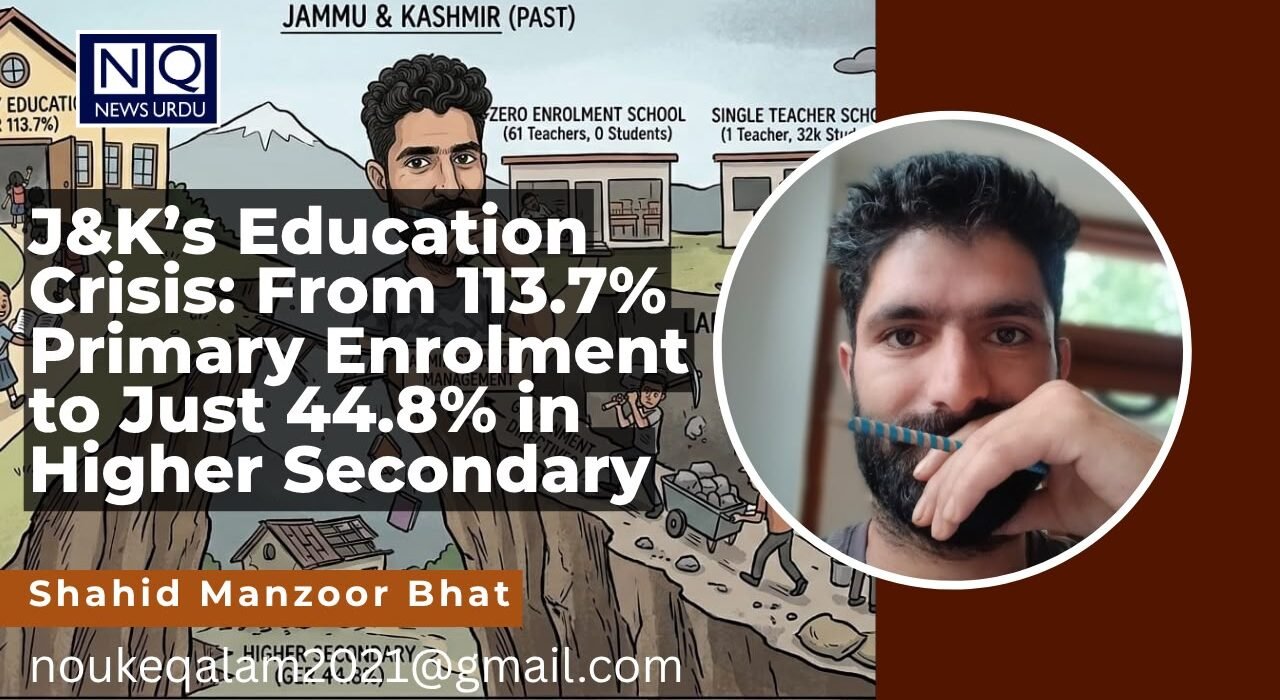
The report detailing Jammu & Kashmir’s sharp drop in higher-secondary enrolment paints a tragic, systemic tailspin—a reality mirroring the underlying premise of Udta Punjab, where a region’s future slips away while institutions stand by idly. Instead of chemical addiction, “Udta Kashmir” exposes a socio-educational crisis: an acute drop in Gross Enrolment Ratio (GER) from a buoyant 113.7% at the primary level to a dismal 44.8% at the higher-secondary stage.
A Steep Structural Drop
Much like the vulnerable youth in Udta Punjab who fall through the cracks of broken societal safety nets, J&K’s secondary-level dropout rate of 12.9% (exceeding the national baseline of 11.5%) signals a systematic collapse. Over half the student population vanishes from the formal education stream before reaching Class XI. The journey from primary school to matriculation becomes an obstacle course where systemic apathy, economic pressures, and infrastructural deficits quietly snuff out aspirations.
Ghost Schools and Mismatched Resources
The article highlights deep administrative paralysis through staggering structural paradoxes. The presence of 146 schools with zero enrolled students—yet staffed by 61 teachers—reads like a surreal storyline where public resources are allocated without accountability or oversight. Conversely, 1,371 single-teacher institutions shoulder the burden of educating over 32,000 students. This gross misallocation leaves rural and marginalized youth stranded in substandard environments, guaranteeing that any initial educational momentum stalls out entirely before higher secondary levels.
The Labour Sector Trap and Looming Unemployment
Crucially, this academic exodus is driven by a stark economic reality: a soaring youth unemployment rate that ranks among the highest in the nation. Facing a grim job market where even higher degrees offer no guarantee of white-collar security, J&K’s youth are forced into a survivalist trade-off. Abandoning secondary and higher education—despite available academic pathways—thousands of young individuals bypass higher studies to enter the informal labour sector early. Education is increasingly perceived not as an elevator for social mobility, but as an unaffordable delay in earning a daily wage, locking an entire generation into low-skilled, precarious manual labour.
Digital Isolation and Lack of Inclusivity
The report’s stark infrastructure metrics underscore how far behind the Union Territory lags in modernizing its learning spaces. With only 16.5% of schools possessing functional smart classrooms, students are effectively isolated from modern digital literacy. Furthermore, with less than half of institutions (45.4%) featuring basic ramp accessibility for children with special needs, the system actively excludes fragile demographics.
Conclusion
While the news coverage functions as a factual diagnostic of NITI Aayog data, the narrative must shift from reporting numerical decline to demanding policy interventions—such as school rationalization, targeted teacher redeployment, and local job-market diversification. Without urgent structural reform, the valley risks losing an entire generation to educational disenfranchisement and low-wage labor, leaving its youth floating without a future.
Support Independent and Impartial Journalism
Nouk-e-Qalam News is a free and independent journalistic platform. To maintain our ethical standards and avoid obscene advertisements, we have disabled Google Ads. We now rely on your generous financial support to continue our unbiased reporting. Our Writers and readers are kindly urged to contribute—daily, weekly, or monthly. Thank you for standing with truth.