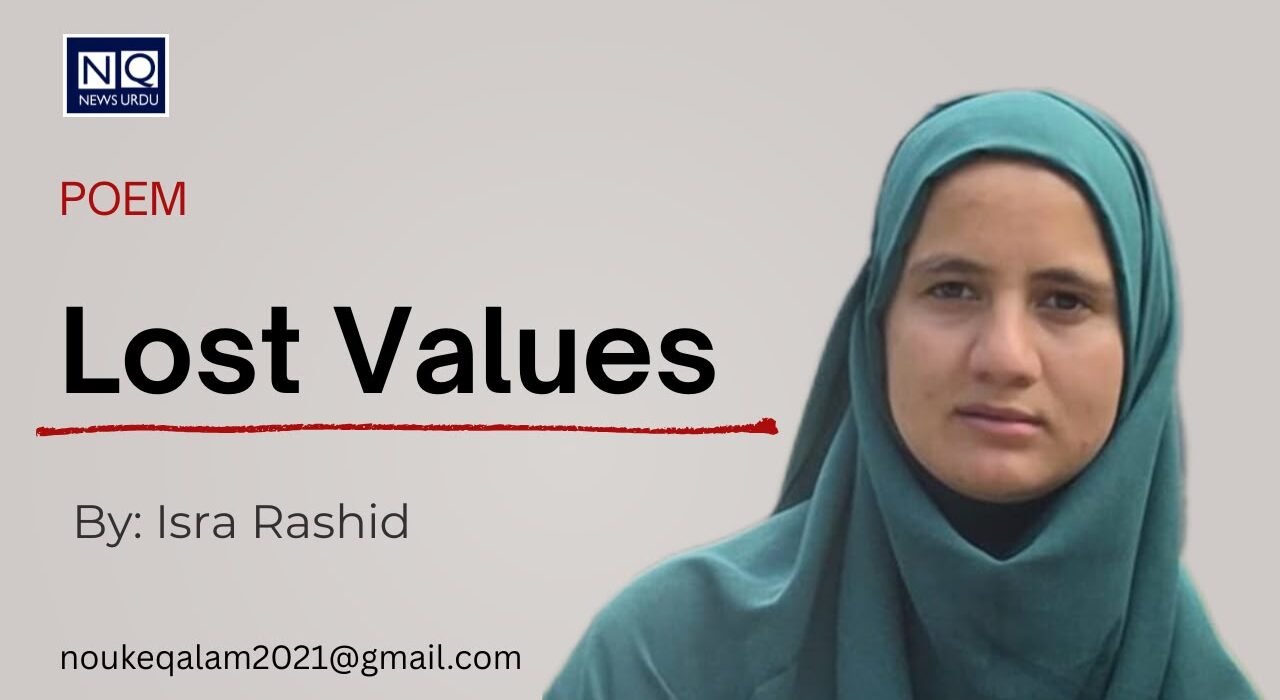
✒️:. Isra Rashid
Nations do not become weak when their resources run out. They fall into decline when they lose their values.
Every era has its own identity. One age is known for its knowledge, another for its bravery, another for its culture, and another for its moral greatness. But the real foundation of every great civilization has always been
values.When that foundation weakens, even the tallest buildings do not stand for long.
Today we are living in a time where there is a lot of talk about progress, but the light of character is growing dim. Humans have built machines, but the distance between hearts has increased. We have been flooded with information, but the thirst for wisdom remains. Education has become common, but grooming is now rare.
This is the biggest sign of our lost values.
There was a time when speaking the truth was a matter of pride. Today lies are called cleverness.
There was a time when keeping a promise was a sign of honor. Today breaking a promise has become normal.
There was a time when serving parents was considered a blessing. Today many elders live in loneliness, even among their own children.
We made progress, but we left our soul behind.
Lost values are not just about the decline of ethics. They mean that the human within the human has gone missing. When the conscience falls silent, justice grows weak, mercy disappears, and self-interest dominates every decision, then a society may look alive on the outside but is sick on the inside.
Today we teach children how to be successful, but we teach them less about how to be good human beings.
We teach them to compete, but not to cooperate.
We give them the drive to win, but give them little sense of feeling another person’s pain.
This is the void that has weakened our society from within.
Islam taught humanity truthfulness, trustworthiness, justice, mercy, patience, gratitude, modesty, and good character. These were the very values that transformed a scattered society into a great nation. When these qualities begin to weaken, neither power, nor wealth, nor knowledge can save a society from decline.
Our civilization was also the guardian of these values. Neighbors shared each other’s sorrows. Elders were the center of decisions. A teacher did not just teach lessons, he taught character. And a family was bound together not just by blood, but by the bond of love.
Today cracks are growing in those relationships.
The reason is not just the change of time, but also a change in priorities.
We started valuing fame over character, self-interest over service, and showiness over simplicity.
But hope is not gone yet.
Values never disappear completely. They only become faint. If a father teaches his children to speak the truth, if a mother nurtures mercy in them, if a teacher becomes an example of integrity, if a young person listens to the voice of their conscience, and if a leader makes justice his motto — then these small lamps together can light up an entire society.
The return of lost values depends more on character than on laws. This journey begins in our homes before it begins with governments, in grooming before it begins in the curriculum, and in action before it begins in speeches.
We need to look within ourselves and ask:
Am I truthful?
Am I trustworthy?
Are my decisions based on justice?
Is there mercy in my heart for others?
Does my life make things easier for others, or harder?
Lost Values It is the mirror of our times. If we want future generations to see a better world, then we must revive those values today — in our character, in our homes, in our schools, and in our society — the very values that made a human, human.
Remember, the future of nations is not secured in their banks. It is secured in their character.
What use is light in the lamps, if values are gone?
What use are grand palaces, if hearts are not alive?
Return to truth, trust, loyalty and modesty,
For this is the journey where a human becomes human again.
There was a time when a neighbor’s grief was everyone’s grief.
Today we know everyone’s status, but not the pain next door.
There was a time when honesty in trade was called “deen.”
Today profit is praised, even if the scale is crooked.
There was a time when children listened before they spoke.
Today we shout to be heard, but forget to listen.
There was a time when elders were libraries, and we sat at their feet.
Today we swipe for answers, and let the libraries grow lonely.
There was a time when shame kept us from wrong.
Today shamelessness is called “confidence.”
We built faster phones, but lost the patience to talk.
We gained followers online, but lost friends in real life.
We chase trends, but forget traditions that kept us human.
A society can have tall towers and empty hearts.
It can have full wallets and empty duas.
It can have a thousand opinions, and not one conscience.
But values are like seeds. Bury them deep and they wait for rain.
The rain begins when
A student returns a lost wallet instead of keeping it.
A shopkeeper gives the right weight even when no one is watching.
A son calls his mother before checking his phone.
A leader chooses fairness over applause.
A young person says “I was wrong” without fear.
Change does not need a crowd. It needs one person, in one home, to begin.
For nations are not remembered by their tallest buildings.
They are remembered by the character of their people.
What use is progress, if we lose ourselves in it?
What use is success, if our children do not know how to be kind?
Return to truth, trust, loyalty and modesty,
Return to the neighbor, the elder, the teacher, the promise.
For this is the journey where a human becomes human again.
And when humans become human again, nations rise again.
Isra Rashid
D/o:Abdul Rashid wani
R/o: zirhama district kupwara
2nd sem student GCW Ma road srinagar
Support Independent and Impartial Journalism
Nouk-e-Qalam News is a free and independent journalistic platform. To maintain our ethical standards and avoid obscene advertisements, we have disabled Google Ads. We now rely on your generous financial support to continue our unbiased reporting. Our Writers and readers are kindly urged to contribute—daily, weekly, or monthly. Thank you for standing with truth.