✒️ :. Talha sultan
Student/social & political activist/founder TCT.
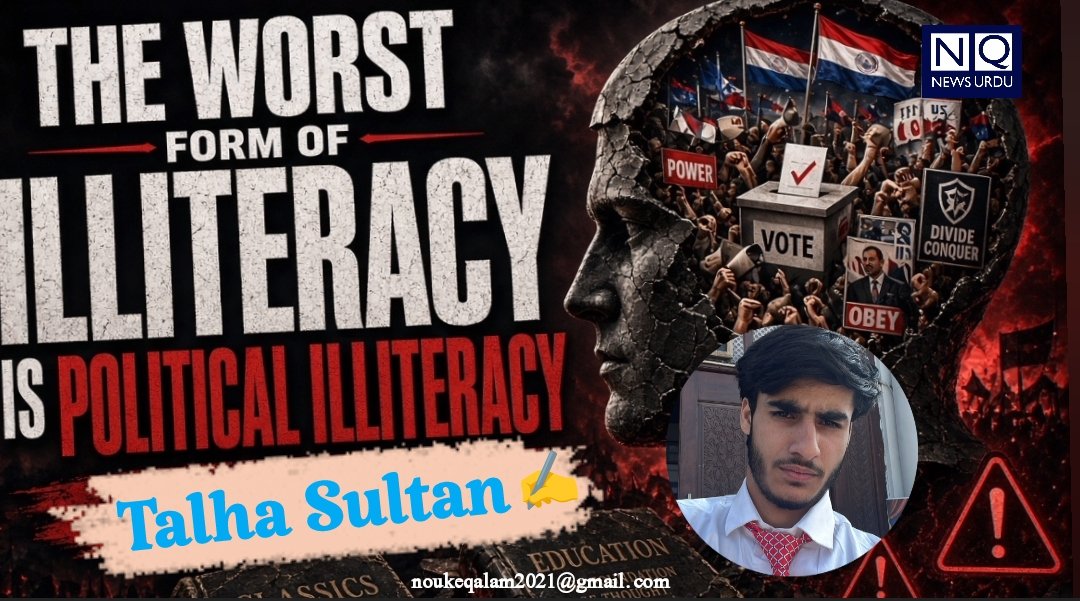
Education is the fundamental pillar of the development of any society. However, merely learning to read and write does not complete a person’s awareness. A person may learn to recognise letters, but that does not necessarily mean they are also aware of their rights, duties, social responsibilities, and the complexities of the political system. This is where a clear distinction emerges between general literacy and political awareness. The reality is that the worst form of illiteracy is one in which a person, despite being educated, lacks an understanding of their collective interests, fundamental rights, and political responsibilities.
In our society, a large part of political discourse revolves around ideological affiliations, emotional slogans, and personal likes and dislikes. Instead of impartially evaluating the performance of politicians, public issues, basic facilities, and government policies, political debates often become consumed by ideological differences. One important reason for this situation is political instability, which certain political elements have exploited to serve their own interests.
Political parties and their leaders attempt to gain public support through different ideologies, slogans, and promises. Ideologies are undoubtedly an important part of politics, but the purpose of politics is not merely to keep ideological affiliations alive. It is also to resolve public issues, promote collective welfare, and protect the rights of citizens. Therefore, while deciding whom to vote for, equal importance should be given not only to a political party’s ideology but also to its past performance, public services, policies, and fulfilment of promises.
Unfortunately, in many societies, political affiliation becomes so emotional that people begin to overlook the shortcomings of their preferred leaders. Questioning their failures is considered disloyalty to one’s political party or ideology, whereas even minor mistakes by opponents are portrayed as unforgivable offences. In this way of thinking, political disagreement turns into intellectual prejudice, and blind support takes the place of accountability.
The consequences of this attitude are not limited to political debates; their effects can be felt across different areas of life. Issues related to healthcare, education, employment, infrastructure, and public facilities remain unresolved for long periods, yet people’s attention often shifts away from these fundamental needs and becomes entangled in debates that have relatively little direct connection with the problems of their daily lives.
For an aware citizen, it is essential not only to know their rights but also to understand the constitutional and legal mechanisms available for protecting those rights. They should know what responsibilities their elected representatives have, how government institutions function, where public resources are spent, and how questions can be raised about their utilisation. When citizens remain unaware of these fundamental matters, it becomes difficult for them to effectively evaluate the performance of their representatives.
Highlighting public issues during election campaigns and promising to resolve them is nothing new for political leaders. At every election, people are shown dreams of development, prosperity, employment, justice, and a better future. But the real question is: How many of these promises have been fulfilled? How many have remained confined to election speeches? And how many have been followed by serious efforts to translate them into action?
The public has the right to demand answers to these questions from its representatives. Democracy is not merely about casting a vote; rather, it is a continuous process in which citizens’ oversight, their participation, and the accountability of those in power are of fundamental importance. If a representative fails to meet public expectations, questioning their performance is both a citizen’s right and a necessity for strengthening the democratic system.
It is also true that not all problems within the political system can be attributed solely to politicians. Members of society must also examine their own ways of thinking, political attitudes, and collective responsibilities. If we ourselves take no interest in understanding the political process, remain unaware of our rights, and blame others for every failure while absolving ourselves of responsibility, how can we expect any meaningful change?
Public awareness and collective participation are indispensable for reforming the political system. When citizens become detached from the political process, avoid serious discussions, or begin to believe that their opinions and participation cannot make any difference, those elements who wish to exploit public ignorance for their own interests benefit from the situation. Consequently, accountability within the political system weakens, and the genuine needs of citizens are pushed into the background.
Another prominent manifestation of political illiteracy is that ordinary political discussions often remain limited to praising or criticising personalities. A leader’s speech, a party’s slogan, or an opponent’s statement becomes a subject of debate, but comparatively little discussion takes place about legislation, public policies, constitutional powers, and the actual performance of government institutions. In this way, personal allegiance takes the place of political awareness, and the tradition of seriously analysing issues becomes weaker.
Educational institutions can play an important role in improving this situation. The purpose of education should not be limited to achieving success in examinations, collecting certificates, or preparing for professional life. Making students responsible, informed, and aware citizens should also be a fundamental part of education. Educational institutions should encourage discussions and debates that provide students with opportunities to understand social issues, constitutional rights, civic responsibilities, and the functioning of democratic institutions.
Mock parliamentary sessions, debates, and discussions on public issues can be organised in schools and colleges. Students can be trained to examine different points of view, present their arguments, listen to others, and tolerate differences of opinion. Such activities will not only improve their political understanding but also enable them to distinguish between arguments and emotions, facts and propaganda, and criticism and prejudice.
However, the purpose of political education should not be to turn students into supporters of any particular party, personality, or ideology. Its real objective should be to develop the ability to think independently, encourage the courage to ask questions, and cultivate the habit of forming opinions on the basis of facts. In a healthy society, disagreement is not considered hostility; rather, it is seen as a potential means of reaching better outcomes.
In this regard, the responsibility of scholars, teachers, intellectuals, and social workers is also extraordinary. They should elevate political discussions beyond personal attacks and emotional slogans and bring them to an intellectual, ethical, and academic level. When serious and educated individuals engage in reasoned discussions about public issues, the prospects for developing political awareness within society will also increase.
Developing political awareness among young people is particularly important because this section of society will play a fundamental role in shaping the future of society, the economy, and the political system. Young people should not limit themselves to criticising others or expressing their anger on social media. Instead, they should also try to understand how institutions function, how laws are made, the principles governing the distribution of public resources, and how citizens can raise their voices effectively.
Criticism is undoubtedly the soul of democracy, but criticism that lacks research, reasoning, and facts often remains nothing more than an expression of emotions. Meaningful criticism is that which understands the nature of a problem, analyses its causes, and also identifies possible solutions. Similarly, political awareness also demands that a person question the decisions of their preferred leader according to the same principles they use to hold their opponents accountable.
Ultimately, political literacy is not merely about knowing the names of political leaders, memorising historical events, or supporting a particular ideology. Its true meaning lies in citizens understanding the relationship between the state and society, being aware of their rights and duties, evaluating the performance of those in power, and recognising their responsibilities within the democratic process.
The development of a society cannot be measured solely by its literacy rate, the number of educational institutions, or the acquisition of academic qualifications. It is also necessary to examine the extent to which its citizens understand their problems, question their representatives, make decisions based on facts, and give priority to collective interests over personal or group affiliations.
Without bridging the gap between general education and political awareness, the dream of genuine social progress may remain incomplete. As long as people do not distinguish between political slogans and actual performance, compare promises with results, and make efforts to hold their representatives accountable, the possibility will remain that political discussions will continue to revolve around the same familiar circles.
It must be remembered that an aware society is not one in which everyone supports one political ideology or another. Rather, it is one in which everyone has the courage to reflect on their own ideology, listen to the arguments of others, admit their mistakes, and question their representatives.
Because education teaches a person to read and write, but political awareness enables them to understand what their rights are, what the consequences of their decisions may be, and how important their own role is in shaping their future.
And perhaps this is the very difference that draws the dividing line between a merely educated society and a society that is truly aware in the real sense of the word.
Support Independent and Impartial Journalism
Nouk-e-Qalam News is a free and independent journalistic platform. To maintain our ethical standards and avoid obscene advertisements, we have disabled Google Ads. We now rely on your generous financial support to continue our unbiased reporting. Our Writers and readers are kindly urged to contribute—daily, weekly, or monthly. Thank you for standing with truth.