


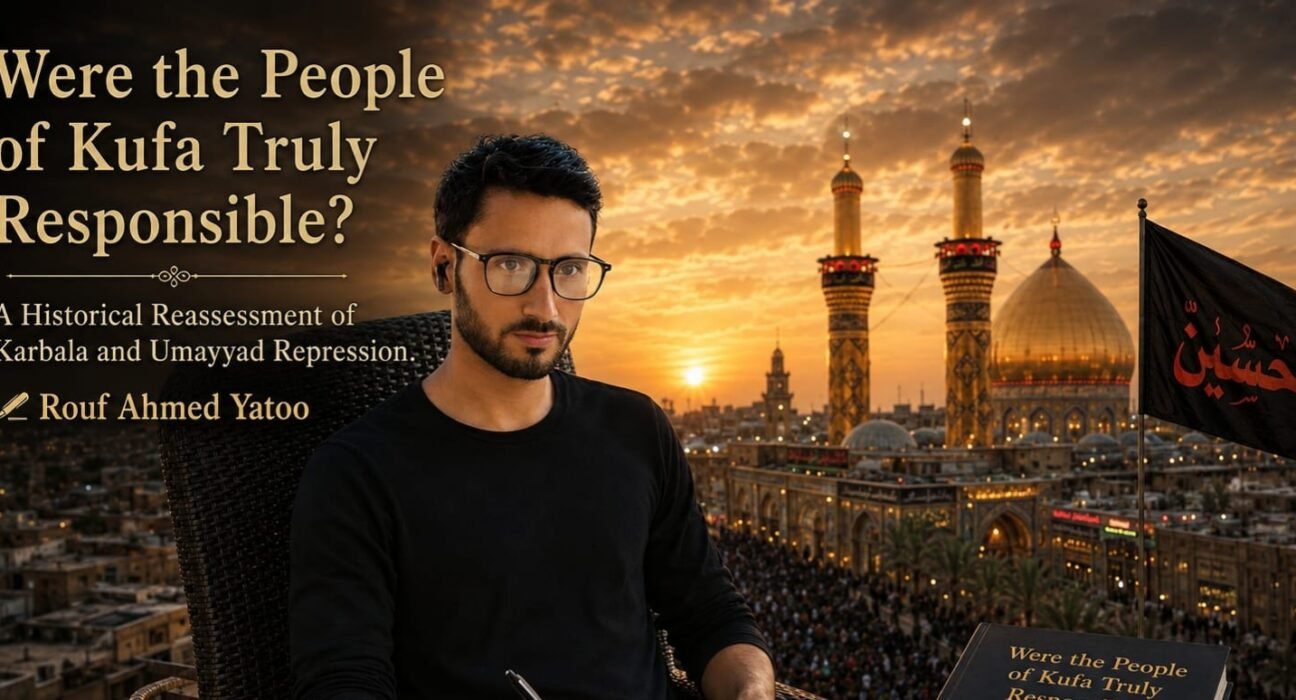
✒️ :. Rouf Ahmed Yatoo
For nearly fourteen centuries, one question has continued to reverberate throughout Islamic history that were the people of Kufa truly responsible for the martyrdom of Imam Husayn ibn Ali (A.S.), or were they themselves victims of an oppressive political machinery that rendered meaningful resistance nearly impossible?
The popular narrative often reduces the tragedy of Karbala to a simple charge of “Kufan betrayal.” Yet history is rarely so simple. To understand what transpired in 61 AH (680 CE), one must examine the political, social, and historical circumstances that preceded the martyrdom of Imam Husayn (A.S.).
Historically, tensions between Banu Hashim and Banu Umayyah predated the advent of Prophet Muhammad (PBUH) as a Messenger in Arabia. Both clans belonged to the Quraysh tribe of Makkah and competed for influence and prestige within Arabian society. With the advent of Islam in 610 CE, Prophet Muhammad (PBUH), who belonged to Banu Hashim, challenged the existing social and religious order of Makkah. Among his foremost opponents during the Makkan and early Medinan periods was Abu Sufyan ibn Harb, a prominent leader of Banu Umayyah, who led or supported the Quraysh in the Battles of Badr (624 CE), Uhud (625 CE), and the Trench (627 CE). Although Abu Sufyan embraced Islam following the Conquest of Makkah in 630 CE (8 AH), the political relationship between the two clans remained a subject of debate and tension in the decades that followed.
Following the martyrdom of Imam Ali ibn Abi Talib (A.S.) in 661 CE (40 AH), the people of Kufa pledged allegiance to his eldest son, Imam Hasan (A.S.). However, political instability, tribal divisions, and military exhaustion had weakened Iraq. Faced with these realities, Imam Hasan (A.S.) concluded a peace treaty with Muawiya ibn Abi Sufyan in 41 AH (661 CE).
This treaty was intended to preserve the lives of Muslims and prevent further bloodshed. Different historical reports mention five important conditions attached to the agreement, including that Muawiya ibn Abi Sufyan would govern in accordance with the Qur’an and the Sunnah, would not appoint a successor after himself, would guarantee the safety and security of the supporters of Imam Ali (A.S.), would refrain from publicly abusing Imam Ali (A.S.), and would provide stipulated financial allowances to the Ahl al-Bayt (A.S.) and the families affected by previous conflicts. It is widely maintained that most of these conditions were subsequently disregarded, with the financial provisions for the Ahl al-Bayt (A.S.) being cited by some historians as among the few terms that continued to be observed in some form. Nevertheless, it remains historically undeniable that Muawiya later nominated his son Yazid as his heir, thereby introducing hereditary succession into the caliphate and fundamentally altering its earlier mode of political transition.
For many Muslims, this represented a profound political transformation. What had once been presented as a consultative leadership was increasingly perceived as a dynastic monarchy centred in Damascus.
The accession of Yazid ibn Muawiya in 680 CE marked a decisive turning point. Imam Husayn (A.S.), the beloved grandson of Prophet Muhammad (PBUH), refused to pledge allegiance to a ruler whom he regarded as unfit to represent the moral and spiritual leadership of the Muslim community. His refusal was not a quest for worldly power but a stand for principles that he believed were essential to preserving the integrity of Islam.
Meanwhile, thousands of residents of Kufa wrote letters inviting Imam Husayn (A.S.) to Iraq. They expressed dissatisfaction with Umayyad rule and pledged their support if he would come and lead them. In response, Imam Husayn (A.S.) dispatched his trusted cousin and representative, Muslim ibn Aqil, to assess the sincerity of these invitations.
Muslim ibn Aqil arrived in Kufa on 5 Shawwal 60 AH (9 July 680 CE). Historical reports indicate that between 12,000 and 30,000 people pledged allegiance to him.
Some may argue that the reported 12,000 to 30,000 Kufans who pledged allegiance to Muslim ibn Aqil (A.S.) could have stood firm and resisted. Such an argument, however, often overlooks the nature of Umayyad rule and the methods employed by its governors to suppress dissent. The governorship of Ubayd Allah ibn Ziyad in Kufa was characterised by intimidation, arrests, executions, surveillance, and collective punishment.
More broadly, the Umayyad state had demonstrated its willingness to use overwhelming force to maintain authority. During the reign of Yazid ibn Muawiya, the tragedies of Karbala (61 AH/680 CE), al-Harrah in Madinah (63 AH/683 CE), and the siege of Makkah (64 AH/683 CE) resulted in the deaths of several thousand people. Likewise, later Umayyad governors such as al-Hajjaj ibn Yusuf acquired a reputation in historical literature for severe repression, with some medieval reports attributing to his administration the deaths of tens of thousands, and even as many as 120,000 people, although the precise figures remain debated among historians.
Against such a backdrop, expecting ordinary inhabitants of Kufa many of whom had already pledged allegiance, suffered imprisonment, witnessed executions, and faced threats against their families and tribes, to mount a successful uprising against a formidable imperial administration may not fully appreciate the realities under which they lived.
At this stage, Kufa appeared prepared to welcome Imam Husayn (A.S.). Yet the political situation would soon change dramatically.
Yazid appointed Ubayd Allah ibn Ziyad as governor of Kufa with clear instructions to suppress the growing movement. Ibn Ziyad was not merely an administrator; he was a skilled political operator who understood how to employ fear as a weapon of governance. Upon arriving in Kufa, he moved swiftly to dismantle support for Muslim ibn Aqil.
Tribal leaders were threatened. Informants were recruited. Suspected supporters were arrested. Public gatherings were monitored. Economic pressure was exerted upon influential families. Entire tribes were warned that collective punishment would follow any act of rebellion.
The atmosphere of Kufa changed almost overnight.
Muslim ibn Aqil, who had initially enjoyed the support of thousands, found himself increasingly isolated. One by one, supporters withdrew, not necessarily because they no longer believed in his cause, but because the consequences of defiance had become terrifyingly clear. Eventually, Muslim ibn Aqil was captured and martyred on 9 Dhul-Hijjah 60 AH (10 September 680 CE). His loyal host, Hani ibn Urwah, met the same fate.
The question therefore arises that if the people of Kufa had truly betrayed Imam Husayn (A.S.), why had thousands pledged allegiance in the first place? Why had they risked their lives by supporting Muslim ibn Aqil? Why were prisons filled and executions carried out before Imam Husayn (A.S.) even arrived?
These facts suggest a more complex reality than the simplistic accusation of collective betrayal.
It is also important to remember that Kufa was not an independent city-state. It was a provincial capital under the authority of the Umayyad government headquartered in Damascus. The governor possessed military forces, intelligence networks, tribal influence, and the backing of the state. Ordinary citizens had neither the resources nor the organisation necessary to confront such power effectively.
Indeed, a striking contradiction often appears in discussions about Karbala. Some of the very people who emphasise absolute obedience to rulers and discourage rebellion against established authority later blame the people of Kufa for not rising against Ibn Ziyad. If obedience to a ruler is considered a religious obligation, then the reluctance of many Kufans to rebel against a powerful Umayyad governor ruling in the name of the caliph should not be surprising. Conversely, if resisting tyranny is regarded as a moral and religious duty, then those Kufans who pledged allegiance to Muslim ibn Aqil, sheltered his supporters, endured persecution, imprisonment, and even execution deserve recognition for acting according to their capacity rather than being collectively condemned for the tragedy of Karbala.
The tragedy of Karbala must also be viewed within a broader spiritual and historical context. Numerous reports preserved in Islamic literature describe Prophet Muhammad (PBUH) foretelling the martyrdom of Imam Husayn (A.S.). These traditions were known among early Muslims and contributed to the understanding that Karbala was not merely a political confrontation but a moment of profound religious significance.
Unaware of the full extent of the repression unfolding in Kufa, Imam Husayn (A.S.) continued his journey towards Iraq. On 2 Muharram 61 AH (2 October 680 CE), he arrived at Karbala. There, he was surrounded by forces acting under the authority of Ubayd Allah ibn Ziyad and commanded in the field by Umar ibn Sa’d.
The events that followed would leave an indelible mark upon Islamic history.
On the 10th of Muharram 61 AH (10 October 680 CE), Imam Husayn (A.S.), together with members of his family and his loyal companions, embraced martyrdom after refusing to submit to injustice. Their sacrifice transformed Karbala from a battlefield into a symbol of resistance against oppression.
It is an undeniable historical fact that the primary responsibility for the tragedy of Karbala rests with Yazid ibn Muawiya as the sovereign ruler of the Umayyad state, Ubayd Allah ibn Ziyad as the principal architect of repression in Kufa, and the commanders who planned and executed the military campaign. Although some Kufans undoubtedly abandoned their pledges out of fear, coercion, or personal weakness, it is neither historically sound nor morally justifiable to attribute collective guilt to an entire city for a tragedy orchestrated by a powerful state apparatus.
Nor should it be forgotten that the roots of this conflict may be traced back generations to the long-standing rivalry between Banu Hashim and Banu Umayyah, a rivalry that many historians regard as having shaped the political tensions that ultimately culminated in Karbala.
History demands nuance. The people of Kufa were not a single individual acting with one mind and one will. They were a population living under a powerful state apparatus that employed intimidation, surveillance, imprisonment, and execution to crush dissent. Some remained loyal. Some faltered. Some were imprisoned. Some were killed. Others were paralysed by fear.
To reduce all of them to the label of “betrayers” is to ignore the complexities of history.
Support Independent and Impartial Journalism
Nouk-e-Qalam News is a free and independent journalistic platform. To maintain our ethical standards and avoid obscene advertisements, we have disabled Google Ads. We now rely on your generous financial support to continue our unbiased reporting. Our Writers and readers are kindly urged to contribute—daily, weekly, or monthly. Thank you for standing with truth.



MUNEEB NARWAVIE
June 26, 2026To reduce all of them to the label of “betrayers” is to ignore the complexities of history.